Get Full Government Meeting Transcripts, Videos, & Alerts Forever!
Get email alerts on the Budget And Taxes topic
No spam. Unsubscribe anytime.
Clay County commissioners reject proposed utility-tax increase; direct staff to seek alternatives
Summary
After hours of public comment and debate over staffing and capital projects, the board voted 4-1 to decline an ordinance that would raise the public service utility tax; commissioners directed staff to identify roughly $1.5–$3.8 million in reductions and to review other revenue options for future budgets.
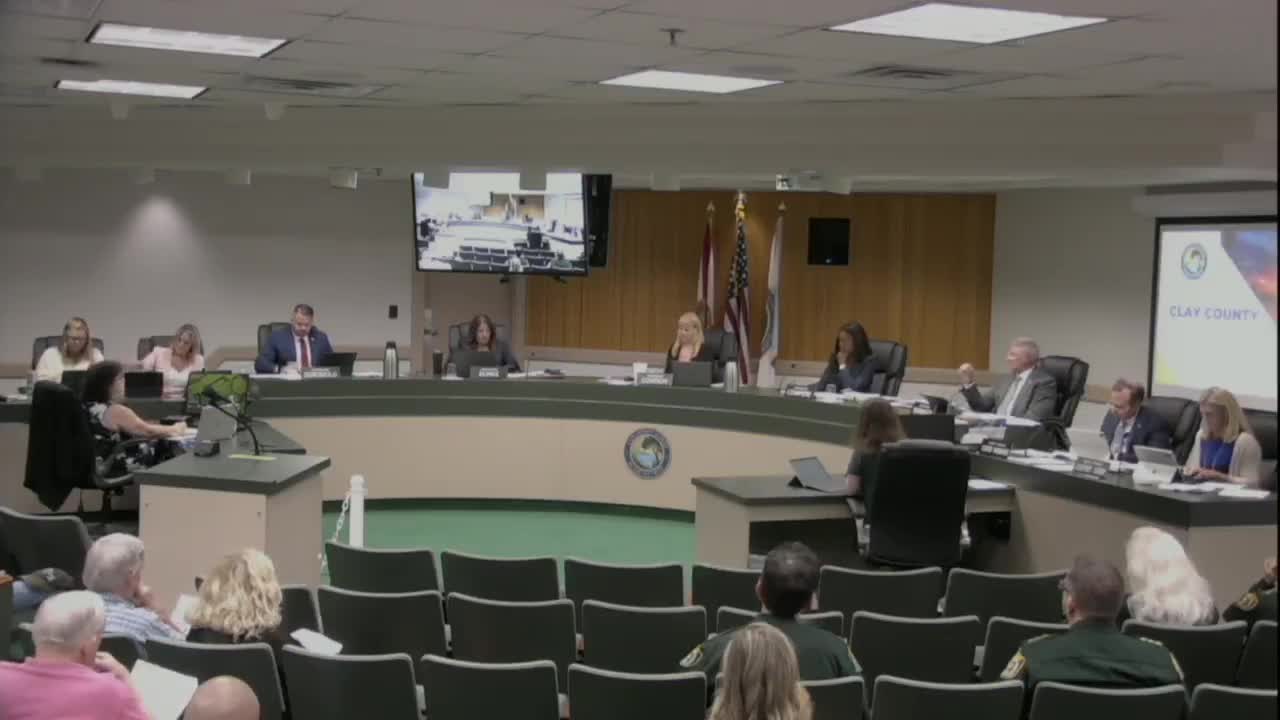
Clay County—s Board of County Commissioners voted 4-1 on July 8 to decline an ordinance that would have raised the county—s public-service utility tax, leaving the rate at its current level. The meeting followed an extended public hearing with more than a dozen residents speaking primarily against an increase and nearly three hours of discussion among commissioners and staff on options to close a projected budget gap.
The ordinance before the board would have raised the county—s utility-tax rate from the existing level toward a 10 percent cap outlined in background materials. After public comment and staff presentations about the county—s fiscal pressures, Commissioner Scromello moved to decline the increase; a second motion carried on a 4-1 vote. The board did not adopt the new ordinance and left the tax rate unchanged for now.
Why it matters: Commissioners and the public framed the debate around two competing priorities: avoiding new costs to residents, many of whom described being on fixed incomes, and funding public-safety and infrastructure needs that county department heads say are under-resourced. Staff told the board the county faced a multi-million-dollar shortfall when comparing the proposed FY 2025-26 budget to revenue estimates, and urged either new revenues or deeper cuts.
What the board decided and next steps: After the vote the board gave staff direction to pursue a targeted set of adjustments: staff will work to identify roughly $1.5 million in savings as a minimum and explore additional reductions and financing changes that could reach up to $3.8 million if requested by the commission. The board also directed staff to: - Prepare more detailed analyses of operating- versus capital-funding options (moving selected current-year vehicle purchases and other items between the general fund and CIP) and the fiscal impacts of those moves; - Provide a staffing-cost plan and operating projections for the Oakleaf library project (see separate article) before the commission makes a final decision on that project; - Continue evaluating longer-term revenue alternatives, including various discretionary sales surtaxes and non-ad valorem assessments, understanding that most of those options require additional legal and public processes and cannot be implemented in time to close the current fiscal year—s gap.
Legal question addressed in the hearing: At public comment a resident raised a legal challenge asserting the county lacked authority to levy the utility tax. County legal counsel responded that Clay County is a charter county and, under the state constitutional and statutory framework and a 1990 Florida Supreme Court decision (McLeod v. Orange County) cited in the county—s implementing ordinance, charter counties have the authority to impose a utility tax. Counsel also noted that certain charter counties have explicitly restricted such authority in their own charters; Clay County—s charter does not include that bar.
Public comment and concerns: Dozens of residents spoke. Speakers who identified themselves as living on fixed incomes told commissioners the increase would be difficult or impossible for them to absorb. Others urged the board to find cuts in the county budget and not add a new recurring tax. A subset of commenters pressed for the county to prioritize public-safety funding and noted that sheriff—s deputies and firefighters are already in short supply.
Staff and commissioner context: Staff summarized inflationary pressures on construction and operating costs, the loss of one-time federal dollars from the pandemic period, and rising costs reported by local utilities and agencies. Commissioners debated the short-term need to balance this year—s budget against the cohort of long-term fiscal choices that will affect future years, including staffing, maintenance, and capital projects.
What was not decided: The vote did not change the county—s budget itself; rather it rejected the proposed change to the utility-tax ordinance. The board retained the ability to revisit revenue options and asked staff to return with analyses before the budget adoption deadline.
Ending note: Commissioners said they intended to return to the budget at upcoming meetings with staff-provided analyses and with an eye to solutions that can be pursued with public input and adequate legal review.