Lifetime Citizen Portal Access — AI Briefings, Alerts & Unlimited Follows
United Nations marks International Day of Reflection on 1995 Srebrenica genocide; survivors urge truth, justice and remembrance
Loading...
Summary
At a UN observance marking the International Day of Reflection on the 1995 Srebrenica genocide, UN officials, survivors and Bosnian representatives recalled the more than 8,000 victims, reported ongoing efforts to identify remains, and warned against denial and glorification of war criminals.
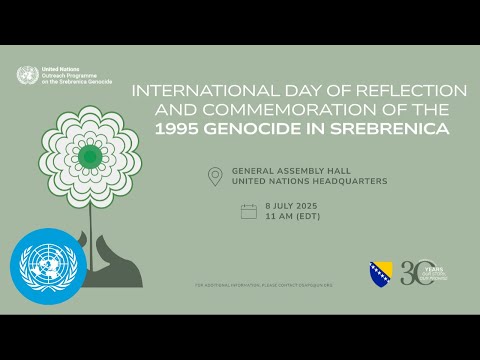
At United Nations Headquarters, officials and survivors gathered to mark the International Day of Reflection and Commemoration of the 1995 Srebrenica genocide, a commemoration established by United Nations General Assembly resolution 78/282 and timed with the 30th anniversary of the July 1995 killings.
Robert Skinner, officer in charge of the United Nations Department of Global Communications, opened the event and said the observance was organized under the outreach program established by the General Assembly resolution. He thanked survivors and families who addressed the gathering and recognized Melissa Fleming, Under-Secretary-General for Global Communications, who sent regrets.
Earl Courtney Rattray, chef de cabinet of the executive office of the secretary-general, delivered remarks on behalf of Secretary-General António Guterres and said, "We commit never to forget the up to 8,000 boys and men who were tortured and murdered" in Srebrenica. Rattray called the killings "the worst atrocity on European soil since the Second World War" and said the international community had failed the people of Srebrenica.
Pramila Patten, acting special adviser of the secretary-general on the prevention of genocide, described the event as dedicated to victims and survivors. Patten said that, "the remains of five victims of the Srebrenica genocide will be laid to rest at the Srebrenica Genocide Memorial site in Potocari" this year and that many remains remain unfound or unidentified, causing ongoing pain for families.
Munira Subašić, founder and president of the Association of Mothers of Srebrenica and Žepa, gave a personal testimony about the loss her family suffered and the decades-long campaign by survivors to secure recognition and accountability. Subašić said 22 members of her family were killed, including her husband and youngest son, and urged action against denial and impunity while stressing that mothers who survived have worked to raise children without hatred.
Denis Bećirović (noted in remarks as a member of the presidency of Bosnia and Herzegovina) called for implementation of the General Assembly resolution and criticized political leaders who deny judgments of UN courts, saying such denial is "illogical, immoral, and unacceptable." He urged support to build a modern, democratic Bosnia and Herzegovina grounded in truth and justice.
Mirella Usmanović, liaison for international cooperation at the Srebrenica Memorial Centre, described the memorial as a place where testimonials are preserved and where younger generations learn about what happened. Zlatko Lagundja (delivering remarks as permanent representative of Bosnia and Herzegovina to the United Nations) thanked survivors and organizations that helped organize the commemoration and called for moving tribunal verdicts "from courtrooms to the classrooms" to preserve historical truth.
Speakers repeatedly warned about rising hate speech, denial, and the glorification of convicted war criminals. They emphasized preservation of judicial findings by the International Criminal Tribunal for the former Yugoslavia (ICTY), the International Residual Mechanism for Criminal Tribunals, and the International Court of Justice (ICJ) that acts in Srebrenica in 1995 constituted genocide.
Organizers presented a short film by the Srebrenica Memorial Centre and the Balkan Investigative Reporting Network and included music and testimony from survivors and younger-generation participants. The observance closed with calls to education, remembrance, and continued efforts to locate remains and pursue accountability.
No formal votes or policy directives were recorded at the event; remarks and testimony focused on commemoration, survivor testimony, and appeals to member states and institutions to preserve truth and prevent future atrocities.