Get Full Government Meeting Transcripts, Videos, & Alerts Forever!
Get email alerts on the Tyler Street Sidewalks topic
No spam. Unsubscribe anytime.
Carlsbad commission backs scaled‑back Tyler Street sidewalk improvements after resident concerns
Summary
The Traffic Safety and Mobility Commission voted unanimously to support staff’s recommendation for a reduced Tyler Street sidewalk project, narrowing scope to repairs and grade changes on the east side and lowering planning estimates from a previous $900,000 budget to roughly $400,000–$500,000.
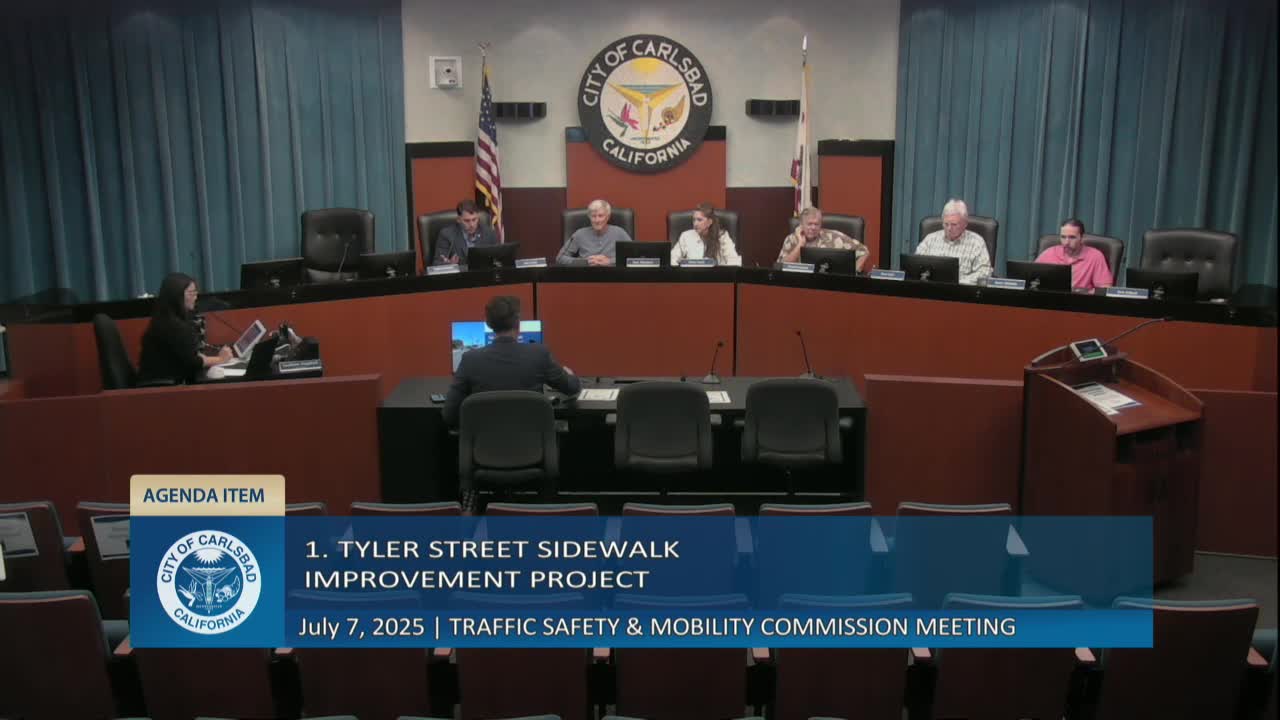
The City of Carlsbad Traffic Safety and Mobility Commission voted 6–0 to support staff’s recommendation that the City Council approve a scaled‑back Tyler Street sidewalk improvement project for the block between Oak Avenue and Chestnut Avenue.
Transportation Planning and Mobility Manager Nathan Schmidt summarized the proposal as a pared‑down approach focused on improving existing sidewalks and driveway grades on the east side of Tyler Street rather than installing sidewalks on both sides or pursuing a shared‑space street. “What we're recommending is, at a minimum, providing a more comfortable, safer walking surface, which we feel is the primary need along Tyler Street,” Schmidt said.
The project area, just south of Carlsbad Village Drive, currently has one travel lane in each direction and sidewalks only on the east side. Schmidt told commissioners that measured daily traffic volumes on Tyler Street are low (about 377 southbound and 383 northbound vehicles per day), recorded speeds were approximately 22–23 mph (posted 25 mph), and city collision records show two collisions over the previous five years (one DUI sideswipe and one solo bicycle collision). The proposal drops previously considered alternatives — a shared‑space street, conversion to one way and new bike lanes — and retains on‑street parking and a minimum 20‑foot clearance for emergency vehicles.
Two residents who identified themselves as long‑time Roosevelt Street neighbors urged commissioners to treat conditions as a safety issue. David McGee said the neighborhood sees high speeds and pedestrian risk and urged the commission to emphasize safety rather than parking. Jackie McGee said she “is in support of the Tyler Street project” and urged measures to slow traffic, citing children on e‑bikes, families using golf carts and limited visible speed limit signage.
Commissioners asked for clarifications about prior analyses and costs. Schmidt said the earlier concept had a $900,000 budget; the scaled‑back plan has a planning‑level estimate of about $400,000–$500,000 and would require more detailed engineering to refine costs. Commissioners also asked about speed data timing; Schmidt said the most recent speed study cited was from 2023 and that recorded speeds on Tyler Street have not changed materially in the staff’s view.
Motion and vote: A motion to support staff’s recommendation to present the proposed Tyler Street sidewalk improvement concept to the City Council passed (vote recorded as 6 yes). The motion did not amend the project scope; it directs staff to seek Council approval of the recommended, scaled‑back east‑side improvements.
The commission’s endorsement will be provided to the City Council when staff brings the project forward for authorization and funding.
Details the commission noted for City Council and future design: focus limited to east‑side sidewalk and driveway reconstructions to reduce cross slopes, addition of a crosswalk at Walnut Avenue for pedestrian connectivity, no removal of on‑street parking, maintaining emergency vehicle clearance (minimum 20 feet), and retaining existing curb ramp upgrades. Schmidt also noted many residents use the Coastal Rail Trail as an alternate route and that the southern end of the corridor serves senior housing with residents who walk to the village.
Next steps: staff will advance design and engineering to refine costs and construction details, and the item will go to City Council for final authorization.