Get Full Government Meeting Transcripts, Videos, & Alerts Forever!
Get email alerts on the Dialysis Services topic
No spam. Unsubscribe anytime.
Schneider Regional Medical Center takes in 32 dialysis patients after Caribbean Kidney Center suspends services; lawmakers press for emergency funding
Summary
The Caribbean Kidney Center (CKC) temporarily suspended services July 1 with fewer than two hours' notice; Schneider Regional Medical Center (SRMC) received and treated 32 displaced hemodialysis patients and expanded capacity but says it needs immediate funding and staff to sustain the added caseload.
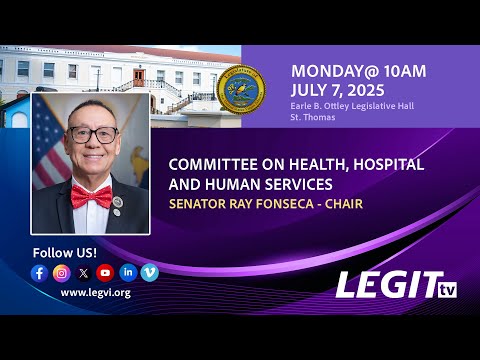
The Senate committee on Health, Hospitals and Human Services heard sharply divergent accounts July 7 after the Caribbean Kidney Center (CKC) abruptly suspended services on July 1 and handed many patients to Schneider Regional Medical Center (SRMC).
SRMC Chief Executive Officer Tina Khamis Young told the committee that the hospital received an email on July 1 from CKC stating it would cease operations at 5 p.m., giving less than two hours' notice. "SRMC received an email from doctor Gardiner indicating that CKC would cease operations effective 5PM that same day, providing less than 2 hours notice and offering no plan for patient transition," Young said.
SRMC said it received 15 patients early on July 2, later treating a total of 32 patients who arrived with incomplete or missing medical records; hospital physicians reassessed patients and wrote new orders as needed. SRMC executive testimony said the facility had expanded its dialysis capacity in October 2024 by adding 12 stations; SRMC now reports 28 CMS‑certified dialysis stations available and said staff worked extended hours to absorb the influx.
CEO Young told senators the hospital needs immediate funding to secure contract staff and supplies: one estimate given to the committee included an upfront staffing and supply package in the several‑hundred‑thousand‑dollars range (testimony suggested an initial tranche of $300,000–$500,000 and up to roughly $1 million to cover the remainder of the year and replenish hurricane stock). Young said Act 8876, a $1,000,000 appropriation to SRMC for dialysis expansion, has not been disbursed to the hospital.
CKC medical director Walter Gardner told the committee CKC suspended services because it no longer met its own staffing‑and‑patient‑ratio policy after several clinical staff suffered unexpected family or medical emergencies. Gardner said the decision was made to avoid unsafe care: he described staff shortages arising from three critical absences and said CKC plans to resume services once adequate staff are recruited and vetted. Gardner said he considered the temporary suspension the most prudent action under the circumstances.
Schneider chief nursing officer Delphine Olavaci disputed CKC's approach to the transition. Olavaci said SRMC did not receive a formal clinical handoff or complete medical records in the way CMS requires for orderly transfers of dialysis patients; SRMC staff had to reassess arriving patients, and some were escorted to the hospital by staff who had been turned away at CKC. "We did not get the H&P, which indicates to us what other core morbidities...so we did not have that information," Olavaci said, describing an on‑the‑spot reassessment by SRMC nephrologists early the next morning.
The committee also heard from the Virgin Islands Healthcare Foundation Renal Center on St. Croix (VIHCF), which said it has capacity for up to 78 patients and is prepared to accept additional patients; the nonprofit requested parity in reimbursement arrangements if it assumes former CKC patients.
Why this matters: Hemodialysis is life‑sustaining care delivered multiple times a week; a sudden service interruption risks harm if patients cannot access treatment. Senators pressed for an urgent release of funds, clearer regulatory guidance and improved notification rules so receiving facilities are given time to plan organized handoffs.
The committee asked the Department of Health and the hospital for documentation on billing, allocations and operational plans; several senators also signaled interest in a financial audit and oversight of previous appropriations to private dialysis providers. SRMC said it will continue treating the displaced patients while the territory coordinates staffing, supplies and reimbursement.
Ending: Committee leaders thanked SRMC for stepping in and said they will follow up on the outstanding $1,000,000 appropriation and seek to ensure continuity, oversight and clearer rules for patient transfers in future facility suspensions.