Get Full Government Meeting Transcripts, Videos, & Alerts Forever!
Get email alerts on the Fire Safety topic
No spam. Unsubscribe anytime.
Lake Creek fire officials present plan and costs to lower insurance ratings; request county support for radios, water points and equipment
Summary
Fire department leaders told Alleghany County commissioners they plan to apply for a lower ISO/NC OSFM rating by January 2026 but need county funding for communications, water points and equipment. They said improved ratings could cut insurance costs for property owners by roughly 12% per step, compounded.
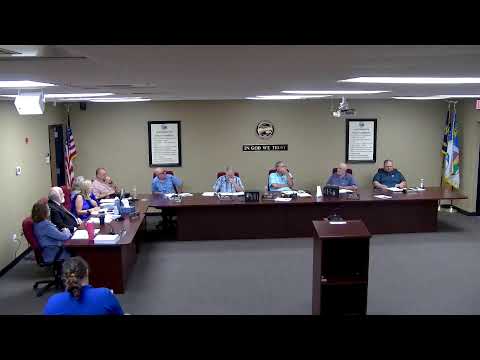
Chief David Higgins of the Lake Creek Fire Department and retired fire chief Lee Sudia told the Alleghany County Board of Commissioners on July 8 that the department has a multi‑facet plan to lower its fire suppression rating and asked the county for financial and logistical support.
The request focused on three rating components the North Carolina Office of State Fire Marshal (NC OSFM) and the Insurance Services Office (ISO) use: the fire department (50% of the score), water supply (40%) and communications (10%). "Communications, which is your biggest factor," Sudia said during the presentation, adding that "communications is a pure 10%." He and Higgins pressed county leaders for upgrades including Viper radios, certified water points and equipment purchases.
The plan and why it matters
Sudia outlined that the OSFM/ISO assessment looks at apparatus, equipment, training, personnel and documentation for the department; water supply reliability and proximity to target hazards; and dispatching and radio reception for communications. He said 64 water points in the district have been identified and will be narrowed to those usable in an emergency. He also noted the department uses a combination of static water sources and temporary (mobile) hybrids and tankers.
The presenters said improved ratings reduce insurance costs for property owners: "For each rate reduction, commercial and residential, customers in our district will see an insurance rate reduction of 12% compounded," Sudia said. He and Higgins estimated the department could be ready to request an OSFM inspection in January 2026; the OSFM inspection could take several months and will require three to five years of records to be available at the time of inspection.
Costs and specific needs
Sudia and Higgins gave line‑item examples and cost estimates discussed during the meeting: SCBA air packs run roughly $10,000 each; turnout gear averages about $2,000 per set; a Viper radio is about $7,000 apiece; five‑inch large diameter hose costs about $7 per foot (a 1,000‑foot section therefore about $7,000); ladder trucks and heavy apparatus range in the hundreds of thousands of dollars; and some grants or donated equipment have reduced immediate needs (the department referenced a roughly $21,000 grant/grant application with the Blue Ridge Foundation and donations of hose and equipment).
Higgins said the department already secured some equipment through donations and opportunistic purchases, and described an existing grant application for hose. He warned that achieving sustained daytime staffing with career firefighters would be costly: a hypothetical 24/7 career staffing model with multiple pumpers, ladder trucks and support units could require average salaries near $60,000 per position plus benefits and would be "astronomical" in total cost for the county.
Volunteers, contract limits and operations
Presenters stressed the district remains largely volunteer. Sudia said certain contract language and the county contract will need review if policymakers consider paid daytime staffing. He also emphasized that tanker operations are critical in rural areas but yield no direct OSFM points; tankers support water supply even though they are not scored the same way as fixed or hybrid water points.
Commissioner and staff responses
Commissioners asked about how private ponds or dry hydrants factor into ratings, travel radii for water points, and communications coverage. Sudia said the OSFM historically looked for a water point every three roadway miles (so no point would be more than 1.5 miles from a roadway), but target‑hazard prioritization has shifted how points are validated. On radios, presenters and commissioners discussed the state Viper system as the preferred solution for broad coverage; Sudia called it the "Cadillac of the communication system," noting it would not fix every coverage gap but would "reduce the problems with the communications by probably... 90%."
No formal county action was taken at the meeting; presenters said they would return with more specific requests. The department requested county consideration of funding for radios, water‑point certification, modest compensation for volunteer time related to rating work, and continued assistance with grant applications and donated equipment retrieval.
Ending
Sudia and Higgins asked county staff and commissioners to consider targeted investments and to allow the department to return with costed proposals; they said lowering the rating could provide recurring savings to residents through reduced insurance premiums and would require up‑front and ongoing investment.