Get Full Government Meeting Transcripts, Videos, & Alerts Forever!
Get email alerts on the Solar Development topic
No spam. Unsubscribe anytime.
Edgecombe commissioners call public hearing after stakeholder review of solar rules; planning board recommends deeper setbacks, buffers and development-agree‑ m
Summary
After months of stakeholder meetings, planners recommended zoning and procedural changes for industrial-scale solar in Edgecombe County; the board called a public hearing to consider extending the solar moratorium and possible ordinance changes.
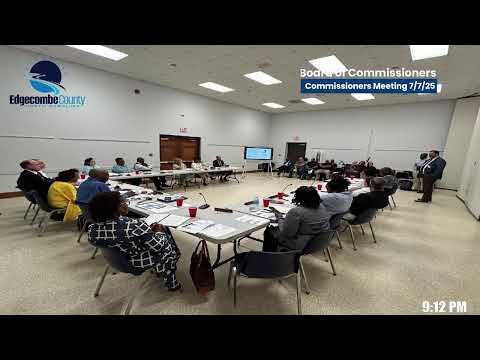
Edgecombe County commissioners on July 7 directed staff to schedule a public hearing on proposed changes to the county’s solar energy conversion rules after a report from code consultants and planning staff and comments from residents for and against solar farms.
The stakeholder process and the planning board review produced a raft of suggested changes to the county’s Unified Development Ordinance, including shifting approvals from the current special-use-permit (quasi‑judicial) path to a conditional rezoning (legislative) process, adding development agreements and community benefit standards, stricter vegetative screening, and limits on individual facility size in non‑industrial districts. County planning staff and consultant Chad Meadows of CodeRight Planners presented the proposals and legal context, and the board voted to call a public hearing at a future meeting to consider extending the moratorium while those options are refined.
The recommendations aim to address residents’ concerns about appearance, site maintenance, impacts to community character and farmland loss, and to put the county in a stronger legal and practical position for reviewing proposals. Meadows said the county’s current ordinance allows level‑2 and level‑3 solar uses in every zoning district and treats them through the special‑use permit process, which he described as “quasi‑judicial,” meaning that if an application meets ordinance standards it must be approved and there is limited opportunity for broader public negotiation. He recommended exploring a conditional rezoning pathway so citizens can participate in a legislative process without proving standing.
Stakeholder feedback and planning board input focused on several concrete items: limiting individual facility size in most districts (planning board discussed a 10‑acre cap in some districts while exempting industrial zones), lowering the maximum array height (currently 25 feet) possibly to 20 feet, deepening setbacks from residences (planning board discussed increasing an existing 100‑foot setback to as much as 500 feet), and enlarging vegetative buffers (a proposed minimum 50‑foot buffer with three staggered rows of evergreen plantings and an expectation of larger initial plant size so screening reaches facility height). Planning board members also suggested applying buffer upgrades to existing approved or built sites and asked staff to study legal mechanisms to do so.
Meadows and staff also recommended using development agreements to secure enforceable commitments: maintenance performance guarantees, community benefit agreements (for scholarships, local hiring, training), and clearer decommissioning assurances. Meadows cited recent state law changes requiring operators of industrial‑scale solar to file decommissioning plans and financial guarantees with the North Carolina Department of Environmental Quality (DEQ) and recommended revising the county’s salvage‑value clause, which his review found could allow a zero guarantee when salvage value is calculated as zero.
On inspections and enforcement, stakeholders and the planning board discussed quarterly county inspections called for in the current UDO; staff and Meadows recommended third‑party inspections paid by applicants, with planning board support for annual third‑party inspections (planning board suggested annual rather than the three‑year option in the memo). Meadows said third‑party inspections could include drone footage and written reports provided to the county and recommended retaining multiple inspection vendors to avoid conflicts.
Public comment at the meeting included residents urging a moratorium extension and opposing large solar installations on agricultural land, citing farmland loss and concerns about site maintenance and visual impacts. Several speakers asked the county to prioritize youth programs and local investment instead of permitting more solar farmland conversions. One landowner who supports solar described how a previously installed site there can be restored to cropland and argued landowners should have the right to lease their property to diversify income.
County manager Evans told the board staff recommended extending the moratorium for a year to allow additional review and to await potential state legislative changes (Meadows flagged Senate Bill 587, which had passed the Senate but not the House as of the presentation, and noted an uncertain timeline) before drafting final UDO text. The board’s motion at the meeting was to call a public hearing at the next meeting to consider sending the moratorium; the motion passed by voice vote.
Why it matters: Edgecombe County has substantial tillable acreage and residents, planning staff and elected officials said the county must balance agricultural preservation, visual impacts, maintenance and the fiscal opportunities solar development can offer. The choice of regulatory process — quasi‑judicial special‑use permits versus legislative rezones and development agreements — affects how much and in what forum citizens can be heard and what enforceable conditions the county can require.
What’s next: Staff will draft proposed UDO text amendments consistent with state law for planning board review and bring drafts back to the board; the public hearing called by commissioners will be the formal next step for public input on a moratorium extension and the proposed regulatory pathway.