Get Full Government Meeting Transcripts, Videos, & Alerts Forever!
Get email alerts on the Cannabis Retail topic
No spam. Unsubscribe anytime.
Lynnwood council hears broad debate on retail cannabis rules, high‑THC risks and zoning options
Summary
Councilmembers, a public-health speaker and four license holders debated whether Lynnwood should allow retail cannabis, how to regulate high‑THC products, and proposed zoning, separation buffers and design standards; no vote was taken and staff will draft ordinances for future council consideration.
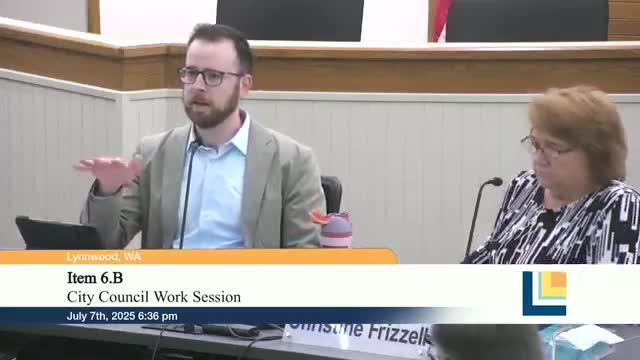
The Lynnwood City Council spent most of its July 7 work session discussing retail cannabis policy, hearing a public-health presentation and comments from state and local industry representatives, license holders and a registered lobbyist about the benefits and risks of allowing retail cannabis in Lynnwood.
Council President Nick Coelho opened the item by saying the evening’s invited guests were asked to share regulatory experience rather than lobby. The council then heard a 30-minute public-health overview from Caitlin Ryan, executive director of the Cannabis Alliance, who described the complexity of high‑THC products, evidence gaps and youth-risk questions. “High concentrations are not inherently dangerous,” Ryan said, but she urged the council to place risks in context, to focus on regulated retail to enable age‑gating and to fund education and prevention programs.
Nutrition: why this matters. The discussion is significant because council decisions will determine whether, where and how Lynnwood allows retail storefronts and whether the city seeks additional local safeguards—rules that affect youth access, neighborhood siting and the design of retail operations.
Councilmembers pressed several themes: public-health risk to youth and people with preexisting vulnerabilities; whether high‑THC concentrates increase the chance of problematic mental-health outcomes; the difference between state-level regulation and what a city can reasonably enforce; and equity concerns about siting shops near lower-income neighborhoods and schools.
Public-health and evidence: Dr. Ryan summarized recent work and said some research shows associations between cannabis use and later psychosis in susceptible individuals but not clear causation; she cited the need for education, age-gating and state-level action on product differentiation or taxation for high‑THC products. She cautioned that much of the high‑THC research comes from jurisdictions with different regulatory histories and that unregulated hemp products sold outside the regulated market are associated with spikes in accidental ingestions.
Industry and license‑holder perspectives: Councilmembers heard from four license holders or industry representatives invited to the table. Sanuk Abraha, who said he grew up in Lynnwood and operates licensed stores nearby, described security and compliance practices: 24/7 surveillance, reinforced storefronts and ID checks at entry and purchase. Gene Konofsky, a long-time region operator, said he has seen no “negative comments” from cities that allowed retail and emphasized operator compliance. Eric Anderson (joining via Zoom) and another local license holder said real-estate availability is a major barrier and argued that wider zoning options and moderate buffers can prevent clustering while letting businesses thrive. Josh Estes identified himself as a registered lobbyist and said he was present to help answer ordinance and implementation questions.
Council questions and concerns: Councilmember Decker challenged the characterization that invited industry guests were not lobbyists and highlighted public-health studies linking cannabis use with later psychiatric outcomes in some populations. Councilmember Parcel cited the Washington State Health Care Authority’s 2022 high‑THC policy work and asked why the state wouldn’t take stronger regulatory steps; she suggested raising the legal purchase age for high‑THC products to 25 and adding labeling and point‑of‑sale education. Councilmember Binda urged moving forward with regulation that reflected the will of voters but said the city must protect youth and vulnerable populations.
Zoning and buffers: The planning commission recommended allowing retail in Highway‑99 mixed-use, general commercial and Alderwood zones with minimum buffers (1,000 feet in Highway‑99 mixed use and general commercial; 300 feet in Alderwood) and re-evaluating city-center zoning after Town Square Park construction. License holders generally favored greater availability and asked planners to avoid artificial clustering by permitting multiple zones; they also voiced support for minimum separation among stores so operators would not compete on a single block.
Design and operational standards: Council and the industry discussed signage, window visibility and security measures. License holders said operators typically prefer to be transparent about interior operations, but that roll-down security measures for after-hours protection and controlled signage are common. Industry representatives said they already invest in lighting, cameras and other safety measures and that many stores conduct community donations and sponsorships (examples cited included food-bank donations and pandemic-related mask drives).
What the council decided: No ordinance was adopted at the meeting. Councilmembers asked staff to draft proposed local regulations and zoning language, to return with additional stakeholder outreach (neighborhood groups, schools and public‑health practitioners were specifically requested by several councilmembers), and to include options for buffers, permitted zones and potential design standards. Several councilmembers suggested discussing whether to hold a public ballot measure in the future; staff and industry noted the cost of a city ballot measure and that state law and prior initiatives (I‑502) shape the baseline regulatory environment.
Ending: The council did not vote on an ordinance July 7. Staff will draft and circulate ordinance language and planning recommendations and continue outreach to community stakeholders and public-health experts before council action.