Get Full Government Meeting Transcripts, Videos, & Alerts Forever!
Get email alerts on the Solid Waste Finance Operations topic
No spam. Unsubscribe anytime.
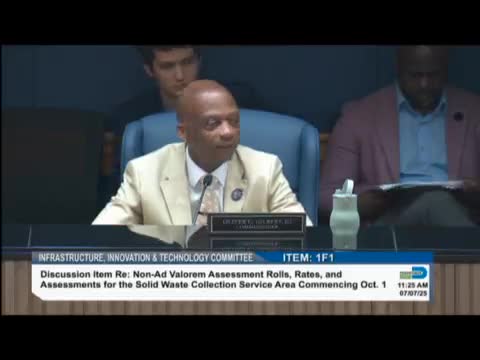
Directors and commissioners debate fee increase, landfill revenue outlook and methane, yard-waste options
Summary
Miami-Dade Solid Waste Director presented five-year projections showing growing deficits without fee increases; commissioners discussed methane-to-RNG projects, mulching/mini-dump options and the risk of reducing pickup frequency if revenues fall.
An extended committee discussion on July 9 focused on the county solid-waste enterprise fund, near-term fee proposals and operational alternatives that could reduce costs or generate revenue.
Key facts presented by staff: Anisha Daniel, Director of the Department of Solid Waste Management, said the department identified over $8 million in savings and that the net savings after certain offsetting costs was “almost $5,000,000.” She repeatedly flagged inflationary pressures on fleet, construction and labor, noting fleet costs had risen “45% within the last year.” Daniel told commissioners that, without additional revenue or offsets, the department’s five‑year projection would show a cumulative deficit of about $56 million and an $8 million deficit in the single year 2028 if only the 1% increase is approved.
Commissoners’ concerns about service levels and labor: Commissioner Cohen Higgins pressed staff on the threshold at which the county would have to reduce service frequency, asking, “At what point in time ... do we move from 2 garbage pickups to 1 garbage pickup a week?” Director Daniel replied that a range of actions would be required and that the choices would include borrowing, raising fees or reducing service. She quantified the risk: “it will take me into a red $8,000,000 in deficit in 2028, and then ... I'm going to go $56,000,000 in the deficit by year 5.”
Potential revenue and operational offsets discussed: - Methane / renewable natural gas (RNG): Daniel said an RNG project at the landfill is in procurement and estimated it could generate roughly “about a million dollars a year” once online; commissioners discussed timeline uncertainty (12 to 18 months) and agreed methane capture also reduces odor and community nuisance. - Yard waste and mulching: Commissioners and staff described expanding separated yard-waste collection at transfer-recycling centers (TRCs), on-site mulching, and allowing residents to pick up mulch. Daniel said some TRCs already accept clean yard waste and that the department has adjusted bulky-pickup protocols to separate clean yard materials into dedicated trucks. - Mini dumps and transfer stations: Several commissioners argued for expanding local mini-dump sites to reduce hauling distances and collect tipping-fee revenues without increasing county collection costs. Commissioner Regalado said municipalities and residents would use nearby mini-dumps rather than hauling to distant sites if better options exist.
Equity and budgeting questions: Commissioners repeatedly asked for a transparent accounting of baseline costs, past pauses in fee increases (a “reset”), and what portions of past disposal revenues subsidized collection. Chief Operating Officer Jimmy Morales confirmed the administration had asked departments to identify efficiencies but said most of the deep general-fund cuts targeted non-proprietary departments; he noted disposal-side revenues had historically subsidized collection.
Next steps and decisions: Committee members asked the director for more granular fiscal scenarios (including 1.5% options), the expected schedule for RNG revenue, and the likely fiscal effect of expanding yard-waste mulching and mini-dump programs. No final decision to reduce pickups or adopt a specific fee change was made on July 9; several solid-waste items, including proposals tied to disposal and waste-to-energy procurement, were scheduled for the full commission meeting on July 16.
Ending: Staff and commissioners agreed to continue working on a portfolio of measures — methane capture, yard-waste reuse, mini-dumps and operational efficiencies — while preserving service levels and identifying protections for low-income households if a pay-as-you-throw or other fee change moves forward.