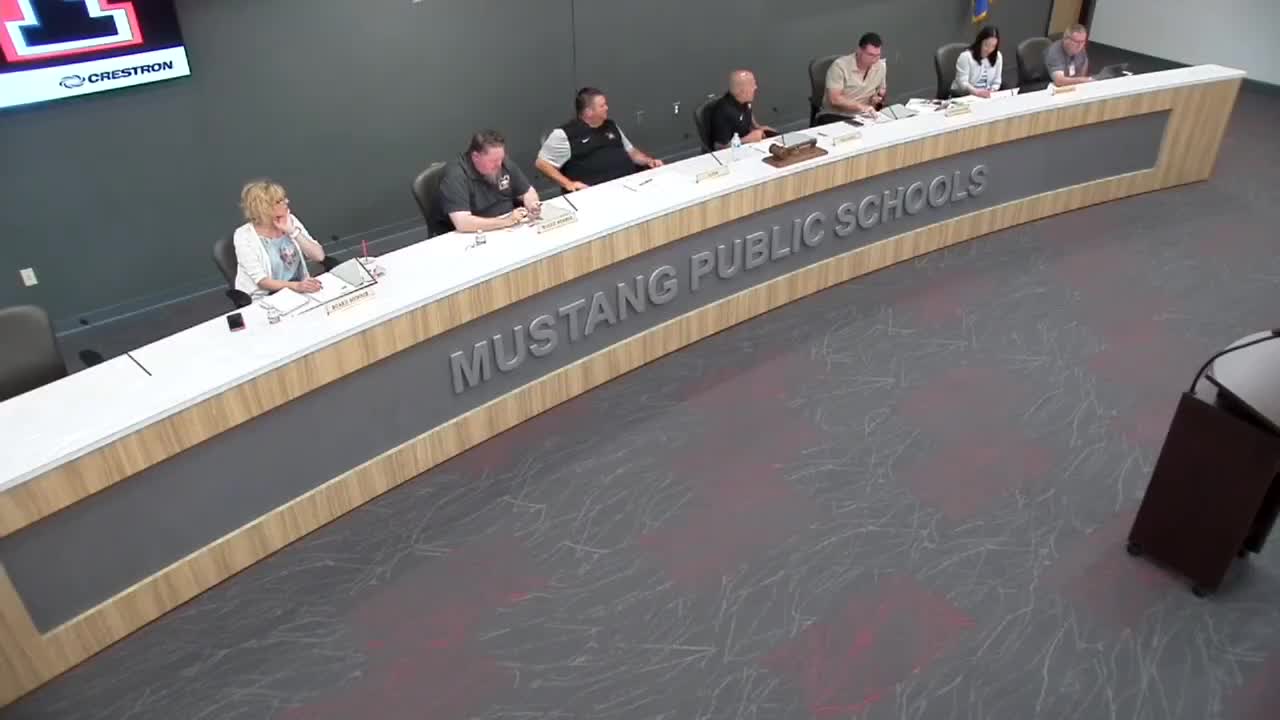
Mustang School District reviews multiyear grading changes, plans parent outreach and staff training
Loading...
Summary
Assistant Superintendent Ryan McKinney reviewed a three-year grading-policy rollout that introduced a 50–100 grade scale, a 70/30 summative/formative weighting, retake opportunities and an NHI (not handed in) code; the district will offer professional development and parent sessions to address implementation issues and student disengagement.
Mustang — Assistant Superintendent Ryan McKinney presented the district's annual update on a multi-year grading-policy revision during the school board meeting, outlining changes already implemented at high school, intermediate and middle school levels and next steps for staff and families.
McKinney said the district adopted the changes to make grades “a valid and pure representation of what a student knows and is able to do based on given skills and concepts by the standards.” The policy committee worked for 18 months and then phased changes in a stair-step approach across schools, with the high school piloting the model first.
The revised policy includes four principal changes: a consistent points scale (all intermediate assignments recorded out of 100), a 70/30 summative/formative weighting at middle and high school levels, formal retake (redo) opportunities for summative assessments, and a base-50 grading floor so grades run from 50 to 100 rather than 0 to 100. McKinney said the retake option is not automatic and must be earned.
McKinney explained how the district records late or missing assignments in PowerSchool, naming a code created by district staff: “Margaret Brown in PowerSchool created us a code that's called NHI — not handed in,” McKinney said. An NHI is averaged in as a 50 under the base-50 system; at the high school, teachers may record an actual zero for formative daily work when a teacher judges a student made no valid attempt.
The presentation included two years of grade-distribution charts from the three intermediate schools, three middle schools and the high school. For example, Canyon Ridge Intermediate showed a decline in A grades from 60.9% (spring 2024) to 56.2% (spring 2025) while B and C percentages rose slightly. Across the district’s intermediate grades combined, A/B rates moved from about 85.8% to 86.8% year over year; D/F rates remained low. McKinney attributed some differences among schools to local instructional and schedule variations (for example, an increase in daily intervention at one middle school).
On GPA, the district presented three-year seasonal snapshots (spring semester) rather than cumulative GPAs to reduce early implementation noise. McKinney said some grade levels showed small dips during the rollout while others were flat or increased; he characterized the pattern as an implementation dip that research and district experience indicate can take several years to normalize.
Board members raised concerns about possible student gaming of the system and parent awareness. McKinney acknowledged both: he said some students treated a 50 (NHI) as acceptable and did not take redo opportunities, and that parents had received district emails and texts for the feedback survey. The district reported roughly 4,000 intermediate and middle-school parents were contacted and that about 302 parent responses were received to the survey.
Next steps McKinney described include: professional development at the start of the next school year focused on the base-50 system and redo protocols (for new and veteran teachers); a parent university at all three intermediate schools to explain grading differences when students move from elementary to intermediate; middle-school infographics and communications for families; and principal-level data reviews in July to consider local adjustments.
McKinney also noted benefits the district has seen so far: more consistent grading language across schools and teams, reduced failure rates for some student groups (including English-language learners), and clearer identification of whether low marks reflect lack of effort or lack of mastery — information the district said helps target intervention.
Board members asked the administration to provide a report showing how many NHI codes appear in grade books and to continue monitoring assessment design, frequency and the balance of formative checks vs. summative measures. McKinney said the district would provide those numbers on request and that instructional coaches and PLCs (grade-team professional learning communities) are being used to build consistency.
The board did not vote on further policy changes at the meeting; the presentation was an informational update and the administration will return to principals and bring potential changes to the board after summer review.