
State preservation official outlines grants, tax credits and design-review rules for certified local governments
Get AI-powered insights, summaries, and transcripts
Subscribe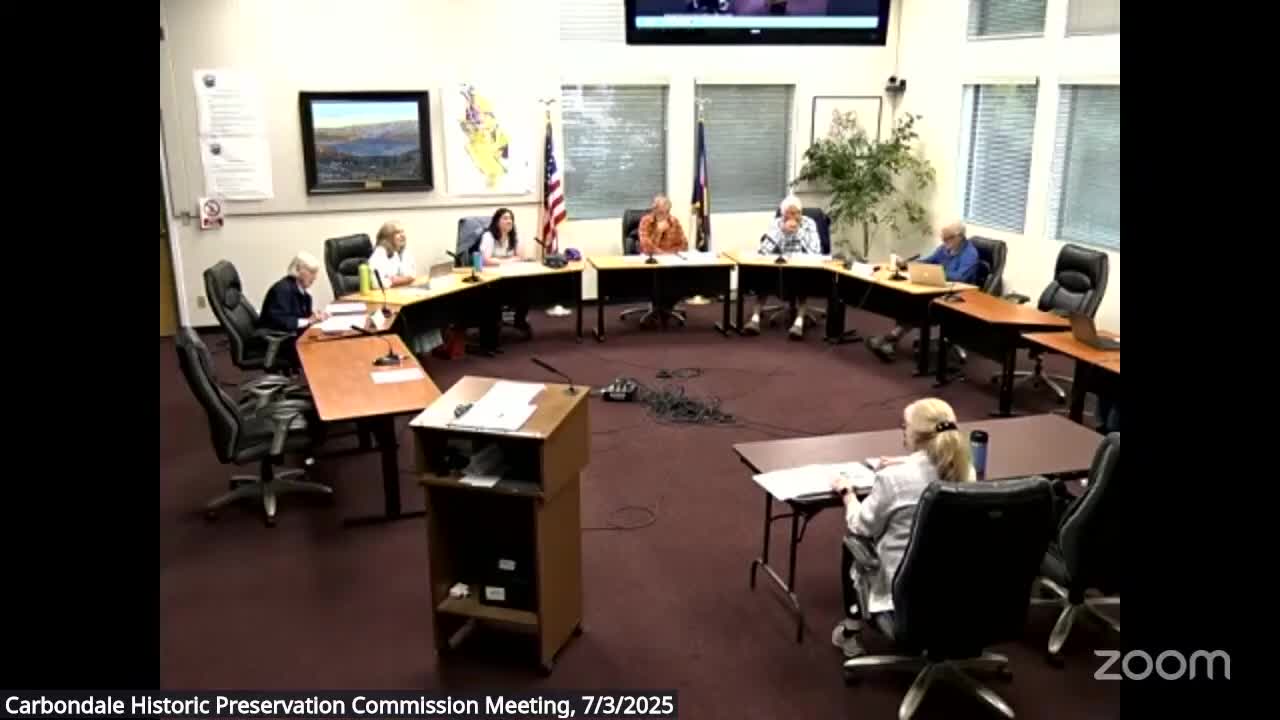
Summary
History Colorado’s CLG coordinator reviewed grant programs, tax-credit incentives, mandatory design-review rules for certified local governments and the Heritage for All initiative, and answered commissioners’ questions about deadlines and eligibility.
Lindsay Fluelleng, the Certified Local Government (CLG) coordinator at History Colorado, briefed the Carbondale Historic Preservation Commission on the CLG program and related state and federal funding opportunities, including tax-credit incentives and National Park Service grants.
Fluelleng said CLG status recognizes a local government’s preservation program as meeting state and federal standards and makes local governments eligible for competitive CLG grants, which she described as intended to fund preservation plans, surveys, design-guideline work, and outreach. She said CLG grant applications are normally released in October and are due in mid-January, though federal funding changes could alter that schedule. She also described parallel grant opportunities through the National Park Service, including emergency grants that require the affected property to be in a federally declared disaster county within the prior two years.
Fluelleng outlined the State Historical Fund program: competitive grant deadlines are Oct. 1 and April 1 each year; the program funds planning, construction documents, historic structure assessments and physical rehabilitation work; and construction grants can be awarded up to $250,000. She described noncompetitive state fund pools that renew July 1 (typical awards about $15,000) and microgrants of $5,000 for small projects and outreach. She noted state grants commonly require a local match and can be phased over multiple grant rounds.
She also reviewed Colorado’s state historic tax-credit programs for locally designated properties and contributing properties in locally designated districts. She said the residential credit provides up to 35% of rehabilitation costs and that beginning in 2027 the residential credit will be fully refundable (current rules spread credits over 10 years if an owner’s state tax liability is insufficient). For commercial projects she said the credit is 35% on the first $2 million of qualifying expenditures and 30% on the remainder.
On design review, Fluelleng said that certified local governments in Colorado must require design review for landmarks. She explained Carbondale’s current process distinguishes courtesy reviews (used for non‑landmark buildings in commercial areas) from mandatory landmark alteration certificates for designated properties. She advised commissioners to apply the Secretary of the Interior’s Standards (SOI standards) as a fallback when local design guidelines do not address an issue.
Fluelleng also described History Colorado’s Heritage for All initiative, which aims to increase the number of state and national register listings associated with underrepresented communities. She noted the Rebecca Lodge in Carbondale was recently placed on the state register and said the program includes fellows who can assist with writing nominations.
Commissioners asked about grant timing, stacking grants with tax credits, design-review triggers, and state action on accessory dwelling unit (ADU) rules. Fluelleng said the state revised some ADU requirements in 2024 for transit zones and encouraged coordination with the town’s planning and zoning process for any incentives tied to local design-review participation.
The presentation concluded with commissioners thanking Fluelleng and noting the commission would rely on the CLG office as a resource as it advances local design-guideline and landmarking work.