Get Full Government Meeting Transcripts, Videos, & Alerts Forever!
Get email alerts on the Growth Management topic
No spam. Unsubscribe anytime.
Board adopts growth management resolution keeping 3% ceiling (774 housing starts) and 43/57 allocation
Summary
The Board adopted a growth management resolution that keeps the annual allocation at 3% (774 housing starts for 2026), retains a 43%/57% split between general and developer categories and maintains a 10,000 gallons‑per‑day threshold for large commercial/industrial water users; the vote was unanimous.
The Board of Supervisors unanimously adopted Resolution 2025‑R‑18 setting growth management parameters for fiscal year 2026.
Community Development staff reviewed activity and a Growth Management Commission recommendation to retain the same formula used in recent years. Under the adopted resolution the city will: (1) maintain a 3% growth cap, which equates to 774 housing starts for 2026; (2) keep the 43%/57% allocation split between the general category and developer category; and (3) continue using a 10,000 gallons‑per‑day average threshold to identify large commercial and industrial water users for special consideration.
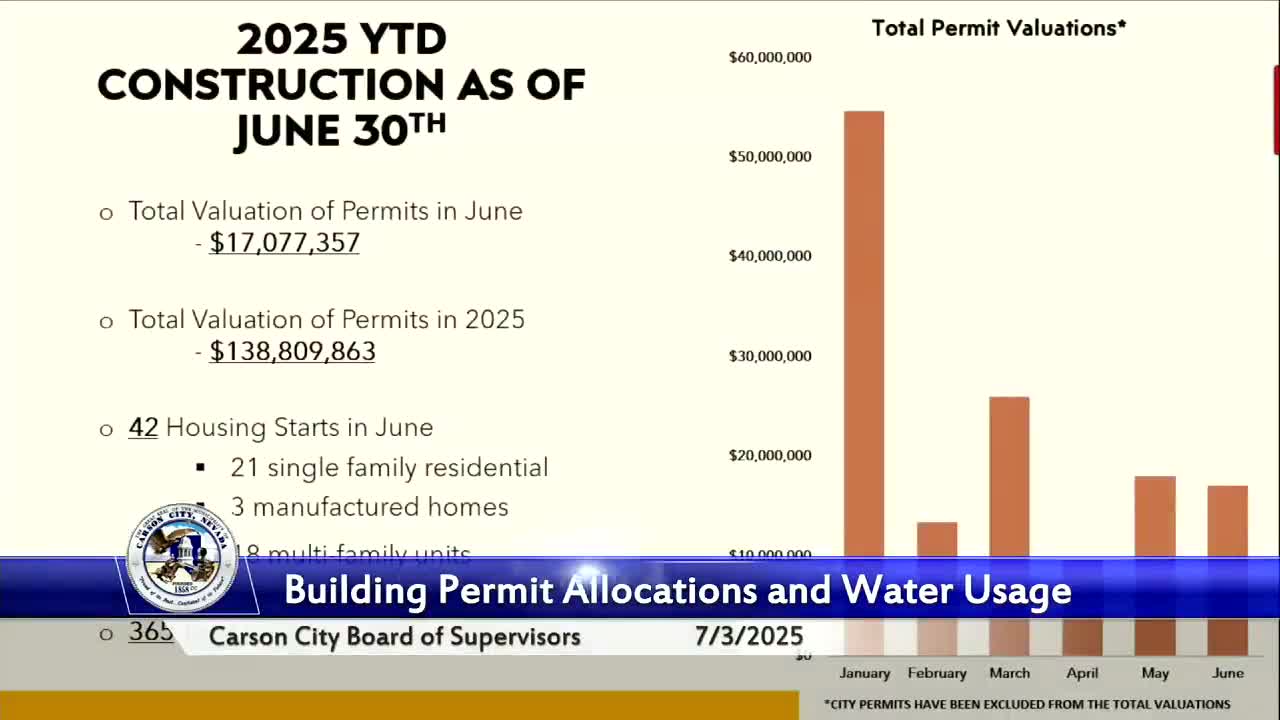
Staff said the commission also recommended studying the underlying growth formula and alternatives — including a build‑out horizon approach — and asked staff to return with options for the commission’s further consideration. Community Development provided a snapshot showing year‑to‑date permits, housing starts (365 year‑to‑date) and that the city continues to see single‑family detached construction dominate by unit counts; the state demographer’s five‑year projection was shared, showing modest population growth assumptions.
The board approved the growth management resolution unanimously and staff will continue to brief the commission and board on water, public safety and school‑district impacts. Several supervisors asked staff to explore formula alternatives and agreed that a further study on how the growth cap is calculated would be useful for long‑range planning.