Get Full Government Meeting Transcripts, Videos, & Alerts Forever!
Get email alerts on the Rezoning Industrial topic
No spam. Unsubscribe anytime.
Commission denies rezoning and comp‑plan change for long‑standing storage yard near Coal Creek
Summary
The Tulsa Planning Commission denied a rezoning (Z7820) and a companion comprehensive plan amendment (CPA‑119) that would have redesignated and rezoned a narrow parcel on East Newton/North New Haven to permit industrial‑light outdoor storage.
The Tulsa Planning Commission denied a rezoning request (Z7820) and a companion comprehensive plan amendment (CPA‑119) that would have redesignated a property west of the southwest corner of East Newton Street and North New Haven from Neighborhood to Employment and rezoned it from RS‑3 to IL (Industrial‑Light).
Staff recommended denial on both applications. Planning staff said the parcel is narrow — roughly 160 feet wide — and that an IL zoning adjacent to RS would require a 75‑foot setback, effectively preventing any buildable industrial footprint on the lot. Staff also noted a tributary of Coal Creek runs through the property, creating FEMA floodplain constraints and stormwater issues. The staff report concluded those physical constraints and the site geometry make industrial redevelopment infeasible and are inconsistent with the Sequoia Neighborhood Plan, which calls for buffering between industrial and residential uses.
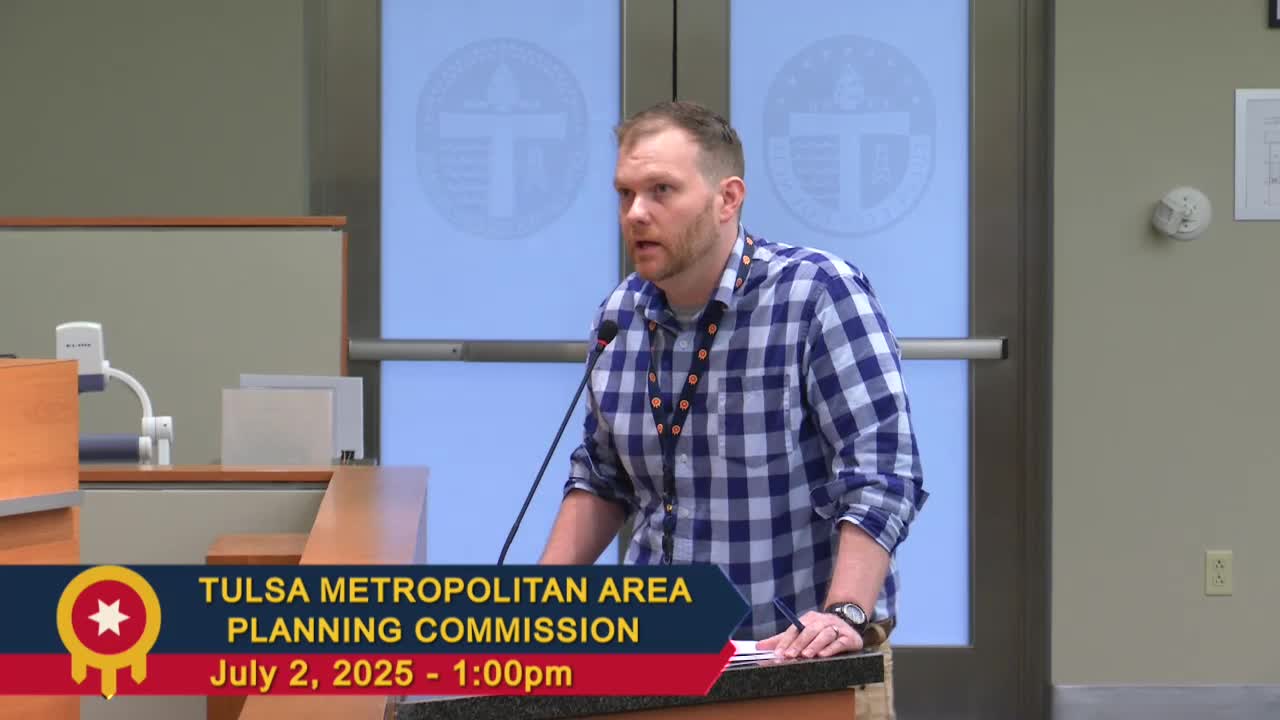
The applicant’s attorney, Ralph Weingarten, and Gunnar Harris, director of property services for Hemphill Legacy LLC, told commissioners the parcel has been used for outdoor storage of equipment and materials for at least a decade. Weingarten said the property is narrow and floodplain constraints limit typical industrial or residential development; Hemphill sought IL zoning and an employment land‑use designation to bring existing storage use into conformance after an enforcement action in 2023.
Commissioners discussed the long duration of the nonconforming use, the nearby pattern of mixed uses, and whether rezoning would set a precedent. One commissioner said the area’s land‑use boundary is clear at this scale and that rezoning would amount to a “spot zone.” A motion to deny Z7820 carried on a voice vote; a separate motion to deny CPA‑119 also carried.
The commission’s denials were based on the staff recommendation; the record shows the decisions as denials by voice vote but does not provide individual roll‑call tallies. The applicant said Hemphill reached out to neighbors during the application process and reported limited opposition, and the company framed the request as an attempt to rectify a long‑standing zoning noncompliance. Commissioners and staff noted alternative paths (residential cottage‑style or park/open‑space uses) might be more compatible given floodplain and setback constraints.
Speakers at the hearing included planning staff, the applicant’s representatives, and multiple commissioners. The record does not show any permit approvals tied to the parcels at this meeting.