Get Full Government Meeting Transcripts, Videos, & Alerts Forever!
Get email alerts on the Fire District Evaluation topic
No spam. Unsubscribe anytime.
Consultants urge phased staffing, equipment and training upgrades for Douglas County Consolidated Fire District 1
Summary
Emergency Service Consulting International (ESCI) presented a high‑level agency evaluation to the Douglas County Board of Commissioners on July 2, saying Consolidated Fire District 1 should adopt phased staffing increases, replace or phase out outdated apparatus, and tighten training, communications and facility standards to improve response goals.
Emergency Service Consulting International (ESCI) presented a high‑level agency evaluation to the Douglas County Board of Commissioners on July 2, saying Consolidated Fire District 1 should adopt phased staffing increases, replace or phase out outdated apparatus, and tighten training, communications and facility standards to improve response goals.
The report, about 100 pages in length and described by ESCI as an overview, identified gaps in staffing levels and recommended a three‑phase staffing plan that would move the department toward continuous, 24‑hour coverage with at least two firefighters on frontline apparatus. ESCI also recommended investing in vehicle‑location (AVL) technology, verifying emergency‑button functionality on portable radios, developing a 5‑ to 15‑year capital improvement plan for apparatus and facilities, and creating more accessible standard operating procedures and training records.
Why it matters: Commissioners and county staff said the district sits at a “crossroads” roughly five years after consolidation and face competing budget pressures across county and municipal fire/EMS providers. Several commissioners said the county must prioritize feasible items first, coordinate with other regional providers including Lawrence‑Douglas County Fire Medical (LDCFM), and balance staffing needs against expected cuts elsewhere.
ESCI consultants Jeff Stone and Joanne Lorber summarized the firm’s methodology and key findings. Stone said the evaluation relied heavily on GIS and data analytics plus a site visit and interviews. “There needs to be enhancement of some of the staffing level to meet response and time goals,” Stone said, adding that volunteer availability creates predictable gaps in some response windows.
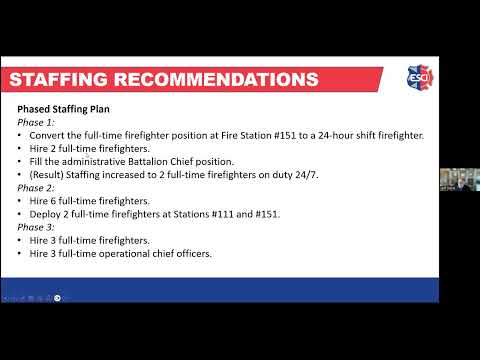
Consultants recommended a three‑phase staffing model tied to funding. Phase one would convert existing full‑time firefighters to 24‑hour shifts and add two firefighters while filling an open administrative battalion‑chief position; phase two would add six more full‑time firefighters to staff additional apparatus (ESCI suggested starting at Stations 111 and 151); phase three would add three more full‑time firefighters and reconfigure command staffing as needed. Stone emphasized a safety baseline: “you should always at least have 2 people riding on a fire truck,” calling a single‑person staffing model “a huge safety concern.”
Joanne Lorber outlined administrative and training recommendations, including an annual review of SOPs and SOGs, digital access to policies, reestablishing a year‑long training calendar, forming a training committee that includes paid and volunteer members, and creating task books for driver and officer progression. “Conduct an annual review of their SOPs and SOGs to ensure they are updated according to the department standard,” Lorber said, and she urged making those documents digitally accessible.
The report also flagged equipment and facility needs. ESCI noted lead times and costs for apparatus — the consultants cited roughly $1 million and two‑year lead times for engines and $2–2.5 million and about four years for ladder trucks — and recommended a formal apparatus‑replacement plan, more vigorous maintenance schedules, and hiring an emergency‑vehicle technician. On facilities, consultants recommended diesel‑exhaust removal for inhabited stations, consistent exterior signage, clarity on facility ownership and maintenance responsibilities, and legal reviews of leased or shared properties. Lorber also recommended discontinuing volunteer living arrangements at stations without proper lease or oversight and noted a suggestion to decommission Fire Station 152 while relocating stored apparatus where needed.
Technology and communications recommendations included enabling the emergency alert function on new portable radios, installing an AVL (automatic vehicle location) system so dispatch can identify the closest responding apparatus, and standardizing agency email domains and public recruitment materials. Stone said AVL and dispatch integration can reduce response times by identifying apparatus that are en route and closer than the default station assignment.
Commissioners and the district’s interim fire chief discussed next steps and constraints. Interim Fire Chief (unnamed in the transcript) stressed retention and on‑the‑ground staffing: “we need boots on the ground more than they needed another me,” and said higher retention and experienced leaders were priorities amid recent turnover. Commissioner Willie framed the findings as a countywide issue that will require coordination with other districts and LDCFM, and Commissioner Eden urged staff to separate short‑term "low‑hanging fruit" items from longer‑range projects and to identify priorities that are within current budget capacity. Commissioner Kelly noted some factual errors in the draft report (for example, the report mistakenly stated commissioner term lengths) and asked for clearer dispatch and operational data in future briefings.
No formal actions or votes were taken at the work session; the presentation was informational. County staff and ESCI said they will work with the fire chief and commissioners to prioritize recommendations and return with next steps. Staff advised the public that the Board of County Commissioners is the fire board for CFD 1 and encouraged interested residents to send comments to the county; a business meeting with public comment was scheduled for 5:30 p.m.
The ESCI evaluation was offered as a planning tool rather than a finalized implementation plan; consultants and commissioners repeatedly described it as a conversation starter and recommended further study, countywide stakeholder meetings and a phased approach tied to available funding.