Get Full Government Meeting Transcripts, Videos, & Alerts Forever!
Get email alerts on the Public Safety topic
No spam. Unsubscribe anytime.
Richland adopts lateral-hire incentives for fire department to attract experienced firefighters
Summary
The Richland City Council unanimously approved a resolution creating a lateral recruitment incentive package for Richland Fire and Emergency Services that includes higher starting step, shortened promotion eligibility, vacation accrual credit and paramedic-debt assistance.
The Richland City Council on July 1 adopted Resolution 2025-99 authorizing a lateral incentive program for Richland Fire and Emergency Services, intended to attract experienced firefighters from other departments.
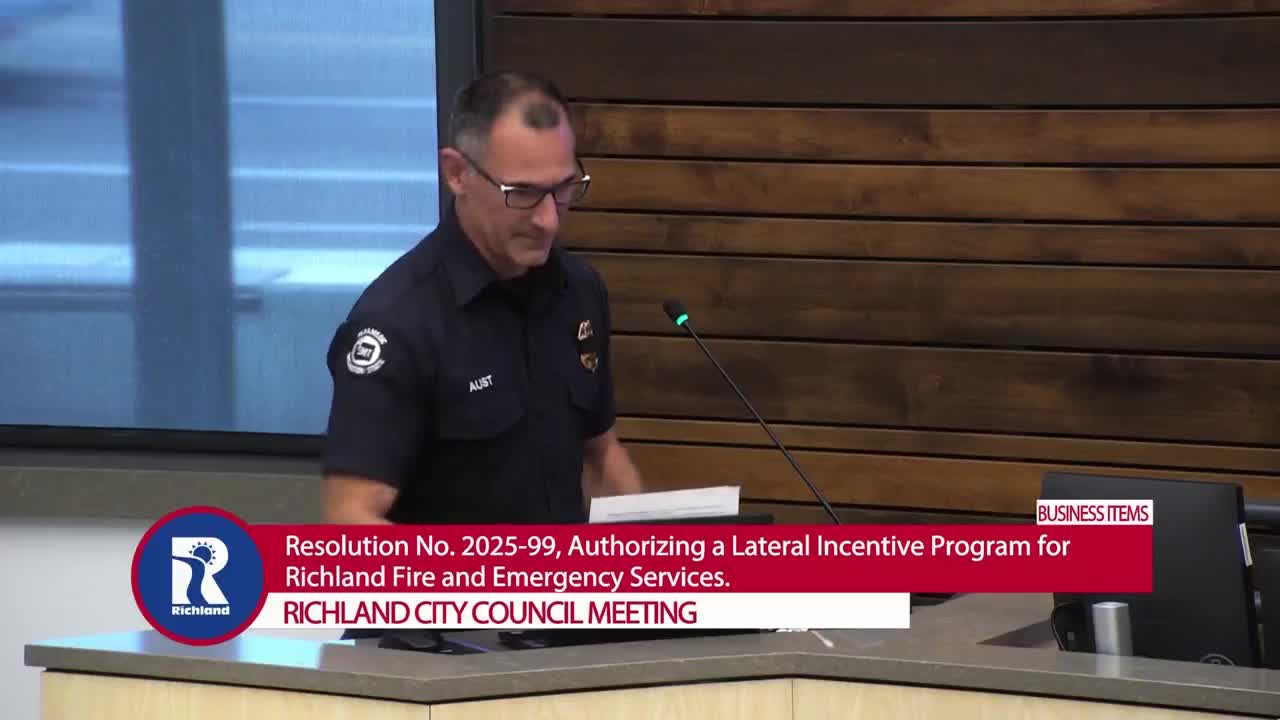
Deputy Chief Randy Ost described four proposed elements of the program: hiring laterals at the top pay step (changing hires from step E to step F), shortening the department's promotion eligibility for lateral hires from five years to three years, crediting prior service for vacation accrual so laterals do not restart at entry-level leave rates, and reimbursing remaining employer-held paramedic training debt for officers who come to Richland. "By allowing laterals to come in, it really prepares our organization to be much more efficient in the hiring process," Deputy Chief Randy Ost said.
The council discussion focused on market parity, concerns about perceived "poaching" of officers from neighboring agencies and how the city ensured fairness. Council member Jones asked whether the incentives might be seen as drawing top officers from nearby agencies; Deputy Chief Ost said the city is not actively recruiting locally but rather promoting openings to attract candidates who want to relocate or join Richland. City Manager Amundsen said other nearby agencies already offer similar lateral incentives and that Richland had fallen behind market parity.
Council member Witten asked why the promotion eligibility was set at three years rather than two; Ost replied that three years balances organizational equity and gives laterals time to learn Richland's specific policies and culture. Other council members supported the program as a way to add experience quickly to a relatively young force.
Council moved to adopt Resolution 2025-99. The motion carried by voice vote with the council recording the outcome as 6-0.
The resolution directs staff to implement the four incentive elements and to evaluate the program after two years for possible adjustments. The council did not attach additional funding amounts to these provisions in the meeting minutes; specific budget impacts were not specified during the discussion.
The council's action follows department leaders' reports that lateral hires typically require 6 to 8 weeks of onboarding compared with 5 to 6 months for entry-level recruits, and that prior experience can quickly add operational depth to patrol and response teams.