Get Full Government Meeting Transcripts, Videos, & Alerts Forever!
Get email alerts on the Emergency Declaration Policy topic
No spam. Unsubscribe anytime.
Cochise County supervisors review update to emergency-declaration rules, direct staff to revise and return
Summary
Emergency management director presented revisions to a 1979 county resolution and a 2020 policy to align with current Arizona statutes and federal guidance; supervisors asked staff to tighten review steps, add a 24‑hour validation for chair actions and return revised documents in about three weeks.
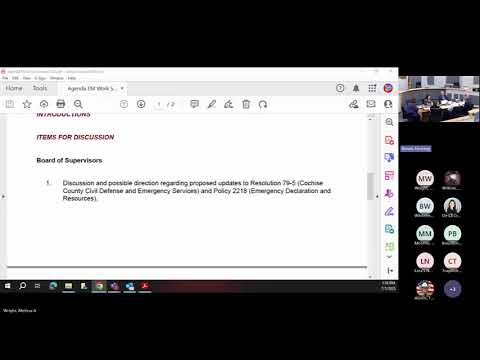
Cochise County emergency management director Dan DeShawn outlined proposed revisions to the county's 1979 emergency-declaration resolution and its 2020 corollary policy at a Board of Supervisors work session, and supervisors directed staff to incorporate changes and return the documents for consideration in roughly three weeks.
DeShawn told the board the draft text updates statutory references to Arizona Revised Statutes, Title 26, and federal guidance including the Robert T. Stafford Disaster Relief and Emergency Assistance Act and Homeland Security Presidential Directives 5 and 8. He said the revisions replace dated language such as "civil defense" with the contemporary term "emergency management" and adopt an "all hazards" framing to cover threats to health, welfare, property and safety across the county.
The proposed resolution mirrors current state statute language about definitions, emergency functions, powers of the board, and duties of the emergency management director, DeShawn said. He noted one statutory change since COVID: counties are explicitly excluded from ordering business closures, a power reserved to incorporated cities under state law. He also described how declarations and requests for outside assistance are routed through state emergency management and the governor's office.
Why it matters: supervisors questioned how much unilateral authority the chair should hold during an emergency, and whether the county should impose time limits and board validation on actions taken by a chair in the hours immediately after an incident. Several board members said they wanted to preserve the county's ability to respond quickly to life-or-death incidents while guarding against an overconcentration of power.
Board concerns and proposed edits
Supervisors discussed scenarios in which immediate action would be required, from hazardous-material incidents to major crashes or large-scale flooding. Board members asked that the draft include a clear process requiring the chair's emergency actions to be validated or rescinded by the full board within a short, specified interval (discussants proposed 24 hours or "as soon as practicable").
DeShawn described the operational chain of command in the draft: the emergency manager coordinates response under the incident command system; resource requests generally flow through the county administrator; and enforcement authority rests with the sheriff's office. The draft also clarifies that elected officials may make their personnel and resources available and that department directors will be consulted when county-controlled resources are reassigned.
Fiscal and mutual-aid questions
The discussion touched on funding and procurement adjustments that follow an emergency declaration. DeShawn said declaring an emergency can change procurement rules and allow the county to reallocate funds to respond immediately. He said that if the governor subsequently declares a state emergency and federal public assistance is approved, a county may be eligible for reimbursement of a portion of eligible costs (DeShawn described reimbursement scenarios of up to 75% in the context of traditional federal public-assistance formulas).
Board members also asked staff to clarify existing mutual-aid agreements and how incidents that cross municipal boundaries are handled, noting that state statute references county, city and town jurisdictions and that local mutual-aid agreements exist between fire and emergency services.
Next steps
Supervisors did not adopt any changes at the work session. The board asked staff to revise the resolution and the 2020 policy to reflect the board's feedback'including adding language on transmission of local declarations to the governor's office and a requirement that chair actions be validated by the board within a short time frame'and to return the revised documents for board review in about three weeks (a date referenced during the meeting). No formal vote was taken at the session.
Context and precedent
DeShawn and board members cited prior local incidents as background for the discussion: the Monument Fire and flood damage affecting homes in Elfrida and St. David (previously presented to the board as examples of events that prompted declarations). DeShawn said many local declarations are intended to notify residents and signal community need; fewer declarations are driven by immediate resource exhaustion that requires external assets.
The county's draft changes are intended to bring its resolution and internal policy into line with current state law and federal emergency-management practice; the documents have not been comprehensively updated since 1979 (resolution) and 2020 (policy). The board scheduled further review after staff revisions.