Get Full Government Meeting Transcripts, Videos, & Alerts Forever!
Senate energy subcommittee advances a package of bills on data centers, hydrogen, geothermal, housing electrification and utility accountability
Summary
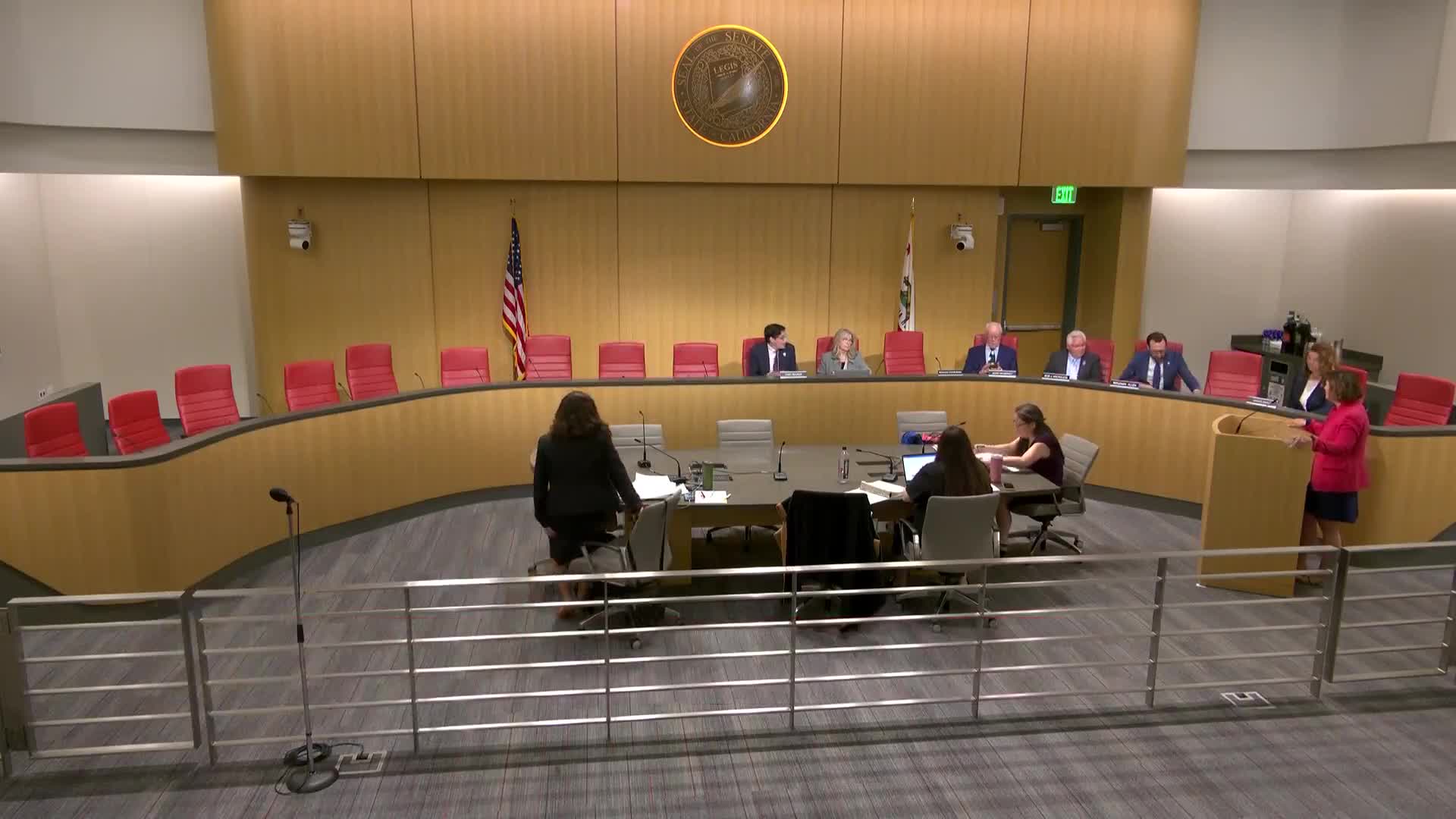
The Senate Committee on Energy, Utilities and Communications advanced a package of 11 bills that would expand data-center reporting, study curtailed renewable energy for hydrogen production, streamline geothermal permitting, tighten utility application timelines, require utilities to share aggregated outage data for disaster food-assistance requests and increase transparency around utility spending and community funding for offshore wind.
The Senate Committee on Energy, Utilities and Communications advanced a package of eleven bills that would increase reporting on data-center energy use, study use of curtailed renewable energy for hydrogen production, expand geothermal permitting options, clarify public access to biological resource maps, clarify tariff-on-bill rules for gas utilities, set expectations and transparency for utility energization timelines, require utilities to share aggregated outage data for disaster food-assistance requests, tighten rules on utility use of ratepayer funds, automatically opt customers into power-shutoff notice systems and require offshore-wind developers to report community capacity-building contributions.
The measures were presented by Assembly members and stakeholders and voted out of the subcommittee for further consideration in committees including Judiciary, Appropriations, Natural Resources and Water, Environmental Quality, Housing and Transportation. Supporters emphasized grid planning, consumer protections and community engagement; opposition from industry witnesses focused on possible regulatory duplication, competitive concerns and First Amendment or trade-association implications.
AB 222 (Bauer-Kahan) would require energy-intensive data centers to report biannual energy-use data to the California Energy Commission and direct the California Public Utilities Commission to analyze possible cost shifts to other ratepayers. Assemblymember Bauer-Kahan described the bill as “the data center accountability act” and said it would allow the state to plan for energy demand as data centers expand. Supporters included the League of California Cities, Sierra Club California and California Environmental Voters; the Data Center Coalition, Silicon Valley Leadership Group and the California Chamber of Commerce testified in opposition or respectful opposition, saying existing reporting and utility planning partially address the issues and warning of competitive impacts. The committee accepted amendments narrowing reporting, protecting customer- and security-sensitive details, and directing the CEC and CPUC to include load trend assessment and cost-shift analysis; the measure was advanced to the next committee.
AB 443 (Bennett) would require the California Energy Commission to assess where renewable curtailment occurs and recommend whether curtailed renewable energy could be used to produce hydrogen. Bennett said the bill would help determine whether curtailment is due to oversupply or transmission congestion so prospective hydrogen projects could plan investments. Supporters included Invenergy, the Independent Energy Producers Association and community choice aggregators; no opposition…
Already have an account? Log in
Subscribe to keep reading
Unlock the rest of this article — and every article on Citizen Portal.
- Unlimited articles
- AI-powered breakdowns of topics, speakers, decisions, and budgets
- Instant alerts when your location has a new meeting
- Follow topics and more locations
- 1,000 AI Insights / month, plus AI Chat