Get Full Government Meeting Transcripts, Videos, & Alerts Forever!
Get email alerts on the Committee Votes topic
No spam. Unsubscribe anytime.
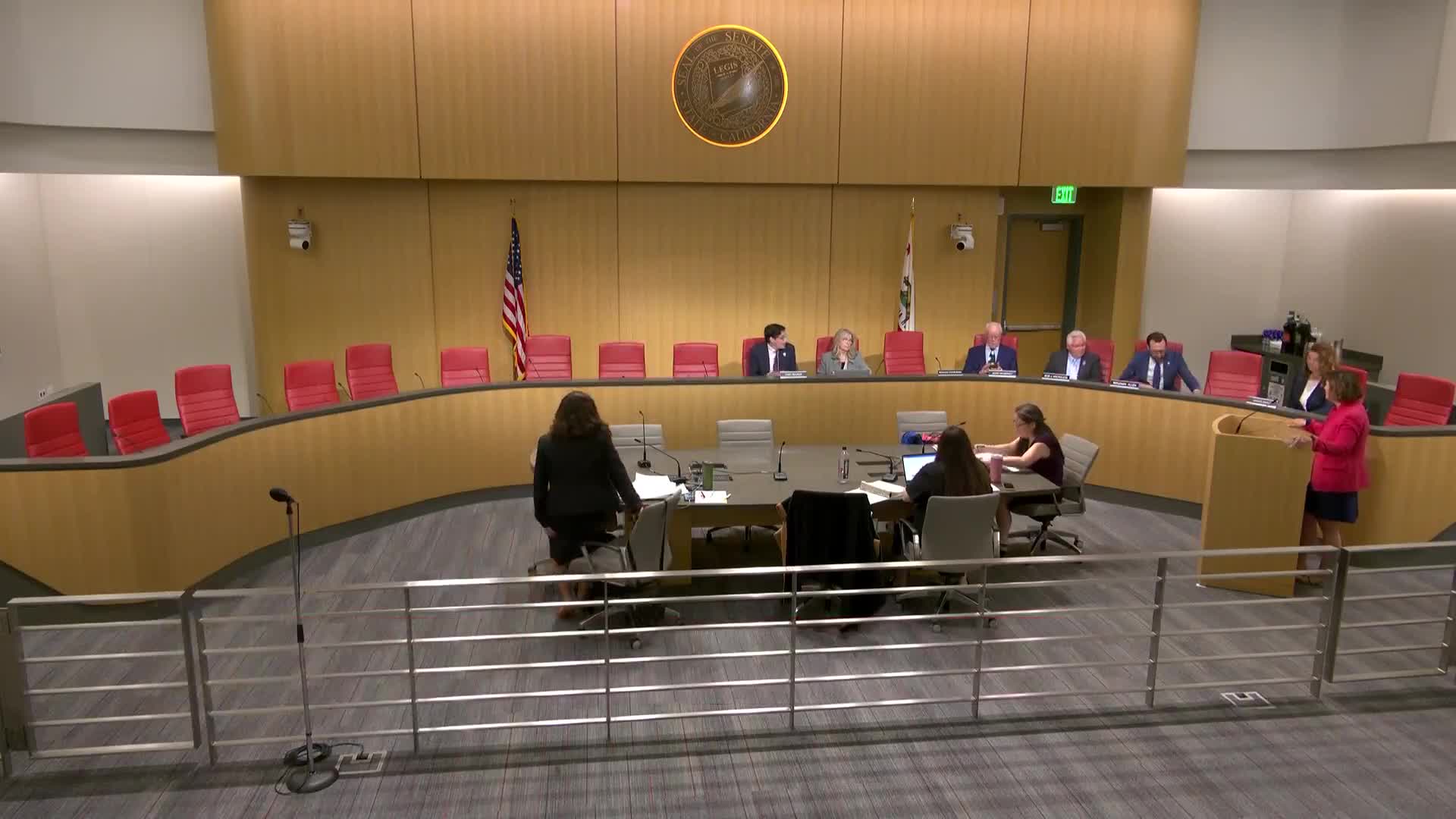
Senate energy subcommittee advances a package of bills on data centers, hydrogen, geothermal, housing electrification and utility accountability
Summary
The Senate Committee on Energy, Utilities and Communications advanced a package of 11 bills that would expand data-center reporting, study curtailed renewable energy for hydrogen production, streamline geothermal permitting, tighten utility application timelines, require utilities to share aggregated outage data for disaster food-assistance requests and increase transparency around utility spending and community funding for offshore wind.
The Senate Committee on Energy, Utilities and Communications advanced a package of eleven bills that would increase reporting on data-center energy use, study use of curtailed renewable energy for hydrogen production, expand geothermal permitting options, clarify public access to biological resource maps, clarify tariff-on-bill rules for gas utilities, set expectations and transparency for utility energization timelines, require utilities to share aggregated outage data for disaster food-assistance requests, tighten rules on utility use of ratepayer funds, automatically opt customers into power-shutoff notice systems and require offshore-wind developers to report community capacity-building contributions.
The measures were presented by Assembly members and stakeholders and voted out of the subcommittee for further consideration in committees including Judiciary, Appropriations, Natural Resources and Water, Environmental Quality, Housing and Transportation. Supporters emphasized grid planning, consumer protections and community engagement; opposition from industry witnesses focused on possible regulatory duplication, competitive concerns and First Amendment or trade-association implications.
AB 222 (Bauer-Kahan) would require energy-intensive data centers to report biannual energy-use data to the California Energy Commission and direct the California Public Utilities Commission to analyze possible cost shifts to other ratepayers. Assemblymember Bauer-Kahan described the bill as “the data center accountability act” and said it would allow the state to plan for energy demand as data centers expand. Supporters included the League of California Cities, Sierra Club California and California Environmental Voters; the Data Center Coalition, Silicon Valley Leadership Group and the California Chamber of Commerce testified in opposition or respectful opposition, saying existing reporting and utility planning partially address the issues and warning of competitive impacts. The committee accepted amendments narrowing reporting, protecting customer- and security-sensitive details, and directing the CEC and CPUC to include load trend assessment and cost-shift analysis; the measure was advanced to the next committee.
AB 443 (Bennett) would require the California Energy Commission to assess where renewable curtailment occurs and recommend whether curtailed renewable energy could be used to produce hydrogen. Bennett said the bill would help determine whether curtailment is due to oversupply or transmission congestion so prospective hydrogen projects could plan investments. Supporters included Invenergy, the Independent Energy Producers Association and community choice aggregators; no opposition witnesses appeared. The measure moved forward to Appropriations.
AB 531 (Rogers) would expand an existing environmental leadership designation to smaller geothermal projects (50 megawatts and under) so they can access expedited permitting processes intended to speed strategic energy deployment. Sonoma Clean Power and labor representatives supported the bill as a way to bring baseload clean power and jobs to Northern California; county representatives and others opposed any expansion that they said could override local permitting and local control. The author accepted an amendment clarifying some project definitions; the committee advanced the bill.
AB 734 (Schultz) would restore public access to biological resource information at a scale that lets the public meaningfully review energy-project impacts while preserving sensitive location information for special-status species. Defenders of Wildlife and other environmental groups supported the bill as restoring transparency to permitting; county and agency participants discussed confidentiality for the California Natural Diversity Database and a sunset provision in the bill. The committee advanced AB 734 as amended.
AB 737 (Quirk-Silva) seeks parity so gas corporations may participate in tariff-on-bill (TOB) programs on the same terms as electric utilities while limiting TOB to programs that achieve measurable gas-use and greenhouse-gas reductions. Sponsors told the committee the bill clarifies lingering uncertainty created by prior legislation and CPUC rulings and would enable pilots such as SoCalGas’s TOB proposal for water-heater replacement. Earthjustice opposed, saying TOB funding for gas appliances risks locking in fossil-fuel dependence; the author and several senators discussed safeguards that would require measurable emissions reductions. The committee advanced the bill with clarifying amendments.
AB 1026 (Wilson) would require investor-owned utilities to publish clearer guidance about what’s needed to complete an energization application and would align statutory language with CPUC decisions on timelines and processes for energization. Housing advocates and affordable-housing developers said long energization delays add months or years of carrying costs and slow occupancy; utilities said the CPUC ongoing proceedings are the right forum and warned the bill should avoid duplicative requirements. The committee adopted amendments to defer to CPUC decisions and advanced the bill to the Housing Committee.
AB 777 (Rodriguez) would require investor-owned utilities to enter data‑sharing agreements with the Department of Social Services so DSS can obtain timely, aggregated outage data by ZIP code during disasters. The author said gaps in utility outage data prevented complete federal requests for disaster CalFresh in recent disasters; food-bank and anti-hunger groups supported the measure. The committee adopted clarifying amendments limiting data use to nutrition-assistance needs and advanced AB 777 to the Senate Human Services Committee.
AB 1167 (Berman) would strengthen transparency about investor‑owned utilities’ use of ratepayer funds and require shareholder—not ratepayer—payment for political influence and promotional advertising that does not materially benefit customers. Earthjustice, The Utility Reform Network and several environmental and consumer groups supported the bill; PG&E, SCE, SDG&E, Southern California Gas Company and business groups opposed, arguing the measure is overbroad, could cover legitimate customer‑education and safety communications, and raised constitutional questions about political speech. The committee accepted amendments to preserve CPUC authority over penalties and advanced AB 1167 to Judiciary for further review.
AB 1410 (Garcia) would require all public utilities to automatically enroll customers of record to receive automatic notifications about planned power shutoffs and to allow customers to update preferred contact methods; customers may opt out. The sponsor said hundreds of constituents missed timely notices during recent wind- and fire‑related outages. The committee advanced the bill to Appropriations.
AB 1417 (Schultz) would require offshore-wind developers to report to the California Energy Commission when they provide funding directly to local and tribal communities for capacity-building activities and would allow those capacity-building uses to be eligible for voluntary offshore-wind protection program funds. Supporters said proper community and tribal participation requires funding for technical assistance and engagement; the committee moved the bill to Natural Resources and Water.
AB 1532 (committee bill) updates communications and accessibility reporting requirements at the California Public Utilities Commission and extends funding authority for a transportation-access program for riders who need wheelchair‑accessible services. The committee’s bill was advanced to the Transportation Committee.
Votes at a glance (committee action) AB 222 (Bauer‑Kahan): advanced as amended to Senate Judiciary Committee (yes 13, no 2) — data center reporting and CPUC cost‑shift analysis. AB 443 (Bennett): advanced to Senate Appropriations (yes 16, no 0) — CEC assessment of curtailed renewables and hydrogen. AB 531 (Rogers): advanced to Senate Environmental Quality (yes 16, no 0) — expands environmental leadership designation for smaller geothermal projects. AB 734 (Schultz): advanced to Natural Resources and Water (yes 14, no 1) — restores public access to biological resource mapping with sensitive-data protections. AB 737 (Quirk‑Silva): advanced to Senate Appropriations (yes 14, no 1) — clarifies TOB eligibility for gas corporations with emissions-reduction guardrails. AB 1026 (Wilson): advanced to Senate Housing Committee (yes 16, no 0) — utility application transparency and energization timelines. AB 777 (Rodriguez): advanced to Senate Human Services Committee (yes 14, no 0) — utility outage data sharing for disaster CalFresh (aggregated by ZIP code, privacy protections). AB 1167 (Berman): advanced to Senate Judiciary (yes 13, no 4) — increases transparency and accountability on ratepayer-funded promotion and lobbying. AB 1410 (Garcia): advanced to Senate Appropriations (yes 17, no 0) — automatic enrollment for power‑shutoff notifications (opt‑out allowed). AB 1417 (Schultz): advanced to Natural Resources and Water (yes 13, no 2) — offshore wind developer reporting on community/tribal capacity building. AB 1532 (Committee): advanced to Transportation (yes 15, no 0) — revisions to CPUC reporting and program funding authority.
What happened in committee - Authors and stakeholder witnesses presented each measure and responded to clarifying questions from senators about scope, enforcement, and overlaps with existing CPUC/CEC processes. Committee amendments were offered and accepted on multiple bills to narrow or clarify reporting obligations, defer to CPUC-established timelines or processes where appropriate, preserve confidentiality for sensitive biological-resource locations, and confirm privacy protections for any aggregated outage data shared for disaster-assistance purposes. - Industry witnesses often urged continued work with authors and noted ongoing CPUC or CEC proceedings that they said are the more appropriate venue for technical implementation details. Environmental, housing and consumer advocates generally supported the measures, saying the bills would improve transparency, reduce delays, or protect vulnerable residents.
What’s next Each bill will go to the committee named in the motion (Judiciary, Appropriations, Natural Resources and Water, Environmental Quality, Housing, Human Services or Transportation) for further hearings and fiscal analysis where applicable. Several authors said they will continue to negotiate technical amendments with stakeholders before floor consideration.
Ending The subcommittee met again after a brief recess to complete roll calls. Members repeatedly emphasized the need to balance timely energy and housing development, consumer protections and the state’s climate goals while preserving appropriate administrative oversight by the CEC and CPUC.