Get Full Government Meeting Transcripts, Videos, & Alerts Forever!
Get email alerts on the Tax Increment Financing topic
No spam. Unsubscribe anytime.
Brownsburg Redevelopment Commission adopts Parkway Corridor TIF after public hearing
Summary
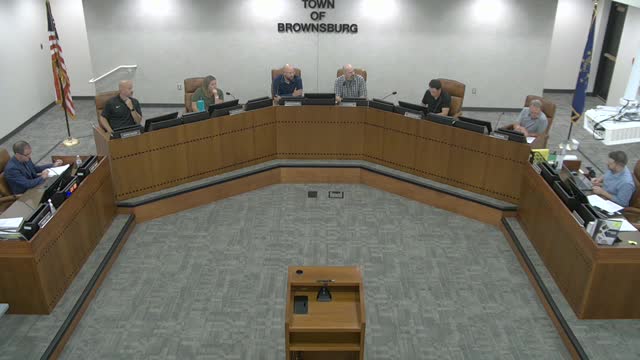
Brownsburg Redevelopment Commission members voted 5-0 on July 1, 2025 to adopt Resolution 2025-01C, a confirmatory resolution establishing the Parkway Corridor Economic Development Area and a coterminous allocation area (a TIF district) on the town’s northeast side near the Ronald Reagan Parkway.
Brownsburg Redevelopment Commission members voted 5-0 on July 1, 2025 to adopt Resolution 2025-01C, a confirmatory resolution establishing the Parkway Corridor Economic Development Area and a coterminous allocation area (a tax increment financing, or TIF, district) on the town’s northeast side near the Ronald Reagan Parkway.
The vote followed a public hearing at which town staff described how a TIF would finance future infrastructure in the area, and residents and the school corporation’s representative raised questions about zoning, drainage, acreage and the potential fiscal impact on other taxing units under recent state property-tax changes.
Staff presentation and scope
Ethan Pierce, town planning/infrastructure staff, told the commission that a TIF is “an economic development tool that helps municipalities fund infrastructure improvements, redevelopment projects, and other public investments within that specific TIF area.” Pierce said the town has invested about $16,600,000 in northeast Brownsburg infrastructure since 2021 and that the proposed Parkway Corridor area consists of parcels voluntarily annexed in 2024 (the Hessian and Maloney properties). He said the annexed parcels were rezoned to I-2 (general industrial) as part of the annexation process and that the proposed town TIF overlaps a portion of an existing Hendricks County TIF created in 2017.
Pierce said seven parcels in the town’s proposed TIF intersect the county TIF footprint; four of those are right-of-way and therefore do not generate property tax revenue, and three parcels could develop and produce incremental assessed value. Shifting those three parcels to the town allocation area would affect roughly 2.7% of the county’s TIF area, he said. Pierce noted that the county assessor sets the base assessed value for any TIF and that the TIF increment becomes available to the town only as new development increases assessed value above that base.
Public concerns raised
Several residents spoke during the public hearing. Jonathan Hibbard, who said he lives near the proposed TIF area but outside the town limits, told the commission that “I‑2 … is a really broad range of things that can possibly be built there,” and asked whether the intergovernmental steering committee associated with the Ronald Reagan Parkway agreement had met and whether residents outside town limits would be represented on that body.
Jim Murphy, another nearby resident, argued the land in question was already zoned I-2, not farmland, and urged the town and county to ensure the county assessor uses an appropriate base value so other taxing units receive correct distributions. David Wyatt asked whether the town can recover the roughly $16.6 million it has already spent on infrastructure in the area, and whether the county had taken any formal action after staff said county officials had been briefed about the annexation.
School concerns and mitigation options
Shane Hacker, identified in the meeting as the school representative, told the commission the school corporation opposes creation of the TIF district “based on just all the concern associated with the potential loss of AV from Senate Bill 1,” referring to recently enacted state property-tax changes that school officials say could reduce assessed-value receipts for the school. Hacker said a loss of incremental assessed valuation (AV) could force the district to reconsider plans for long-term tax-rate reductions and might lead to higher school tax rates if AV drops; he described ongoing demographic and fiscal uncertainty and said the schools want to explore mitigation options if the TIF proceeds.
Hacker and other speakers discussed possible mitigation mechanisms: an automatic pass-through of incremental revenue (used by some jurisdictions in the past), annual negotiated pass-throughs, or direct payments from TIF receipts to the school for workforce-development or other cooperative programs. Town staff said pass-through arrangements have existed historically but were scaled back in earlier redevelopment projects and encouraged future town–school conversations to identify options.
Procedural and legal notes
Town legal counsel and staff said the rezoning and annexation were completed in 2024 and that notice requirements for the TIF (advertisement, mailed and emailed notices to required taxing units) were satisfied; Pierce and legal staff said the county assessor determines the base assessed value as of the statutory base date (noted in discussion as January 1, 2025). Staff confirmed that creating the allocation area does not itself obligate the town to issue debt or to commence projects; the TIF becomes an available financing tool and debt issuance would trigger the start of the allocation period (legal counsel and staff said a 25‑year repayment clock typically begins when an obligation is issued).
Action and next steps
After closing the public hearing, the commission moved to the confirmatory resolution. The motion to adopt Resolution 2025‑01C passed by voice vote, recorded in the minutes as 5‑0. Staff indicated future steps would include project-level approvals and any specific infrastructure authorizations would be considered separately if and when the town identifies a particular project to fund from TIF receipts.
Ending
Commissioners closed the item and moved on to other business. Staff and legal representatives said they would continue coordination with Hendricks County and with the school corporation about implementation details and potential mitigation agreements if the TIF area generates incremental revenue.