Get Full Government Meeting Transcripts, Videos, & Alerts Forever!
Get email alerts on the Paving And Public Works topic
No spam. Unsubscribe anytime.
Holyoke council reviews FY26 paving program; engineers urge preventive maintenance to avoid higher future costs
Summary
City engineers presented a ward-by-ward paving report showing Holyoke maintains about 130 miles of roadway with an average road-surface rating of 71.9; councilors discussed preventive crack sealing, sidewalk funding, and public access to the ratings.
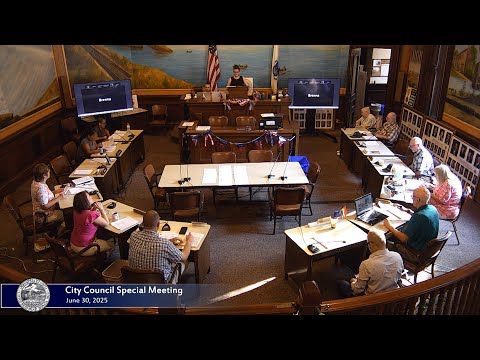
At the June 30 special meeting, the Holyoke City Council reviewed the fiscal year 2026 paving program memo and a presentation from the city engineer and Department of Public Works staff.
The engineering presentation — noted in council comments as including a ward-by-ward analysis and online materials — reported the city maintains roughly 130 miles of road and showed an average road-surface rating of 71.9. Councilors said the report lists candidate streets for resurfacing, and that ratings for streets slated this year include some in the 20s–40s.
Councilor Sullivan said a striking element of the report was that deferred preventive maintenance will raise costs later: “If we don't start spending more money on preventive maintenance, we're going to spend a lot more money in the future,” he said during committee discussion. Councilor McGrath Smith asked that the city publish the full ratings system and the sidewalk-rating data on the DPW website so constituents can see where their street stands relative to citywide needs.
Councilors also discussed preventive treatments: the engineering staff proposed dedicating $100,000 to crack sealing to preserve newly paved roads during years 1–5, and another $100,000 targeted at sidewalk work in non-CDBG areas. Councilor Bacon reminded residents that constituent resurfacing requests are evaluated each year against the ratings and available Chapter 90 and project funds, so a request does not guarantee immediate work.
The committee recorded the order as “complied with.” Councilors noted that paving projects use a mix of Chapter 90 funding and project-specific funds, and that some recent repavings (for example, work in the East Hampton/Anniversary Hill area and High Street) were financed with project money rather than Chapter 90.
Ending DPW staff agreed to make the paving report and ratings publicly available so residents can track their street’s rating and likely place on future paving lists.