Get Full Government Meeting Transcripts, Videos, & Alerts Forever!
Get email alerts on the Municipal Budget topic
No spam. Unsubscribe anytime.
Fulshear releases preliminary FY 2026 budget; streets, police pay and utilities drive difficult trade-offs
Summary
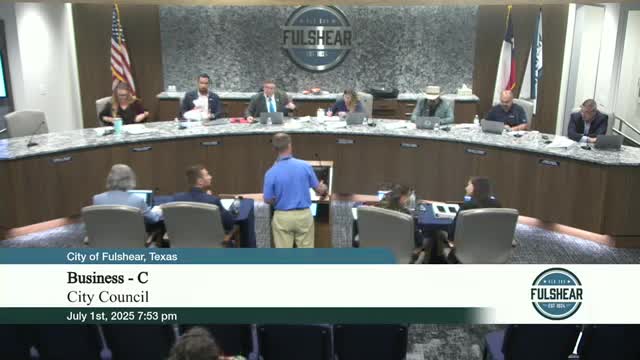
City staff presented the preliminary fiscal year 2026 operating and capital budget to the Fulshear City Council on July 1, 2025, and council members directed staff to return with options for funding pavement management, police pay and utility operations.
City staff presented the preliminary fiscal year 2026 operating and capital budget to the Fulshear City Council on July 1, 2025, and council members directed staff to return with options for funding key priorities including pavement management, police pay competitiveness and utility operations.
Budget staff framed the city’s options as trade‑offs: keep the current low tax rate and defer or reduce capital and maintenance programs, or increase revenue (including the possibility of a voter‑approved tax measure) to fund proactive pavement management, public‑safety compensation and other services. The presentation included high‑level fund projections, requests for new positions and capital projects that staff said could not be fully funded at the current revenue assumptions.
“Mickey Mahoney, the city’s budget manager, presented the highlights and timeline for FY 2026, noting the city’s fund balances and the need to prioritize,” staff said. The presentation showed the general fund in a healthy position by common benchmarks but flagged a long‑term mismatch between the city’s current tax rate and the recurring costs of streets and services as the city grows. Staff recommended keeping a conservative approach and asked council for direction on which priorities to fund.
Pavement management (proactive street maintenance) drew repeated concern from council members and staff. Staff reported that the city is spending reactive funds for pothole and emergency repairs but lacks the recurring revenue to follow the earlier Pavement Condition Index (PCI) recommendation for proactive maintenance. Council members called pavement management a high priority to avoid higher replacement costs in future years and asked staff to model funding scenarios that include tax‑rate adjustments, use of fund balance and other revenue sources.
Police staffing and compensation also drew focused discussion. The police department provided an informal salary survey showing that Fulshear currently lags some neighboring cities on pay; council members asked staff for options to close that gap over time rather than by a single‑year, large increase. Staff said matching top local pay (for example, certain neighboring cities) would be a significant budgetary impact and requested council guidance on pacing and funding sources.
Utilities were another central topic. The draft budget includes a proposal to bring water/wastewater operations in‑house; staff estimated an additional roughly $952,880 to fund operators, equipment, vehicles and an after‑hours call center in the utility fund. Staff also said the utility projections assume a potential rate adjustment (the city is preparing a formal rate study and plans to present a rates recommendation this summer) and asked council whether to present rate options to the public in August.
Other requests and clarifications included: - Several departmental position reclassifications and a citywide step/merit program (staff recommended a 2% cost‑of‑living adjustment and a 2.5‑step merit program with conditions); council asked for statistics on how many employees would be affected and what the dollar impact would be. - Street‑related budgets include nearly $988,800 for maintenance items (signage, pavement/sidewalk lift repair, school zone flashers, tree trimming and electricity for streetlights); staff said the city is researching streetlight types and possible LED conversions to reduce electricity costs. - The utility fund showed a projected beginning balance of roughly $3.1 million, revenues around $24.8 million and expenditures of $16.1 million under the draft assumptions; staff noted those revenues incorporate a placeholder assumption for a rate increase that will be finalized by a forthcoming rate study. - Capital projects not funded in the draft include portions of the diversion lift station and other large utility projects; staff warned that delaying some projects can raise future costs as materials or bids escalate.
Council members asked staff to return with tax‑rate scenarios that would fund a prioritized set of “must‑have” items (pavement management and targeted police compensation improvements were mentioned repeatedly), and to model alternatives that blend tax changes, use of fund balance and EDC contributions. Several council members said they would support a modest tax‑rate increase if it funded durable, visible improvements such as better streets and competitive public‑safety pay.
No final budget vote was taken on July 1. Staff said they would return with more detailed analyses, rate‑impact modeling and specific funding options in coming budget workshops.