Get Full Government Meeting Transcripts, Videos, & Alerts Forever!
Get email alerts on the Public Library Accreditation topic
No spam. Unsubscribe anytime.
Nebraska Library Commission details accreditation rules, deadlines and funding at 2025 workshop
Summary
At a June workshop, the Nebraska Library Commission explained its five‑year accreditation cycle, certification requirements for boards and staff, grant eligibility tied to accreditation, new cybersecurity questions on the application and the community needs response plan that libraries must submit.
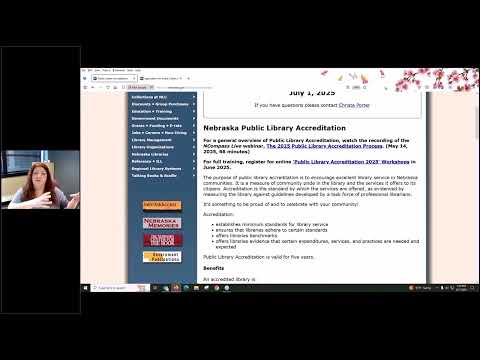
Krista Porter, library development director at the Nebraska Library Commission, led a June workshop explaining the Commission’s public library accreditation program, application calendar and related certification and grant requirements for Nebraska public libraries. The online session included a live walkthrough of the accreditation application and guidance on the separate community needs response plan libraries must submit.
The workshop outlined why accreditation matters and what libraries must do to keep or gain accredited status. “This is not a national program,” Porter said, stressing that Nebraska’s accreditation process is administered by the state library agency. She noted the program’s history (first accreditations began in 1988), the current five‑year accreditation term introduced after a 2022 review, and the Commission’s July 1 application opening and October 1 submission calendar for application materials.
Porter said the Commission changed reaccreditation from a three‑year to a five‑year cycle after a 2022 review and pandemic‑era extensions. “A library’s accreditation is good for 5 years now,” she said, explaining that some libraries ended up in longer staggered cycles during the transition and that staff will work with individual libraries to re‑balance schedules.
Key deadlines and process details - Application form becomes available July 1; libraries must use their BiblioStat login that also submits the public library survey. - Two documents are required for review: the online accreditation application and a community needs response plan. Porter said both items are due “by October 1,” though she added the Commission will grant extensions in cases of extenuating circumstances, new directors, major renovations or disaster recovery. - Commission review concludes by Dec. 31, with new accreditations taking effect Jan. 1 of the following year.
What accreditation requires and what it yields Porter reviewed the program’s structure: 12 minimum qualifications every library must meet (legal establishment under Nebraska statutes, board and director certification, compliance with open meetings law, an annual public library survey and others) and a larger points‑based application with five sections (governance & planning; resources; services; cooperation & collaboration; communications). The application contains peer‑comparison guidelines that use national public library survey data to benchmark local income, hours, circulation and other metrics.
The Commission uses a points system with 275 possible points on the form; Porter said gold, silver and bronze thresholds are 250, 200 and 175 points, respectively. Accredited libraries become eligible for several funding and promotional items: a mailed certificate and an online seal, eligibility for state aid and additional per‑library incentives (Porter said silver earns an extra $200 and gold an extra $400 on top of state aid), and access to NLC‑administered grants.
Grants and funding tied to accreditation Porter listed grants that require accreditation: continuing education and training grants, internship grants, library improvement grants (now state‑funded for the current cycle), and youth grants for excellence. She also noted that the Nebraska Department of Economic Development requires accreditation for community development block grant (CDBG) applicants seeking construction or major facility funding. Porter mentioned the Fernbeheim Library Trustee Scholarship is administered by the Commission but funded by a community foundation and is distinct from the Commission’s state grants.
Certification and continuing education Porter reviewed the Commission’s board and librarian certification programs, which remain separate from accreditation but are prerequisites for it. Board certification requires 20 hours of continuing education over a three‑year period (pooled for the board, not per person). Librarian/staff certification requires 45 hours of continuing education over three years; the Commission provides a free Basic Skills course sequence for staff without a library degree and offers repeated annual schedules for other courses. She said provisional certification (for staff or boards actively earning hours) counts toward accreditation eligibility.
Technology and security questions The Commission added computer security questions to the application after its 2022 review. Porter said the questions ask about operating‑system life cycle, monthly update practices, separate staff/customer logins, BIOS security, reboot/restore tools, DNS filtering and firewall protections. She called out that Windows 10 reaches end of support in October 2025 and advised libraries to plan upgrades. NLC staff (identified in the workshop) can assist with filtering and some technical setup.
Community needs response plan Porter walked through the community needs response plan—a required separate submission distinct from a full strategic plan—that must be current within five years. The plan should include a mission statement, a community profile (census/demographic data), an assessment of community needs (surveys, focus groups, key informant interviews or existing municipal data), an analysis of library strengths/resources/barriers, three SMART goals tied to community needs, and an evaluation approach. Porter emphasized the plan should drive a small set of concrete, measurable actions (three goals is the Commission’s recommended target) and said the Commission will provide feedback on draft plans.
Support resources and Commission contacts Porter demonstrated the Commission’s public tools: the preview accreditation application, the public library accreditation status page (showing accredited and nonaccredited libraries), board and librarian certification status pages, and a library‑by‑library display that links to peer comparison data drawn from the national public library survey. She named staff who support parts of the program—Sam Shaw (state aid and public library survey/statistics), Scott Childers (Southeast Library System and a resource on Nebraska library law), Andrew “Sherm” Sherman (IT support), Holly Duggan (continuing education coordinator) and “Mary” (CE records)—and said Commission staff will submit attendance for Commission‑run trainings automatically.
What the Commission said it will review and enforce Porter said the Commission intends to enforce maintenance requirements (annual public library survey and the 12 minimums) more consistently after pandemic‑era leniency. If a previously accredited library fails to submit the annual public library survey by the ultimate federal deadline, the Commission expects accreditation can be lost.
Workshop format and follow‑up Porter ran a live demo of an application for Atkinson Public Library to show the point tally, prefilled peer‑comparison items, and how to save, resume and submit forms. She encouraged libraries to send draft community plans earlier than the October 1 deadline to get feedback, and she noted Commission webinar recordings and guides (Encompass Live, WebJunction resources, sample plans) are available for libraries that need templates or training.
Porter closed by inviting libraries to contact her with questions, submit drafts for review, and watch the Commission’s Encompass Live schedule for more training. “If you are up for reaccreditation, look for that email I will be sending out on July 1,” she said.