Get Full Government Meeting Transcripts, Videos, & Alerts Forever!
Get email alerts on the Msp Leadership topic
No spam. Unsubscribe anytime.
Michigan lawmakers probe low morale, 98% no‑confidence vote in State Police leadership
Summary
Michigan House Oversight Committee members questioned Michigan State Police Colonel James Grady about a trooper vote of no confidence, employee‑engagement survey results, leadership promotions and discipline, vacancy rates, alleged doxing of troopers, and recent budget transfers during a committee hearing.
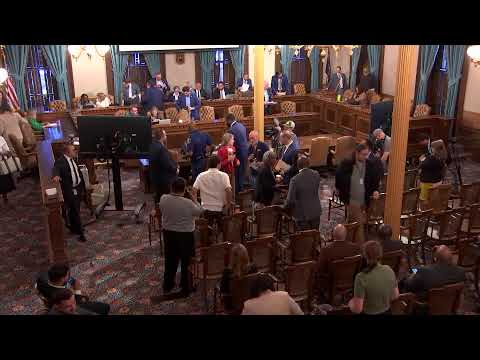
Colonel James Grady, director of the Michigan State Police, told the Michigan House Oversight Committee on Oct. 26, 2025, that he has pushed for pay raises, expanded recruiting and training initiatives, and launched an agencywide action plan in response to low morale and survey results, but legislators pressed him about a 98% vote of no confidence reported by rank‑and‑file members and other personnel and budget concerns.
The committee convened to question Grady about the results of two recent measures — the ICE survey and an employee engagement survey — and a membership vote organized by troopers’ associations that, legislators said, recorded 1,167 “no” votes and 18 “yes” votes on confidence in Grady and Lieutenant Colonel Amy Brimacombe. Chair Mueller said the committee needed to “get to the bottom of it” after hearing that level of dissent.
The results matter because committee members said the votes and survey comments describe systemic problems that could affect public safety and agency function. Representative Snyder told the hearing, “So it's my understanding there's nearly 700 vacancies in the department right now and 500 of those are at the trooper level,” a figure Grady said he did not have at hand but could provide later. Lawmakers also raised questions about the process for handling critical incidents, internal investigations and the selection and discipline of senior leaders.
Grady told the committee he has undertaken worksite visits across the state, established employee resource groups, created a $2,000 annual training fund and advocated for pay raises. “I am a proud veteran and I am an experienced veteran here in the MSP,” he said, describing steps he has taken to improve morale and training. Grady said the department updated its written directive on criminal investigations involving department members in fall 2024 to standardize submissions for prosecutorial review and that the directive was shared with the Prosecuting Attorneys Association.
Lawmakers pressed Grady on personnel decisions. Multiple members questioned the promotion of Lieutenant Colonel Amy Brimacombe to chief deputy, including past internal investigations that lawmakers said were sustained against her. Representative Bridal said, “Prior to her being promoted, she had 3 sustained I investigations against her.” Grady responded that disciplinary matters are investigated by the Professional Standards Section, reviewed with labor relations and that discipline is intended to be corrective so members can continue their careers.
The committee also raised allegations that the Michigan State Police had disclosed the identities and deposition details of troopers to the media; lawmakers called that “doxing.” Grady said he was not aware and pledged to investigate. Lawmakers asked whether the agency had shared deposition notices with media outlets; Grady said this was the first he had heard of that specific allegation and that the agency would look into it.
Representative Mueller and others asked about the agency’s policy directing that certain critical incidents be referred to the Michigan attorney general for review rather than locally elected county prosecutors. Grady said the directive is intended to ensure statewide consistency and that department leadership met with local prosecutors in 2024 to explain the reasoning.
On budgetary questions, Representative Mueller asked about an $800,000 legislative transfer the committee was told had been moved to cover legal settlements and to fund unclassified leadership positions. Grady said the $800,000 was shifted to cover legal expenses and that planned unclassified positions were not filled because of budget uncertainty. The committee also questioned an $40,000 overspend related to a command conference; Grady said he had directed reductions to travel and other changes to prevent a repeat.
The hearing closed with lawmakers asking Grady to return to the committee in several months to report on the agency’s action plan and on measures intended to improve employee engagement. Chair Mueller said the committee would expect updates on results and implementation steps.
Votes and formal actions at the start of the session were administrative: Representative Brock moved to approve the minutes of the June 24 meeting “without objection,” which the clerk recorded as ordered. A subcommittee on Michigan State Police appropriations did not have a quorum during its separate roll call earlier in the meeting and therefore took no formal votes.
The committee hearing recorded extensive public and legislator concerns but produced no formal policy changes at the session; lawmakers asked for data (vacancy counts, details on legal payouts and the directive’s effect) and for Grady to report back with measurable progress.