Get Full Government Meeting Transcripts, Videos, & Alerts Forever!
Get email alerts on the Land Use Annexation topic
No spam. Unsubscribe anytime.
Lake Oswego council approves three annexations, applies mitigation conditions after on-site tree removals
Summary
The Lake Oswego City Council voted 6-0 to annex three Clackamas County properties into the city and imposed tree-mitigation conditions on two applications after staff found multiple trees had been removed before annexation.
The Lake Oswego City Council on July 15 approved annexation of three Clackamas County properties — 5450 Kenny Street, 6210 Lakeview Boulevard and 16284 Bon Air Avenue — and attached mitigation conditions to the first two after staff reported recent tree removal at those sites.
The council voted 6-0 to enact ordinances related to the annexations and to apply subsections a, c, d, e, f and g of Resolution 19-59 to the Kenny Street and Lakeview Boulevard properties. Resolution 19-59 is the city policy that sets review and mitigation requirements when significant tree removal occurs on unincorporated land prior to annexation.
Why it matters: Councilors said the action balanced the city’s interest in encouraging development and adding housing with discouraging property owners from removing trees to avoid local review and public comment. Several councilors described the tree removals as significant and said stronger consequences were needed to deter similar behavior.
Staff presentation and findings: Planning staff member Mister Espy told the council the Kenny Street parcel (listed on the agenda as a 0.44-acre site) showed removal of five large Douglas firs, ranging 32–45 inches diameter at breast height, during a site visit in March 2025. For the Lakeview Boulevard property staff reported six trees removed prior to annexation — five Douglas firs (18–50 inches DBH) and one 15-inch red oak — and that applicants had submitted a retroactive county tree-removal certification after the fact. For both properties, staff said criteria 2 and 3 of Resolution 19-59 would have been met but additional information was needed to evaluate criterion 1 (the justification for removal). Staff recommended approving annexation while requiring mitigation normally required in a Type 2 tree-removal application — typically replanting at a minimum 1:1 ratio with native species prior to final building inspection.
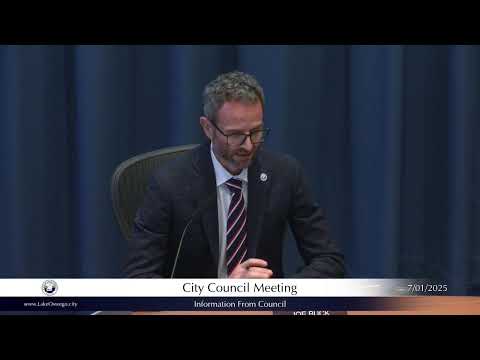
Council debate and action: Council discussion focused on whether the tree removals were deliberate attempts to avoid city review and what sanctions should follow. Councilor Corrigan called the removals “premeditated destruction of canopy” and said applicants who seek to join the city should follow local rules. Councilor Afghan said staff’s forensic review was persuasive but that the council needed to set a precedent to prevent repetition. Mayor Buck moved to apply specific conditions from Resolution 19-59 — including 3:1 mitigation, a restoration fee to the city’s tree fund, a recorded restrictive covenant to maintain mitigation for at least two years, a recorded easement for city access to maintain mitigation, and a performance bond — and the motion passed 6-0.
The third annexation, for 16284 Bon Air Avenue, was presented as meeting public service and infrastructure criteria; staff recommended approval and the council enacted that ordinance 6-0 without the additional tree-related conditions.
What the conditions require: The applied subsections of Resolution 19-59 require enhanced mitigation ratios, a restoration fee, a recorded covenant to maintain mitigation for at least two years, a recorded easement to allow city maintenance if needed, and a bond to cover restoration costs. Staff said mitigation trees would be planted to avoid conflicts with future buildings and that the city offers a county tree-certification program to help property owners document tree work in advance of annexation.
Next steps and context: Staff said two of the annexation applicants submitted retroactive county tree-certification applications after the trees had been removed. Councilors asked staff to consider whether the city should change annexation procedures to close the perceived loophole that allows removals prior to annexation. The council’s approval now allows the annexed properties to proceed under city jurisdiction subject to the recorded conditions.
Ending note: The council’s action reflects a recurring tension in Lake Oswego between preserving tree canopy and accommodating infill and redevelopment on older county lots; council members said they wanted to discourage circumvention of land‑use review while keeping the city open to new housing.