Syracuse officials weigh municipal EV chargers in garages, target state and utility grants
Loading...
Summary
City Planning and Sustainability staff briefed the DPW committee on a proposal to install municipally owned electric vehicle chargers in downtown garages, seeking state and utility funding and noting grid capacity and fleet considerations.
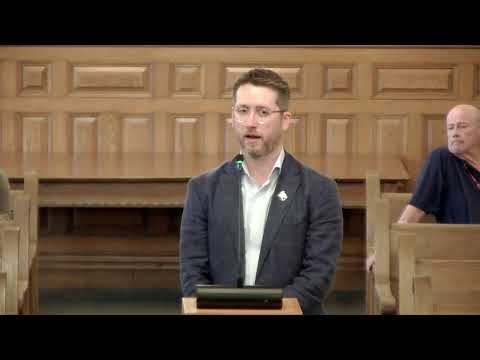
City of Syracuse Planning and Sustainability staff briefed the City Council’s Department of Public Works (DPW) committee on Oct. 26, 2025, about a proposal to install municipally owned electric vehicle (EV) chargers in several downtown parking garages and how state and utility grant programs could pay much of the cost.
The presentation summarized recent sustainability work, the city’s Climate Action Plan contract, funding programs available for charger procurement and installation, and next steps for procurement and site selection. City Sustainability Planner Karina Freeland said the city has secured a $100,000 Climate Smart Communities planning grant from the New York State Department of Environmental Conservation and matched it with $100,000 in staff time to contract CNS companies for a greenhouse gas inventory and climate action plan.
The briefing framed municipal EV chargers as an amenity for garage customers, a modest potential revenue source and a component of the city’s broader climate goals. “This is an amenity, simply put, for our garage customers,” said Owen Kearney of City Planning and Sustainability, adding that chargers could also provide “a potential revenue source, even if it is modest.”
Staff outlined three primary funding streams they plan to pursue: NYSERDA’s Charge Ready program (roughly $4,000 per charger in some offers), National Grid’s Make-Ready program (up to 90 percent support in qualifying public-disadvantaged-community locations), and New York State ZEV/DEC grants (block grants that can cover large shares where the city meets income criteria). Freeland said the city could apply for a facility block grant — for example, up to $250,000 for a single garage — and then issue an RFP to an approved contractor to implement and maintain the equipment.
A preliminary implementation concept in the briefing proposed about 16 chargers distributed across three garages: eight at the Washington Street garage, four at Madison-Irving, and four at the Fayette Street garage. Staff emphasized those numbers are configurable and would be revised after technical assessments and coordination with the city’s parking management team.
Officials discussed likely costs and responsibilities. Freeland and other staff estimated charger hardware procurement could be low (the presentation referenced a per-unit hardware cost in the low hundreds of dollars for some procurement lines), while site work, networking and panel upgrades would typically run about $4,000–$7,000 per charger. Some grant programs include limited initial maintenance funding (commonly 3–5 years), but long-term operations and administration will require staff time and possible vendor contracts.
Grid capacity and site suitability were flagged as gating factors. Freeland said National Grid has been consulted and the city would only install chargers at locations with adequate transformer capacity. “We would make sure that we’re bringing these online where there’s adequate power,” she said. Staff noted some parks and surface lots lack the capacity now and that increasing capacity in those locations would be a National Grid effort rather than a municipal one.
Fleet electrification and sequencing also shaped the discussion. Staff said a Central Regional Planning Agency fleet study recommended beginning with administrative vehicles that park in garages, rather than heavy-duty pickups used for plowing, because many current fleet pickup trucks require horsepower and 24/7 availability that electric models may not yet reliably provide for winter operations. Freeland said the city currently has no electric vehicles in the fleet.
Committee members raised procurement and ownership questions. Staff warned that some grant terms can require the city to retain ownership of improvements for a period (discussed as about five years) or repay incentives if ownership changes sooner. Connor Maltune, chief operating officer, said the likely removal of large numbers of surface parking spaces when the I‑81 viaduct is removed will increase long-term value for downtown garages and argued that the city should consider that context when weighing short-term payback windows. “The removal of a thousand surface spaces likely makes our parking garages much more valuable in the future,” Maltune said.
Next steps the committee discussed included pursuing the state and utility grant opportunities, commissioning deeper parking and technical studies tied to the city’s broader parking assessment, and preparing procurement specifications that could include multi‑year maintenance. Council members and staff agreed to a follow-up meeting to review technical assessments, finalize site choices and outline procurement and funding responsibilities.
Votes or formal actions were not taken at the meeting; staff presented the proposal for committee discussion and follow-up direction.