Get Full Government Meeting Transcripts, Videos, & Alerts Forever!
Get email alerts on the Municipal Signs topic
No spam. Unsubscribe anytime.
Council adopts changes to sign code to allow limited weekend parkway signs, citing Supreme Court precedent
Summary
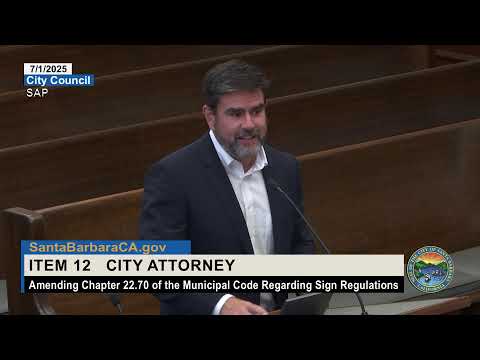
The City Council introduced and adopted amendments to Chapter 22.70 of the Santa Barbara Municipal Code on July 1, establishing a constitutionally framed approach to temporary signs in the public right‑of‑way, restricting signs in the El Pueblo Viejo landmark district, and directing staff to develop administrative procedures for implementation.
The Santa Barbara City Council on July 1 voted 6‑1 to adopt amendments to chapter 22.70 of the municipal code that revise the city’s sign regulations to make temporary‑sign enforcement constitutionally defensible and to establish limited allowances for off‑premise temporary signs in parkway areas on weekend periods.
City staff presented the ordinance changes as a response to U.S. Supreme Court guidance on content‑based regulation of signs and years of complaints about signs placed in public rights‑of‑way. John Duemos, identified in the meeting as a city staff presenter, told council the goal was “to have a constitutionally sound ordinance that’s enforceable,” citing the need to avoid content‑based rules after the court decision referenced in staff’s presentation.
What the ordinance does: The amendments permit temporary off‑premise portable signs in parkway areas (not blocking sidewalks or vehicle lanes) for a limited weekend window — described in staff presentation as a 42‑hour period from 6 a.m. Saturday to 11:59 p.m. Sunday — with size and placement limits (staff said signs must be freestanding, limited to 42 inches above ground and within an area no greater than six square feet, and not attached to utility poles). The ordinance allows immediate removal of signs that violate the new rules and requires the city to store removed signs for 90 days. The downtown El Pueblo Viejo landmark district is excluded from the parkway allowance for safety and pedestrian‑volume reasons.
City staff emphasized that the changes are narrowly targeted to address legal vulnerability in the prior code and that future administrative steps — such as a streamlined review process, wayfinding and directional sign programs for events, and potential design standards — would follow implementation of the ordinance.
Council debate and outcome: Councilmember Jordan, who moved the staff recommendation, framed the adoption as the first step in a longer process to address event wayfinding and downtown signage. Councilmember Gutierrez cast the lone vote against the ordinance, saying the rules could make it harder for local businesses during a fragile economic period. The roll‑call vote was: Sneddon — yes; Friedman (Mayor Pro Tem) — yes; Gutierrez — no; Jordan — yes; Harmon — yes; Santa Maria — yes; Mayor Ross — aye. The motion passed 6‑1.
Key points from staff presentation and Q&A: Staff cited Reed v. Town of Gilbert (Supreme Court case referenced in the presentation) as the legal driver requiring content‑neutral sign regulation. Duemos said the city’s prior ordinance effectively prohibited all temporary off‑premise signs but had been unenforceable because it treated similar signs differently (for example, allowing real‑estate signs). Councilmembers asked for clarification about what counts as a “parkway” (staff said it need not be grass and that the test is whether the sign blocks ingress, egress or ADA access), and whether event or government safety signage would be allowed (staff said government speech and safety signage would not be restricted).
Votes at a glance (formal actions recorded on July 1): - Consent calendar (items 3–5; item 6 removed for separate vote): Motion to approve the consent calendar except item 6. Mover: Mayor Pro Tem Friedman; Second: Councilmember Gutierrez. Roll call: Harmon — yes; Santa Maria — yes; Sneddon — yes; Friedman — yes; Gutierrez — yes; Jordan — yes; Mayor Ross — aye. Outcome: approved. - Item 6 (authorize amendment to legal services agreement with Jarvis Fay LLP; appropriate $50,000 from general fund reserves): Motion by Councilmember Jordan; Second: Councilmember Gutierrez. Roll call: Santa Maria — yes; Sneddon — yes; Mayor Pro Tem Friedman — stepped out/recused; Gutierrez — yes; Jordan — yes; Harmon — yes; Mayor Ross — aye. Outcome: approved (all present; Mayor Pro Tem Friedman recused). - Item 12 (amend chapter 22.70, sign regulations): Motion by Councilmember Jordan; Second: Councilmember Sneddon. Roll call: Sneddon — yes; Friedman — yes; Gutierrez — no; Jordan — yes; Harmon — yes; Santa Maria — yes; Mayor Ross — aye. Outcome: approved, 6‑1.
Next steps and implementation: Staff told council they will develop administrative procedures for enforcement and appeals (appeals to be heard by the full sign committee), create an inventory of enforcement processes and consider wayfinding templates and a streamlined permitting path for sanctioned directional signage. Councilmembers asked staff to return with implementation details and with approaches for event signage and downtown wayfinding that avoid content‑based review.
Context and caveats: Staff said the changes are focused on creating an enforceable, content‑neutral framework rather than remaking sign aesthetics; future design standards or downtownwayfinding programs would be pursued separately. The ordinance also retains prohibitions on signs that are obscene, incite violence or promote illegal activity (the presentation referenced existing penal‑code standards for obscene matter).