Get Full Government Meeting Transcripts, Videos, & Alerts Forever!
Get email alerts on the Criminal Justice topic
No spam. Unsubscribe anytime.
Monterey County approves $1.425 million payment to state for IST growth-cap penalty; supervisors vow to seek fixes
Summary
The Board approved a $1,425,000 appropriation to pay a state penalty tied to an IST (incompetent to stand trial) "growth cap" after officials said the county exceeded a legislatively set baseline; supervisors pressed for legislative and interagency remedies.
The Monterey County Board of Supervisors voted to amend the 2024–25 budget and approve a $1,425,000 payment to the California Department of State Hospitals on July 1, 2025, to satisfy a growth-cap penalty tied to the county's number of people found incompetent to stand trial (IST).
The funding will be taken from the county's general-fund contingency and is required by a state program enacted in 2022. County officials said the payment is owed for fiscal-year 2023—24 commitments that exceeded a statutory baseline.
Why it matters: Supervisors and county staff said the state penalty shifts significant new costs to counties for decisions made in the courts and raised concerns that the rule creates an incentive problem and an unfunded mandate. Supervisors asked county staff to pursue legislative and intergovernmental remedies and to report back on options for reducing future exposure.
What the directors and staff said: CAO Dela Rosa summarized the program and the invoice, saying Senate Bill 184 (chapter 47, Statutes of 2022) established a growth-cap program intended to limit incentives to commit people as IST. The CAO told the board that the county received notice in May that 84 commitments in fiscal year 2023—24 exceeded the baseline and generated the penalty that must be remitted by August 7, 2025. The CAO said the state will place the monies in a Mental Health Diversion Fund and will allow counties to recoup the funds after filing an approved expenditure plan that fits state parameters.
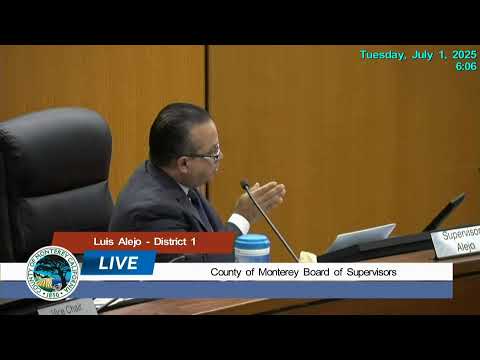
Supervisors pressed for policy responses. Supervisor Alejo and others said the policy is unfair because counties have no role in court determinations of competency and because the baseline was fixed to a prior year; they asked staff to seek legislative remedies, to pursue challenge processes via associations of counties, and to ask the state to clarify or waive penalties and interest. Sheriff's Office representatives and health department staff said they would participate in a multi-agency work group to analyze the IST cases and look for upstream diversion opportunities, such as pre- and post-booking mental-health diversion and reentry supports.
Board action: The Board approved the budget amendment and payment (vote recorded as 5-0). Supervisors directed staff to pursue state-level relief and to return updates on the work group's plans and potential policy proposals.
What happens next: County staff said the state will require an expenditure plan for how the returned funds will be used; the board asked staff to bring the plan ideas and legislative strategies back for the board's review.
Ending: Supervisors voiced shared frustration with the state rule but said they would use intergovernmental channels and the newly formed county work group to pursue changes while county staff prepare the required state paperwork and local proposals for diversion and reentry work.