Get Full Government Meeting Transcripts, Videos, & Alerts Forever!
Get email alerts on the Road Safety Intersection topic
No spam. Unsubscribe anytime.
Waukesha committee backs short-term visibility fixes and asks staff to add median option to CIP for Sunset Drive–Guthrie intersection
Summary
After public comment and traffic-analysis review, the Building and Grounds committee voted to add short-term visibility measures at the Sunset Drive and Guthrie Road intersection and to direct staff to pursue a median design for inclusion in the capital improvements program.
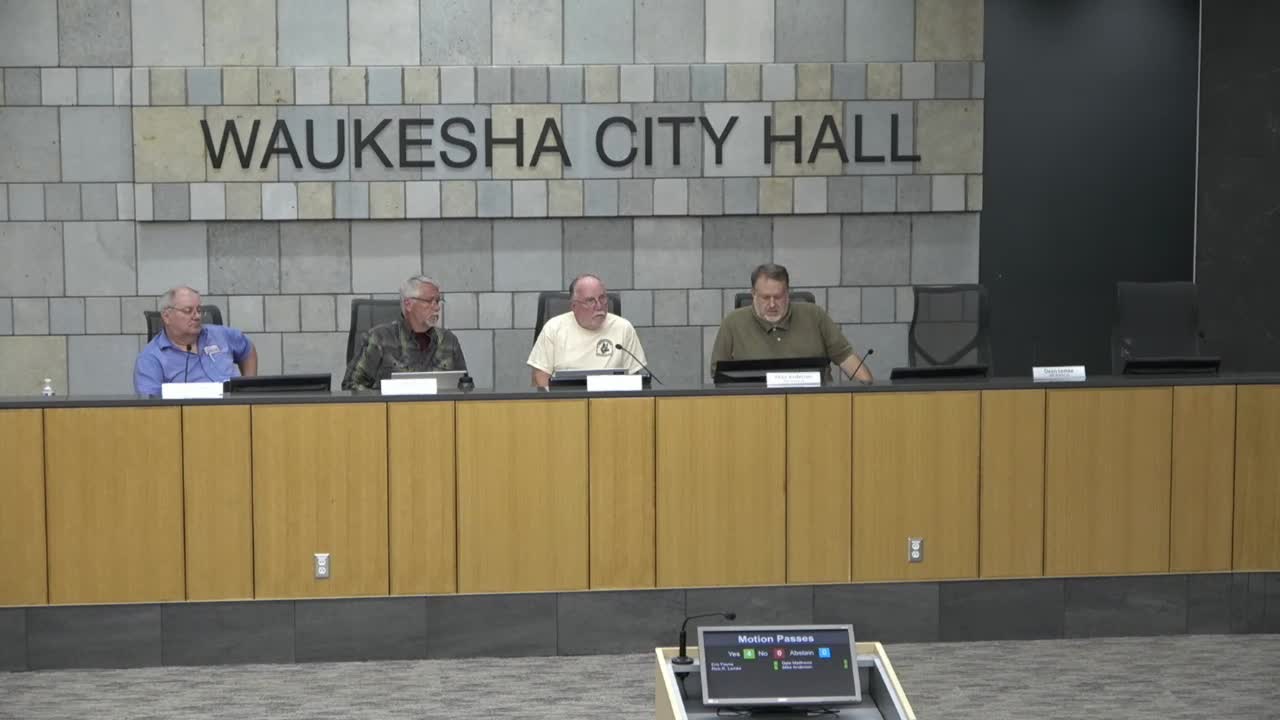
The Waukesha City Building and Grounds committee voted June 30 to direct staff to implement short-term visibility measures at the intersection of Sunset Drive and Guthrie Road and to include a median design option for the intersection in next year’s capital improvements program.
Committee members approved a motion to flag stop signs, install a more robust temporary center stop sign, and ask staff to add the median option into the FY2026 CIP. The motion passed on a voice vote with four ayes and no recorded dissents.
The action followed a staff presentation of short- and long-term alternatives prepared with Ayers Associates traffic consultants. Craig (city staff) and Andy Raul, a traffic engineer with Ayers Associates, reviewed options that range from low-cost, short-term measures — flashing stop signs, speed-feedback signs, restriping and pavement markings, and larger temporary center stop signs — to longer-term changes including medians, a compact roundabout and full signalization.
"We have short-term options that could potentially be done this year," Craig said, including flashing stop signs for the east–west approaches, additional pavement marking and a speed-feedback sign targeted at eastbound drivers. Raul said a compact single-lane roundabout could fit the intersection but would cost substantially more than adding medians.
The consultant’s cost estimates presented to the committee put the median option at about $220,000. Raul estimated a roundabout would be between $500,000 and $1 million. Signal-only equipment, not counting roadway work, was estimated in the $200,000–$250,000 range. A staff “do everything” short-term package shown to the committee came to roughly $53,000.
Public commenters urged the city to pursue a permanent solution. Julie Griffey, a nearby resident, said the intersection “is really hard to look at and think, how do we make this safe?” Angie Beck, who identified herself as a City of Muskego police officer and a resident at the intersection, told the committee she had captured multiple videos of drivers running the stop signs and described the combination of an overly wide roadway and heavy traffic as inviting higher speeds. "When we put a roundabout in elsewhere we have had fewer high-speed, severe crashes," Beck said.
Alderman Paul Wetesca (District 9) told the committee he supports including the median option in the FY2026 CIP. "Someone has died, right? So I think it's important we put something in," he said. Alderman Payne suggested the city should consider restructuring the four‑lane section east of the intersection to reduce lane width and calm traffic.
Committee members debated interim measures. Several members, including Alder Rick Lemke and other committee participants, recommended adding orange flags to stop signs and improving the temporary center stop sign so it would not topple but noted winter snow removal and plow clearance must be considered. Craig said the city garage has placed smaller temporary stop signs on portable bases and that staff could explore heavier weighted bases or other short-term bases that withstand weather and plowing.
Andy Raul also reviewed signal warrants with the committee and reported the study’s traffic counts did not meet the standard volume warrants for a traffic signal. He said crash-based signal warrant (often called warrant 7) also was not clearly met and cautioned that adding a signal can change crash types (for example, introducing red-light running). The consultant reiterated that a roundabout would likely reduce crash severity by lowering speeds and eliminating right-angle conflict points.
The committee’s motion combined an immediate direction for staff to implement improved temporary measures — flagged stop signs and a more durable center stop sign — with a direction to pursue the median option as an addition to next year’s CIP. Staff said a budget amendment would be required to accelerate work into the current fiscal year; absent such an amendment the short-term measures could be procured more quickly than the larger capital project.
The item included clarifications about scope and costs: the median option estimate includes medians, pavement marking, flashing signs, ADA pedestrian ramp upgrades and a mill-and-overlay of the intersection. The roundabout estimate assumed larger geometric and utility work. Raul said pedestrian safety in a single-lane roundabout can be reasonable because pedestrians cross one direction of traffic at a time; multi-lane roundabouts present greater pedestrian challenges.
The committee approved the motion and closed public comment on the item. Members and staff also said they would ask police to increase enforcement in the short term while engineering remedies and CIP planning proceed.
The committee’s next steps: staff will pursue short-term visibility improvements through the city garage and Public Works, and prepare the median option for inclusion in the FY2026 CIP process. The committee did not set an exact construction date for any long-term project.