Get Full Government Meeting Transcripts, Videos, & Alerts Forever!
Get email alerts on the Enrollment And Student Success topic
No spam. Unsubscribe anytime.
UT System report: Knoxville enrollment and retention rose sharply; other campuses show mixed gains
Summary
System analysts presented campus-by-campus comparisons against peers, highlighting large enrollment and retention gains at UT Knoxville and UT Martin, steady or improving outcomes at UTC and UT Southern, and enrollment pressures at UT Health Science Center driven by pharmacy trends.
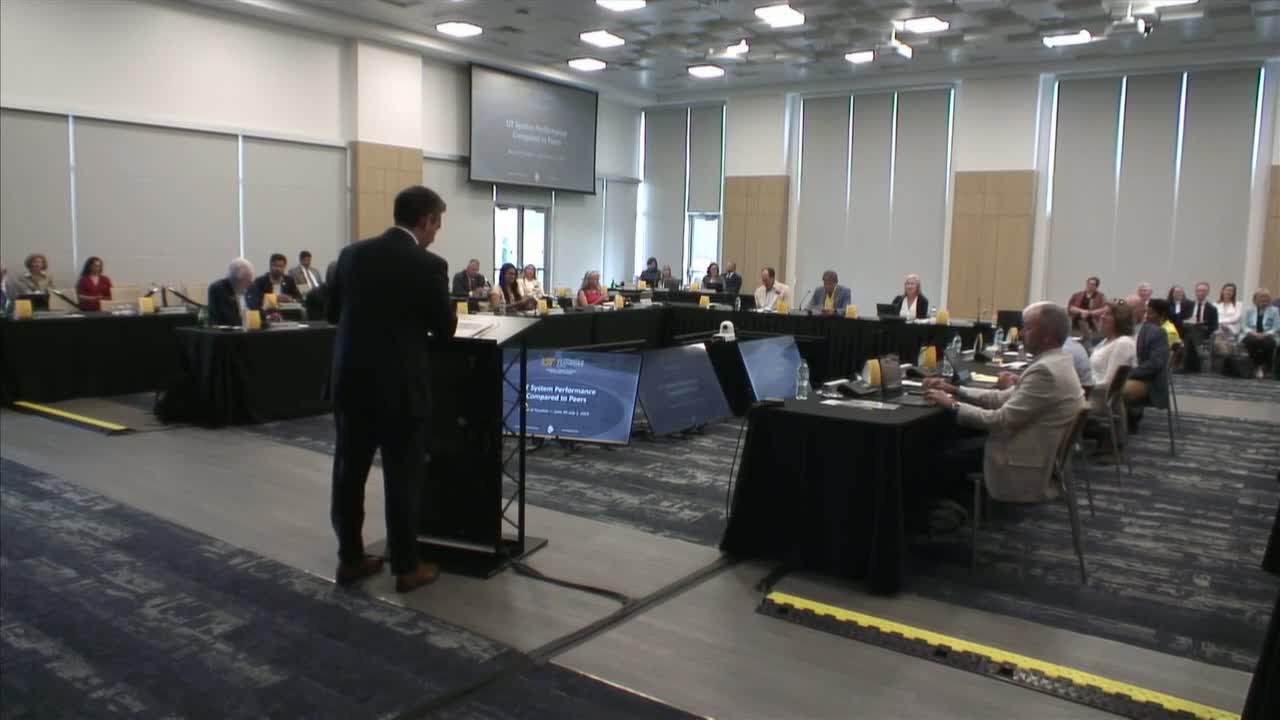
System analysts told the Education Research and Service Committee on May 31 that individual University of Tennessee campuses are showing different enrollment and student-success trajectories compared with peer sets.
"What I love that we're doing for the Knoxville campus and all of our campuses is putting it in context," said Dr. Bernie Sevaris as he reviewed five-year trends and peer comparisons. He said UT Knoxville's total enrollment over five years has risen 23.2% (31.5% if 2024 is counted in an alternate callout) and that the campus achieved a record first-year retention of 91.9% in fall 2024.
Highlights by campus: Sevaris put the Knoxville campus first in his review and said the campus had outpaced comparable, aspirational and SEC peers in enrollment growth, citing admit/yield shifts and strong retention. "Our UT Knoxville campus over the past 5 years' total enrollment is up 23.2%... If you counted the 2024 enrollment there... we'd be up 31.5%," he said.
UTC (Chattanooga): The presentation noted a slight five-year enrollment decline for UTC (about -1.8%) but called recent 2024 increases and graduate enrollment up 3.5% ‘‘bright spots.’' UTC reported a record 4-year graduation rate in 2024 (37.8%) and a 6-year rate above 50% for 2023; Chancellor Dooley said the campus is finalizing a strategic plan with an 80% retention goal for the 2030 horizon.
UT Southern: Sevaris said UT Southern bucked peer trends with an 8.2% increase over the review period (and 15.7% including 2024) and recent record first-year retention (77.2% in 2024). He noted the campus joined the UT system recently and that earlier cohort graduation data reflect the institution’s prior status.
UT Martin: Sevaris credited UT Martin with recovering strongly after COVID and achieving record enrollment in 2024; the campus posted a 77% first-year retention in 2024 and a 6-year graduation rate of about 54.6% for the 2017 cohort. Chancellor Freeman, presenting the Martin plan later, emphasized a system goal of reaching 10,000 students by 2030 for that campus.
UT Health Science Center (Memphis): Sevaris reported a modest enrollment decline for UTHSC driven largely by national trends in pharmacy-school enrollments; he said that absent pharmacy the health center’s other colleges are growing. Chancellor Buckley discussed expanding clinical placements and graduate medical education as part of a multi-part strategy to increase the pipeline of physicians and specialists.
Trustee questions and next steps: Trustees asked for additional metrics and dashboards (persistence by year, college-level retention/graduation, workforce alignment) and for more frequent reporting of campus-level KPIs tied to each campus’s strategic enrollment or student-success targets. Several trustees urged linking the performance review to workforce needs (engineering, health professionals) and asked for breakdowns by college and program where possible.
Ending: Sevaris and trustees agreed to produce more granular KPIs (college-level retention and graduation targets) and to incorporate campus goals into the system reporting dashboard for trustees to monitor progress.