Get Full Government Meeting Transcripts, Videos, & Alerts Forever!
Get email alerts on the Housing Kitchenettes topic
No spam. Unsubscribe anytime.
Council narrows kitchenette and wet-bar rules for residential districts; removes refrigerator size cap
Summary
The council amended and approved Bill 104, which allows kitchenettes in dwelling units under limited conditions, requires long-term occupancy, prohibits gas appliances in kitchenettes, reduces allowed wet bars from two to one, and removes a proposed refrigerator-size restriction.
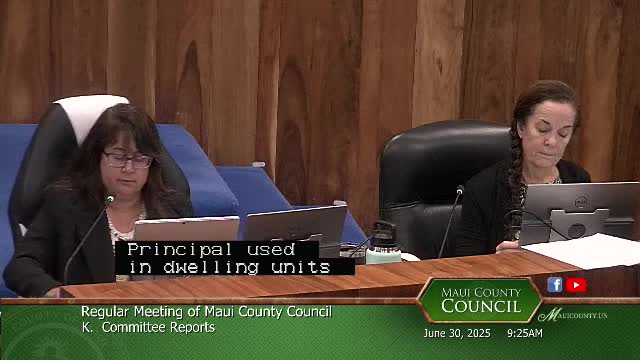
The Maui County Council on June 30 approved, as amended, Bill 104 (CD1, FD1) to change rules for kitchenettes and wet bars in residential and rural zoning districts on Maui and Lanai.
The measure — advanced by the Disaster Recovery, International Affairs and Planning Committee — requires that a dwelling unit containing a kitchenette be occupied on a long-term residential basis and be internally accessible from an enclosed living area. The council also barred gas appliances in kitchenettes and prohibited kitchenettes in accessory dwelling units. The ordinance reduces the allowable number of kitchenettes and wet bars in applicable zoning districts from two to one each.
Council Member Paulton, who moved the amendment on the floor, said the committee sought to address safety concerns and to accommodate multigenerational families in West Maui and expanded provisions for Lanai. During floor debate, members considered and then removed a proposed refrigerator-size requirement; the body voted to eliminate the size cap and leave appliance sizing to building code and inspection processes. The final language instead relies on the county’s existing ‘‘long-term residential’’ standard in chapter 19 (occupancy of 100 or more days) to demonstrate residency.
Deputy Corporation Counsel Rowe advised that residency proof could be demonstrated through a long-term lease or a homeowner’s exemption record, and that the requirement for documentation could be verified during the permitting process. Council members asked staff to identify which department would process and review such documentation; Rowe indicated the demonstration would be requested as part of permit review and suggested the homeowner’s exemption is a useful verification method.
The council voted to adopt the FD1 substitute and amendments and passed the main motion as amended, recorded as 9 ayes, 0 noes. Members said they would return to clarify implementation (permitting vs. certificate-of-occupancy timing) before second reading where administrative rules can be refined.
Supporters framed the change as balancing housing flexibility for multigenerational households with health and safety protections and clarified that accessory dwelling units are not eligible for kitchenettes under the new rules.