Get Full Government Meeting Transcripts, Videos, & Alerts Forever!
Get email alerts on the Transportation Highway22 topic
No spam. Unsubscribe anytime.
Teton County tells WYDOT pre-NEPA letter should include EIS, alternatives and area-specific studies
Summary
At a June 30 meeting the Teton County Board of Commissioners reviewed a draft pre‑NEPA comment letter to the Wyoming Department of Transportation on improvements to Highway 22, signaled support for a full Environmental Impact Statement, and directed staff to expand alternatives analysis and coordinate a workshop with WYDOT and local stakeholders.
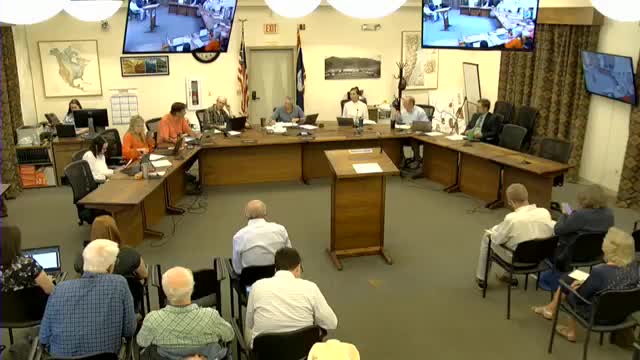
The Teton County Board of County Commissioners on June 30 reviewed a draft pre‑NEPA comment letter to the Wyoming Department of Transportation on proposed corridor work to Highway 22 and signaled that the county wants a full Environmental Impact Statement, a broader range of alternatives and more targeted studies before WYDOT moves into the formal NEPA stage.
County engineer Amy Ramage told commissioners the project is currently in a “pre‑NEPA” phase; WYDOT has said it expects to start NEPA this summer and that NEPA itself would likely run about a year, but the agency has not yet confirmed whether the federal process will be an environmental assessment (EA) or a full environmental impact statement (EIS). Ramage said the letter asks WYDOT to clarify that class‑of‑action decision and to coordinate further technical work with county staff.
The county heard more than a dozen public comments focused on safety, wetlands, wildlife crossings and alternatives to widening. Patrick Dominic, a full‑time valley resident, urged caution: “wait until the bridge construction has been fully absorbed before asserting that a problem even exists that requires this mammoth response,” and called for “minimally invasive traffic control improvements” before wide corridor changes.
Representatives of Teton Science Schools and Indian Springs Ranch emphasized safety at the Coyote Canyon/Indian Springs intersection. Wayne Turner, executive director of Teton Science Schools, said the intersection “is a very dangerous intersection … sometimes your life into your own hands” when trying to turn left onto Highway 22. Rich Bloom, board treasurer for Teton Science Schools, asked the county to press WYDOT to analyze recent fen/wetland studies by Biota and to consider grade‑separated intersection designs or roundabouts that some engineers previously proposed.
Commenters repeatedly urged the commission to request an EIS rather than an EA. Jeff Gottlieb of the Responsible Growth Coalition said, “I encourage you to push for an EIS,” arguing that the corridor’s ecological and community impacts merit the more thorough federal review. Multiple conservation groups and residents said an EIS would better evaluate wetlands, wildlife permeability, and alternatives that avoid large‑scale widening.
Commissioners discussed specific edits to the draft letter. They asked staff to add language urging WYDOT to (1) select an EIS as the NEPA class‑of‑action, (2) include an incremental or intersection‑focused alternative that does not widen the entire corridor, (3) analyze conservation easements and the amount of right‑of‑way that would be needed corridor‑wide (not just at Walton Ranch), and (4) meet with Indian Springs Ranch, Teton Science Schools and other local stakeholders to review intersection alternatives such as grade separation or a roundabout. The board also agreed to request a county workshop with WYDOT staff; commissioners suggested scheduling that workshop in late summer or early fall and asked staff to include a date trigger in the outgoing letter.
Ramage said WYDOT’s pre‑NEPA comment period is open and that public comments submitted now will feed into the formal NEPA phase. Several speakers raised technical issues the board asked staff to emphasize to WYDOT: detailed wetland and subsurface hydrology studies for fen habitat, explicit evaluation of a no‑build/no‑access alternative for Indian Springs Drive, and clear commitments for wildlife crossings and funding assurances for those crossings.
Next steps: commissioners asked staff to revise the draft letter to incorporate the requested changes and to present a final version for adoption the following day. They also asked staff to pursue scheduling a joint workshop with WYDOT and local stakeholders prior to the next NEPA milestone.