Get Full Government Meeting Transcripts, Videos, & Alerts Forever!
Get email alerts on the Downtown Main Street Funding topic
No spam. Unsubscribe anytime.
Main Street Grants Pass asks city for startup funding, seeks $80,000 first year
Summary
Main Street Grants Pass requested city startup funding to staff and run downtown programming, proposing $80,000 in year one, rising to $100,000 by year three. Councilors pressed for details on use of public funds, membership-based benefits, and examples from other cities and directed staff to return with more information.
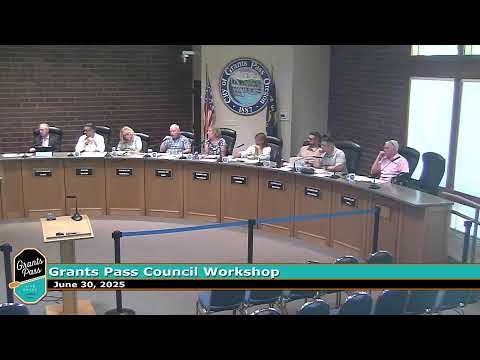
Main Street Grants Pass asked the Grants Pass City Council at a workshop to provide startup funding for a newly formed downtown nonprofit, proposing $80,000 in the first year, $90,000 in year two and $100,000 in year three to hire staff and run events and programs.
The request came during an informational presentation to the council in which Main Street leaders described recent wins — including a secured $400,000 rehabilitation grant for the historic King Jewelers building and an application for a $50,000 T‑Mobile beautification grant — and outlined a public‑private model they say will operate on a net‑zero revenue basis.
Supporters said the nonprofit will promote downtown businesses, coordinate events such as First Friday and the Downtown Cruise (formerly Back to the '50s), and run beautification projects including sidewalk pressure‑washing on G and H streets between Fourth and Seventh. Main Street representatives said much of the requested funding would cover staffing, outreach and coordination, with some contract services and programming costs.
"This is not a blank check," Michael, a representative of Main Street Grants Pass, told the council. He said the group plans to pair city funds with grants, fundraising and membership revenue to sustain operations.
Councilors asked for specifics before committing public money. Several raised legal and equity questions about whether city funds could flow to programs that require membership to receive benefits, and whether downtown property owners who are not members could be excluded from services funded in whole or in part with public dollars. Councilor Joel pressed for a clear breakdown of how much of the taxpayer contribution would pay salaries and operations versus programs and events.
Council members also sought more detail on Main Street's capacity and readiness. Presenters said the group is currently volunteer run with about 12 members (membership drive began June 5) and hopes to hire an executive director and an assistant if funding allows; Main Street estimated executive director salaries in the $50,000–$70,000 range based on comparable organizations. The steering committee became a formal Main Street steering committee in August 2023 and held a public roadmap presentation in January 2024.
Local business owners who spoke in favor of the effort said a focused downtown organization could increase foot traffic and help preserve the area's character. "If we lose the economic heartbeat of downtown, we don't get it back," said John (business owner), who described downtown as the city's economic engine.
City staff clarified existing public support for downtown events: the city currently budgets roughly $50,000 a year for three events (about $25,000 for Art Along the Rogue, $10,000 for the tree lighting and $15,000 for Fourth of July activities). Staff also noted that, under municipal code, sidewalk maintenance is the responsibility of adjacent property owners; past city power‑washing efforts were done years ago and would require renewed planning.
After questioning, the council did not vote on funding. Instead, members reached a consensus to direct city staff to gather additional information and return to a future workshop. Staff was asked to clarify whether Main Street could legally exclude nonmembers from benefits when city or urban‑renewal funds are involved, to provide specific examples of measurable results from comparable Main Street programs in other cities, to detail the amount of public funding that would be needed for events if they were transferred to Main Street, and to supply other budget and staffing specifics.
Councilors who spoke in favor said they would consider a one‑year pilot but emphasized they needed the follow‑up materials — including historic examples and precise cost figures — before approving public dollars.
The council's request for follow‑up information means any decision on the funding request will be postponed pending staff's report and a return workshop.