Get Full Government Meeting Transcripts, Videos, & Alerts Forever!
Get email alerts on the Defense Readiness topic
No spam. Unsubscribe anytime.
Virgin Islands National Guard asks Legislature to approve $3.24 million local match as TAD pay, hangar loss and pension problems loom
Summary
Major General Kojo Knox Limbacher told senators the Virgin Islands National Guard needs a $3,243,939 local appropriation for FY2026 to secure federal funding and to avoid gaps that leave service members unpaid, and warned that the Guard will lose its Blair hangar lease in 2027.
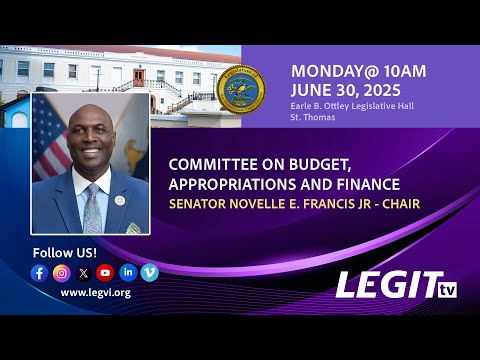
Major General Kojo Knox Limbacher told the Senate Committee on Budget, Appropriations and Finance on June 30 that the Office of the Adjutant General (OTAG) seeks a $3,243,939 territorial appropriation for FY2026 to sustain the Virgin Islands Army and Air National Guard.
The request covers the territory's share of the federal Master Cooperative Agreement (MCA) and local costs the Guard must cover to receive roughly $46,956,770 in projected federal support. Limbacher and other Guard leaders emphasized an operational environment in which readiness, federal deployments, and local emergency response intersect.
Why it mattered: OTAG officials said the local appropriation enables the territory to meet mandatory cost-shares for facility maintenance and operations that the federal government will reimburse only after the territory posts its matching share. The Adjutant General warned that without the local match the territory will forfeit federal reimbursements.
Limbacher described widespread Guard activity—deployments to Qatar, East Africa and support missions across the region—and outlined personnel levels: about 102 Army and 19 Air full‑time employees plus a federally funded civilian technician workforce. He told senators the Guard has had recent success increasing readiness but is constrained by local cash-flow and matching requirements.
"If we cannot pay TAD on time, we should not call them to duty," Limbacher said, using the committee's shorthand for Territory Active Duty (TAD) pay for Guardsmen called to support civil authorities. He told senators late pay for TAD has discouraged service members from volunteering for short, non‑emergency duties such as carnival security, and urged a legislative solution.
The Guard proposed a dedicated internal service fund—what Limbacher described as a VI DISCA (Virgin Islands Defense Support to Civil Authorities) internal service fund—to advance payments for TAD and wait for reimbursements from requesting agencies. "I recommend future legislation and allocation of funding for [a] restricted internal service fund to finance TAD pay for VING service members," he said, adding that reimbursements from requesting agencies have historically taken "2 to 8 months." Senators on the committee described multiple options: drafting a bill, creating a new line item in the executive budget, or using a small initial appropriated amount to seed a fund for recurring events.
Other highlights from OTAG's hearing
- Loss of aviation assets and hangar lease: Limbacher confirmed the Guard no longer has Lakota UH‑72 helicopters assigned; earlier aircraft and structure transfers put the unit in another state. He warned the Port Authority's airport expansion will terminate the Guard's Blair hangar lease in 2027. "That hangar will no longer belong to the Virgin Islands National Guard," Limbacher said. He and senators discussed contingency plans and potential P3 (public‑private partnership) lease arrangements for future military use.
- Master Cooperative Agreement/local match: The Guard's Master Cooperative Agreement program (federal) requires territorial percentage matches for certain facility and maintenance programs (e.g., 25% local for Saint Croix armory projects). OTAG said the territory must commit $396,000 in local FY2026 funds to unlock the federal share.
- Pension/disbursement issues: OTAG testified about a local National Guard pension stipend under Title 23 and said pension payments are currently paid retroactively because of the timing of allotment releases. Senators raised concerns about retirees waiting for monthly stipends; Limbacher recommended addressing the statutory funding language and the timing of allotment releases so retirees receive timely payments.
- Reimbursements and outstanding balances: Colonel Deborah Lobban Meyer, the United States Property and Fiscal Officer (USPFO), described the MCA as a reimbursable program rather than a federal drawdown. She said the territory had $1,167,550 submitted for federal reimbursement and that a single fiscal year 2024 matching shortfall of $185,000 remained outstanding. Meyer said federal operations (personnel, most operations) are largely funded and increase slightly for FY2026.
- Youth and community programs: Limbacher and OTAG staff described youth outreach programs (Youth About Face and Forward March), STEM partnerships, and counter‑drug and WMD civil support team activity. The testimony highlighted both community benefits and continuing costs the territory supports locally.
The committee did not take a vote during the hearing. OTAG officials said they will provide follow‑up materials requested by senators, including exact outstanding vendor and allotment numbers. Limbacher and Colonel Lobban Meyer asked the committee to advance the FY2026 local appropriation to preserve the territory's ability to receive and execute the federal MCA funds.
Ending
OTAG framed the FY2026 request as a modest local investment to secure tens of millions in federal benefits and to prevent operational gaps that affect pay and readiness. Major General Limbacher told the committee: "This body's approval will enable our efforts to increase operational readiness with realistic ends, ethical, legal, and moral ways." Senators pressed several follow‑ups, particularly on the TAD payment timing and the hangar situation; OTAG agreed to provide the requested financial detail and vendor lists to the committee.