Get Full Government Meeting Transcripts, Videos, & Alerts Forever!
Get email alerts on the Events topic
No spam. Unsubscribe anytime.
Santa Clara committee maps community-led events, sponsorship push for 2026 Super Bowl, World Cup and U.S. 250th
Summary
At a June 23 workshop, Santa Clara's Economic Development and Marketing ad hoc committee and community stakeholders mapped event ideas, flagged funding and public-safety constraints and asked staff to analyze outcomes ahead of finalizing a 2026 event calendar and sponsorship plan.
Mayor Lisa Gilmore opened the June 23 Economic Development and Marketing ad hoc committee workshop at the Santa Clara Library, saying the group should be community-driven: "We want this to be your committee. This is your committee," she said.
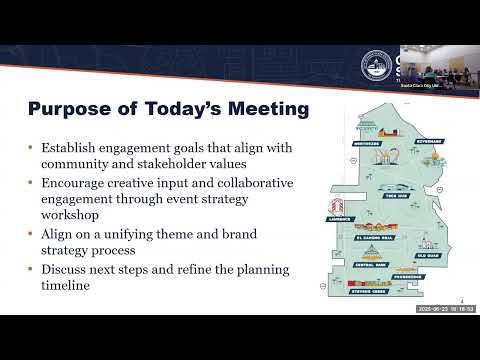
City staff and a cross-sector stakeholder group used a mapping exercise and small-group reports to develop candidate events and locations tied to three major moments in 2026: the Super Bowl (February), six FIFA World Cup matches and the nation's 250th anniversary on July 4. Staff said the workshop is an early-stage step in a timeline that will lead to a proposed unified theme, an events list and budget/sponsorship planning to be returned to the committee for a vote.
The committee emphasized equity, local ownership and partnership with businesses as central goals. Elliot, a Harvard-Bloomberg fellow working with the city, described the engagement goals as "advancing equity," building relationships, generating knowledge and "mobilizing resources" so the community and city co-own programs.
Workshop outcomes and notable ideas
- Watch parties: Multiple tables identified Youth Soccer Park and Reed and Grant Sports Park (listed in reports as Reed and Grant) as suitable locations for large public watch parties tied to game days. - Concerts and performances: Santa Clara University and Mission College were noted as proven concert venues; Great America was identified as a potential site for larger, Super Bowl-linked concerts. - Night markets and food-focused events: Mission College and Peddlers Plaza (downtown) were suggested for night markets and food crawls highlighting local Korean and Portuguese restaurants along El Camino Real. - Arts and museums: The Triton Museum of Art was proposed for art contests, outdoor exhibits (including proposals to bring large-scale works into museum parking areas) and chalk-art activations. - STEM and corporate partnerships: A table recommended pursuing a STEM program in partnership with NVIDIA and involving company employees; group members noted past success with a STEM "Innovation Bowl." One participant suggested using corporate sponsorships to underwrite events and souvenirs. - Partnerships with national organizations: A community member reported ties to the Hispanic Heritage Foundation (a partner with the NFL) and urged early outreach to secure NFL-related youth events and honoree programs during Super Bowl week. - Placemaking and beautification: Ideas included temporary street painting and murals, lighting landmarks (including Levi's Stadium and civic monuments), wrapping VTA buses and adding wayfinding and banners at city gateways to create a welcoming visitor experience. - Souvenirs and merchandise: Several participants urged the city to create Santa Clara-branded gear independent of university logos to distribute to residents and visitors.
Lessons from 2016 and budget context
Staff reviewed the city's 2016 "Super Community" year as a template and cautionary example. The City Council in 2016 adopted a $2,000,000 events budget; staff presented line items from that plan and noted how fundraising and sponsorships reduced net city costs depending on success. Items cited from the 2016 budget included tree lighting and an ice rink ($65,000), commemorative public art ($100,000), a Triton exhibit ($300,000), concerts (about $600,000), volunteer program costs (about $75,000 for merchandise, fingerprinting and background checks), a STEM Innovation Bowl ($17,000), a large university-hosted celebration ($750,000) and three fireworks events ($60,000). Staff warned that sponsorships can be difficult to secure because the city will compete regionally for corporate partners.
Operational constraints and next steps
Staff and community members flagged two practical constraints repeated during the meeting: (1) public-safety resources are likely to be stretched during major events, limiting what the city can safely program on game days; and (2) event scope should align early with city capacity, permitting and cross-department timelines. Staff asked participants to continue completing a public survey (open through June 30) and said they would analyze maps and survey results to propose a unifying theme and a refined event calendar.
Patty Wong, Santa Clara City Librarian, provided an attendance example from a prior event, saying, "10,000 people" attended a library event during the countdown to FIFA; staff said the physical countdown clock is currently housed at the library and will travel around the city.
Committee direction and meeting schedule
Although the workshop produced no formal ordinance or budget vote, staff said they would: collect and analyze the workshop maps; tabulate survey responses; develop a recommended theme and draft event calendar; and return those recommendations to the committee at a meeting planned for July 14. Committee members and some community participants urged the city to build a core sponsorship and outreach team within Economic Development to begin corporate engagement now.
Procedural note
The committee approved the consent calendar (minutes from the prior meeting) by voice vote before the workshop; the motion carried but the transcript does not record the mover/second by name or a tally.
Ending
Staff will synthesize the workshop maps and public survey, return a proposed theme and event calendar to the committee at its next meeting on July 14, and begin outreach to potential sponsors. Community members who presented ideas asked the city to prioritize photographable placemaking, corporate partnerships and visible initiatives that connect neighborhoods to downtown and the university.