Get Full Government Meeting Transcripts, Videos, & Alerts Forever!
Get email alerts on the Small Area Plan Area 11 topic
No spam. Unsubscribe anytime.
Baltimore County planners present Area 11 concept plan, seek public input on connectivity, shoreline preservation and housing
Summary
Baltimore County Planning staff and consultants presented a draft concept plan for Area 11 on Oct. 26, 2025, highlighting four recommendation areas — connectivity, open space, community and economy — and asked residents for feedback; no formal votes were taken.
Megan Oliver, Baltimore County district 6 community planner and lead for the Area 11 small area plan, presented a draft concept plan and a set of nine preliminary recommendations during a virtual public meeting on Oct. 26, 2025, and asked attendees to prioritize actions for five subareas including Essex, Bowleys Quarters, Middle River, Rossville and White Marsh.
The planning team framed the draft around four topic areas — connectivity, open space, community and the economy — and said the concept plan synthesizes community input, spatial analysis and countywide policy from Master Plan 2030. “A concept plan really seeks to synthesize all of those inputs, both comments from community members and residents, as well as the data and spatial analysis,” consultant Amber Wendland said.
Why it matters: Area 11 contains more than half of Baltimore County’s shoreline and a substantial share of the county’s remaining canopy and open space, while also hosting major transportation assets and active development sites. Director Steve Lafferty told attendees, “the importance of this plan can't be overstated because, this sector of the county is a growing area with many dynamic, communities and many dynamic leaders.” The planning team said the draft is intended to refine Master Plan 2030 actions at the neighborhood scale and to identify implementable, place-based strategies.
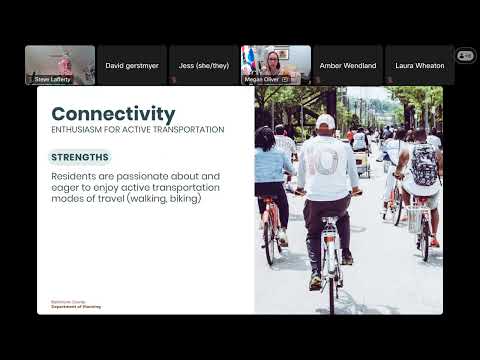
Key recommendations and evidence presented - Four topic areas. The draft prioritizes (1) bike, pedestrian and transit safety and local vehicular strategies; (2) conserving shoreline and habitat while expanding accessible recreational open space; (3) supporting healthy, affordable housing and improved community facilities; and (4) supporting existing businesses, tourism and targeted redevelopment. - Focus nodes. Staff highlighted existing and potential nodes including White Marsh (mall area), the aviation/Amtrak corridor near Martin State Airport, Pulaski Highway, and an identified Eastern Boulevard/Essex focus area. The team flagged opportunities for infill around the White Marsh Mall edge, potential clustering near an Amtrak stop, and underused parcels along Pulaski Highway and Eastern Boulevard. - Open space and natural resources. The presentation stated Area 11 contains about 772,000 linear feet of shoreline — roughly 60% of the county total — and roughly 42% tree canopy within the study area. Planners said many shoreline and park resources exist but are not well connected to neighborhoods by walking and biking infrastructure. - Connectivity. The team emphasized gaps in the pedestrian and bicycle network, disconnected segments of existing facilities, and locations where pedestrians, cyclists and freight vehicles share narrow roadway space (example cited: Eastern Boulevard). Staff noted a limited road network on the area’s peninsulas creates recurring bottlenecks. - Community needs. Presenters said the area includes long-established neighborhoods with some aging housing stock and localized vacancies. In public comments, Shannon Amen, community school facilitator at Sandalwoods in Essex, said housing instability is a pressing local issue: “housing insecurity is huge. . . at the school, we're over 60% for transiency again this year.” - Master Plan 2030 alignment. The team described how they will refine Master Plan 2030 actions for Area 11. Staff cited one example: the Master Plan call to implement the federally funded Safe Routes to School program; for Area 11 planners said they will instead prioritize specific facility connections to schools lacking safe access (they named Vincent Farm Elementary School and Oliver Beach Elementary School as examples) and expand bike connections between parks and recreation sites.
Public engagement and outreach Planners summarized prior outreach: informational interviews beginning fall 2024; a focus group series; an online survey (February–April 2025); intercept interviews and attendance at March 2025 budget town halls; and two earlier public meetings. The presentation cited 37 focus group participants, 158 online survey respondents, and 45 attendees at the first public meeting. Staff encouraged broader participation through a follow-up online survey and a shared MURAL board for input on which of the nine recommendations should be prioritized in each subarea.
Next steps and staff direction Planners said they will use feedback from the meeting and the online survey to refine recommendations and identify which Master Plan 2030 actions to reinforce or edit for Area 11. Staff emphasized implementation: the team said they intend to package recommendations into an implementable small area plan and avoid producing a plan that “collects dust on a shelf.” No formal motions or votes were taken at the meeting.
Community reaction and concerns Attendees who spoke during the meeting focused on community needs in Essex, especially affordable housing, access to parks and safe routes to schools. Planners said they would follow up with participants and community leaders and circulate the draft recommendations and the survey to residents in Districts 5, 6 and 7.
The planning team requested additional public input before finalizing a small area plan report that will identify prioritized projects and implementation tools.