Get Full Government Meeting Transcripts, Videos, & Alerts Forever!
Get email alerts on the Land Use Data Centers topic
No spam. Unsubscribe anytime.
Taylor council hears neighborhood concerns after introduction of employment‑center plan for 1601 MLK Blvd
Summary
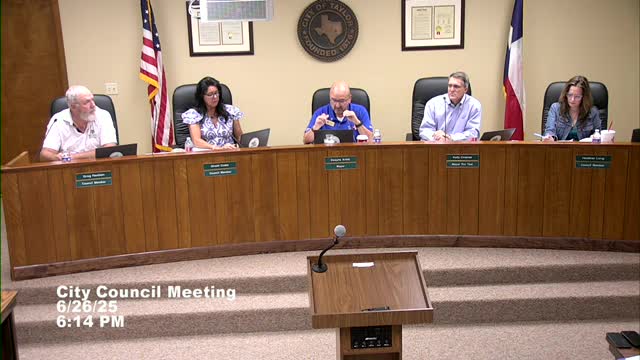
The Taylor City Council on June 26 opened a public hearing and introduced Ordinance 2025‑17, an employment‑center plan for a roughly 52.42‑acre site at 1601 Martin Luther King Jr. Boulevard proposed for data‑center development.
The Taylor City Council on June 26 opened a public hearing and introduced Ordinance 2025‑17, an employment‑center plan for a roughly 52.42‑acre site at 1601 Martin Luther King Jr. Boulevard proposed for data‑center development.
Neighbors and community members urged the council to delay final action and to hold a neighborhood meeting. Speakers raised concerns about notification of nearby residents, potential impacts on water supplies and fire response, noise and air quality, and the concentration of industrial projects in historically Black and Brown neighborhoods on Taylor’s south side.
Planning staff said the site is zoned for an employment center and that the city’s comprehensive plan marks the area for employment use; staff also noted a required design warrant for an eight‑foot screening wall. Miss Roost, a city planning staff presenter, said 13 notices were sent and that the code requires an employment center plan because of the existing zoning. "There is a civic space or open space between the neighborhood and the employment center plan," Roost said, and she confirmed the screening wall is intended for security and screening.
Multiple residents said they received no notice or only learned of the proposal the night before the meeting. Pam Griffin said nobody on her street got a notice and urged the council to oppose placing the facility behind her home. Sarah Winters asked for clear public answers about environmental review, oversight, and coordination with the fire department for lithium‑ion battery fires or chemical leaks. Teresa Bogar stressed water availability as a regional planning issue and warned residents could face higher bills if the city does not fully evaluate long‑term water impacts.
Several speakers requested an independent environmental impact study and noise mapping. Tim McGinnis said he wants an engineering study to quantify impacts including decibel levels at homes. Nakivia Miller, who said she grew up in the neighborhood, asked whether the city has environmental staff and urged consideration of long‑term soil and water risks from battery leaks.
Representatives for Blueprint Data Centers responded at the hearing. Jared Jacob, identified as leading the project team, said the company plans a closed‑loop cooling system and has not requested a large water connection. "We have clarified we will not be a water user of a data center. It has always been closed loop from day 1," Jacob said. He added there will be no on‑site generation and the facility would connect to the electrical grid. Jacob said the company seeks to be a community partner and that the project would create property tax revenue and indirect job opportunities for adjacent industries.
Council members who spoke expressed support for holding an informational meeting in the nearby neighborhood before a second reading of the ordinance. Councilmember Cobb (identified in the meeting as Miss Cobb) and others said they want detailed information on noise mitigation, firefighting preparedness for battery incidents, and the specific technical approach for this site. Several councilmembers said they were surprised residents had not been broadly notified beyond the 200‑foot statutory notice area and recommended a community meeting at the Dickie Givens Center near the site so affected residents can attend.
The public hearing was closed and the city attorney read Ordinance 2025‑17 for introduction. At the time of introduction, council did not take a final vote on zoning or approval of the employment‑center plan; staff and council said they will compile the questions raised at the meeting and present answers prior to any subsequent action. The mayor asked staff to document citizen questions on video and to prepare materials for a neighborhood meeting.
The council did not vote to approve or deny the employment center plan at the June 26 meeting; the action taken was to hold the public hearing and introduce the ordinance as a first reading.
A schedule for follow‑up meetings and materials to be provided to the neighborhood was not specified at the hearing.