Get Full Government Meeting Transcripts, Videos, & Alerts Forever!
Get email alerts on the Residential Rates topic
No spam. Unsubscribe anytime.
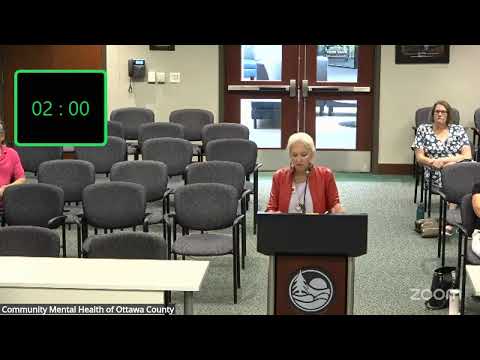
Ottawa County CMH board approves contract and rate changes to shore up residential providers amid budget shortfall
Summary
The Ottawa County Community Mental Health board approved amended, renewed and new service contracts and the agency's financial statement after an extended discussion about underfunding of Medicaid-paid residential services and the risk of provider closures.
The Ottawa County Community Mental Health board approved amended, renewed and new service contracts and the agency's financial statement after an extended discussion about underfunding of Medicaid-paid residential services and the risk of provider closures.
Dr. Brashears, executive director of Ottawa County CMH, told the board the system is "in crisis" and that some residential providers warned they could close unless reimbursement rates rise. "We must provide services regardless of the funding level," Brashears said, explaining the board's decision to move more costs onto Medicaid funding streams rather than county millage dollars.
The action package included amended and renewed residential service contracts, a set of new service contracts and approval of the financial statement. Finance committee chair Bonnie reported that the committee reviewed requests and concluded the rate increases and contract changes were necessary to preserve placements for the county's most vulnerable residents. The board voted to approve the items by roll call.
Why it matters: board members and local providers said current Medicaid reimbursement rates in Ottawa County are below regional averages and have not kept pace with staffing and operational costs, forcing providers to fundraise or use other revenue to cover direct-care expenses. Providers warned that closures or out‑of‑county placements would displace residents and increase system costs; supporters said raising rates now was needed to avoid losing specialized residential capacity.
Key facts from the meeting: - Harbor House Ministries told the board it faced an annual shortfall the organization described as $1,400,000 and a current monthly shortfall of about $120,000; its director urged the board to approve rate increases so Harbor House can fill open beds and avoid closure through attrition. - Brashears said Ottawa CMH had realized roughly $2.4 million in savings from unfilled positions this year and had received a CCBHC quality bonus of about $300,000 not originally budgeted. - Brashears said some withheld state funds had begun to flow through the Lakeshore Regional Entity (LRE) and the state Department of Health and Human Services (DHHS), and that the board expects that increased Medicaid funding will be ongoing rather than a one-time stopgap.
Discussion and dissent: public commenters and at least one board member asked the board to pause or reduce contract increases and to provide clearer, level-of-care data before approving large mid-year rate changes. Becky Patrick (Allendale Township) urged the board to "pause these increases or to consider significantly reducing them" until the county can provide numbers on clients by level of need. Brashears and finance committee members responded that staff had done due diligence, that some providers had long-running deficits because rates had not been raised for over a decade, and that failing to act could leave 30–100 residents without appropriate placements.
Regional and policy context: Brashears said Ottawa's CMH is pushing for a needs-based funding approach within the LRE and that the region recently commissioned an executive summary showing wide variability in residential rates and inconsistent assessment and procurement practices across CMHs. The LRE study found mean daily rates varied by about 26% across CMHs, and Brashears said Ottawa County has developed a tiered, cost‑based model the board intends to present to the region.
Votes at a glance: - Motion to approve amended, renewed and existing service contracts (finance committee recommendation): approved by roll call (motion carries). - Motion to approve new service contracts: approved by roll call (motion carries). - Motion to approve the financial statement: approved by roll call (motion carries). - Motion to table a proposed bylaws change (quorum definition to 51% of serving members): motion to table carried; the board will revisit the change at the next meeting.
What happens next: staff will present a detailed, tiered residential rate model and the data used to justify increases at upcoming finance and Performance, Quality and Improvement (PQI) committee meetings. Brashears said the board will continue to advocate at the regional and state level for a needs‑based Medicaid funding methodology and to monitor federal and state policy risks, including potential changes to Medicaid eligibility that could reduce revenue.
Ending: provider representatives thanked the board for the decisions and urged the board to continue work to stabilize the residential network and retain direct-support staff. The board set the next PQI meeting in July to review detailed rate-setting work and assessment tools.