
San Luis Obispo planning commission revokes Delta Upsilon fraternity conditional use permit for 720 Foothill Boulevard
Get AI-powered insights, summaries, and transcripts
Sign Up Free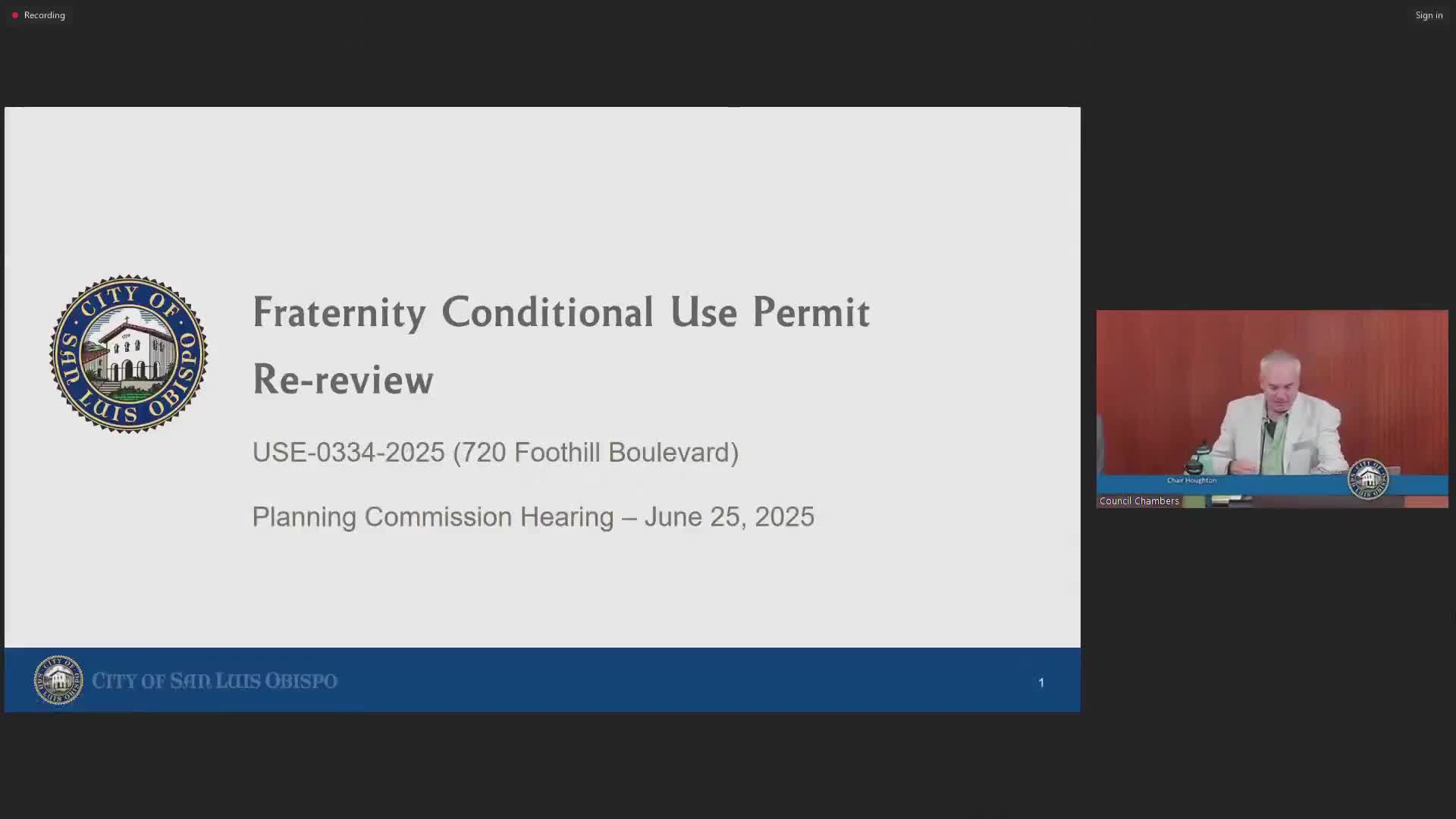
Summary
After hearing staff findings and mixed public testimony, the San Luis Obispo City Planning Commission voted 6-0 to revoke the conditional use permit for the Delta Upsilon fraternity at 720 Foothill Boulevard, citing repeated noise complaints and permit violations.
The San Luis Obispo City Planning Commission voted to revoke the conditional use permit for the Delta Upsilon fraternity house at 720 Foothill Boulevard, adopting staff’s recommendation "without prejudice" by a 6-0 roll call. The commission’s decision means the permit is revoked as of the date of the meeting; the fraternity may reapply in the future but would need to go through the city’s conditional use permit process again.
The ruling followed a staff presentation that summarized the property’s permit history and recent enforcement activity. Assistant Planner Mallory Pitino told the commission the site has been operated as a fraternity since a 1991 use permit (U1515) and was modified in June 2009 under use permit U3609, which limited residents to 14 people and gatherings to a maximum of 21. Pitino said officers and code enforcement documented five police department citations for noise from September 2024 through June 2025, one of which was successfully appealed, and that administrative fines of $50 and $100 were later issued in February and March 2025 in relation to those violations.
"Staff recommends the commission review the existing conditional use permit for consistency with the general plan and zoning regulations to either . . . modify the conditional use permit based on updated findings and subject to revised conditions of approval, or . . . revoke the use permit," Pitino said during her presentation.
Deputy Chief Brian Amoroso of the San Luis Obispo Police Department described the department’s response process for noise calls and how citations are issued. He explained that officers must observe a violation in order to issue a citation and that not every noise complaint results in a citation. On the technical limits of evidence in appeals, Amoroso said body camera audio can under-represent distant or ambient noise because the systems are optimized for conversational audio, which contributed to at least one successful appeal.
Representatives of the fraternity offered history and mitigation commitments. Terry Reeves, identified as president of the alumni corporation that supports the chapter, described the fraternity’s 70-year presence in the community and said the alumni board is establishing a continuity role "to work with the city, use permit, maintain that level of communication" to educate successive active members. Juan Fernandez, identified as the chapter’s active alumni relations chair and as a planning commissioner in Elk Grove, told the commission the property is compatible with its R-4 high-density residential zoning and that the fraternity agreed with staff’s conditions if the permit were to be amended.
Several fraternity alumni and supporters described philanthropic work and mentoring the active members. Active chapter president Wade Spriggs told the commission the chapter averages about 600 hours of community service and raises roughly $10,000 annually for philanthropy. Alumni speakers including John Hatfield, Lisa McKenzie and Doug McKenzie testified about the fraternity’s positive contributions to the community.
Nearby residents and an apartment manager urged revocation. The property manager for a nearby apartment complex said the fraternity’s noise has "nearly nightly disruptions," including loud music and yelling that she said penetrates fully closed apartments and harms tenants’ ability to sleep and work. A neighbor who lives about 20 feet from parts of the fraternity building described late-night groups leaving events, urination on site, and loud multi-hour gatherings that start conversations with police and disturb nearby households.
Multiple public commenters and staff also flagged activity at off-site "satellite" houses occupied by members. A resident who has tracked neighborhood incidents said some satellite locations have hosted gatherings of 200–300 people and asserted registered or sanctioned events at some satellite houses have produced large unruly gatherings; the fraternity representatives said satellite houses are private residences where active members sometimes live and that those events are not sanctioned by the chapter.
Commission discussion emphasized the difference between the fraternity’s community contributions and its compliance with permit conditions. Commissioner Khan said fraternities provide community benefits but "there has to be a way that the fraternities in this community can comply with their use permit." Commissioner Cooley said he was "not able to distinguish this factually from the decisions we made in recent hearings" and indicated he would support revocation. Chair Dave Houghton summarized the competing facts and, after public testimony and staff recommendations, a motion was made and seconded to adopt staff’s recommendation to revoke the permit "without prejudice." The roll call vote recorded yes votes from Commissioner Cooley, Commissioner Jorgensen, Commissioner Khan, Commissioner Munoz Morris, Vice Chair Tully and Chair Houghton.
City staff noted that a revocation without prejudice leaves the door open for the property or organization to reapply for a conditional use permit; staff also said the current cost to file a new use-permit application is over $10,000. The city clarified that revocation of the permit does not, by itself, remove the property’s ability to be used as a residence; it changes the allowed use status as a fraternity under the conditional-use framework and would require a new approval to regain that specific permit.
The commission also noted a grand jury report on town–gown issues had been released this week and that staff will return to a future meeting with a more detailed response. The planning commission closed the public-hearing portion of the meeting after the vote and moved on to other business.