Get Full Government Meeting Transcripts, Videos, & Alerts Forever!
Get email alerts on the Un Charter Commemoration topic
No spam. Unsubscribe anytime.
UN General Assembly marks 80th anniversary of Charter with calls to defend multilateralism and pursue reform
Summary
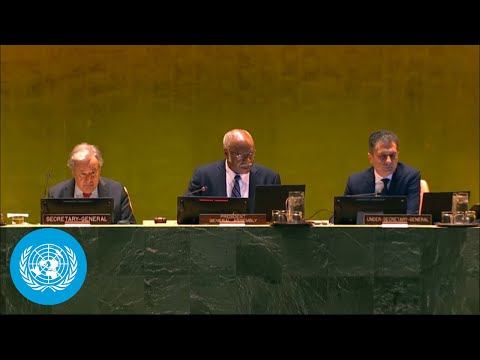
The United Nations General Assembly convened a commemorative plenary on June 26, 2025, to mark the eightieth anniversary of the signing of the Charter of the United Nations, bringing together the president of the Assembly, Secretary‑General António Guterres, senior U.N. officials and more than 60 member‑state delegations to review the Charter’s legacy and outline priorities for reform.
The United Nations General Assembly convened a commemorative plenary on June 26, 2025, to mark the eightieth anniversary of the signing of the Charter of the United Nations, bringing together the president of the Assembly, Secretary‑General António Guterres, senior U.N. officials and more than 60 member-state delegations to review the Charter’s legacy and outline priorities for reform.
Delegations used the occasion to both praise the U.N.’s record — from postwar decolonization to the Sustainable Development Goals — and to issue warnings about an erosion of international norms amid contemporary conflicts. Secretary‑General António Guterres told the Assembly that the Charter "is not an a la carte menu," and urged member states to uphold its purposes and principles rather than normalize violations.
Why it matters: speakers said the Charter remains the foundational legal and political framework for global cooperation but agreed the U.N. must adapt to rising geopolitical tension, digital-age challenges and persistent inequalities. Multiple delegations pressed for concrete steps to strengthen the Organization’s capacity, from reforms under the Pact for the Future to the secretary‑general’s UNAT initiative.
Most speakers emphasized that the Charter’s core aims — preventing war, protecting human rights and promoting development — remain central. Yuji Iwasawa, president of the International Court of Justice, highlighted the Charter’s legal primacy, noting that "the charter prevails over all other international agreements pursuant to its article 103." Several speakers cited the Charter’s role in enabling human-rights instruments and decolonization.
The meeting did not include votes or formal resolutions. Instead, statements from regional and political group representatives underscored divergent priorities. The Bolivarian Republic of Venezuela, speaking for a group that defends the Charter, reiterated a call for full realization of "the inalienable rights of the Palestinian people," and urged admission of Palestine as a U.N. member. Other delegations — including the European Union, the United States, China and many small states groups — emphasized the need to uphold international law and to make the U.N. more effective and representative.
Small states and developing-country delegations repeatedly raised climate finance, loss-and-damage mechanisms and the need for better access to development resources. Tuvalu, speaking for the Pacific Small Island Developing States, said the climate crisis "remains our most urgent priority" and urged delivery on climate finance and operation of the loss-and-damage fund. Several African and developing-country speakers called explicitly for Security Council reform to improve representation and responsiveness.
On reform, multiple delegations supported the Pact for the Future and the secretary‑general’s UNAT initiative as roadmaps to modernize the Organization. Several speakers urged that reforms preserve the Charter’s universality and rule-of-law foundations while making U.N. decision-making and operating methods more efficient and inclusive.
Voices of caution: a number of statements warned against selective application of international law and unilateral coercive measures. Venezuela and Cuba described such measures as violations of sovereignty that harm development, while other delegations warned that the trend of using force or ignoring legal obligations undermines the U.N.’s credibility. The secretary‑general and several member-state speakers listed ongoing conflicts in Gaza, Ukraine and Sudan as evidence of the stakes involved.
Cultural and civic elements opened the session: a youth representative recited a poem reflecting on peace and hope, and an orchestra performed two commissioned pieces before the plenary statements began.
The Assembly adjourned the morning segment and scheduled continuation of the plenary for the afternoon; no formal decisions were taken during the session. The commemoration chiefly served as a high-level stocktaking of the Charter’s achievements and as a public call by many members to translate pledges on reform, climate finance, and equitable representation into concrete action.