Get Full Government Meeting Transcripts, Videos, & Alerts Forever!
Get email alerts on the Immigration Detainers topic
No spam. Unsubscribe anytime.
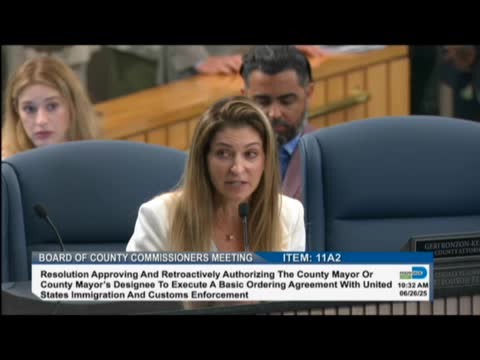
Miami-Dade commissioners defer vote on ICE detainer/BOA agreement after lengthy public comment
Summary
Miami‑Dade County commissioners on May 14 deferred consideration of item 11A2, a basic ordering agreement (BOA) tied to ICE detainers and reimbursement for housing federal immigration detainees, after more than four hours of public comment and questions about transparency, fiscal impacts and legal obligations.
Miami‑Dade County commissioners on May 14 deferred consideration of item 11A2, a basic ordering agreement (BOA) tied to ICE detainers and reimbursement for housing federal immigration detainees, after more than four hours of public comment and questions about transparency, fiscal impacts and legal obligations.
The item was opened for “reasonable opportunity” public comment before a motion to indefinitely defer the matter was made and seconded; the board later voted to defer. The mayor’s office and county staff told commissioners the mayor had already signed required paperwork and that Florida law creates an obligation for local correctional facilities to enter such agreements. County attorneys also warned of potential state enforcement remedies for noncompliance.
Why it matters: the BOA governs how the county coordinates with federal immigration authorities on temporary housing of people subject to immigration detainers, how reimbursement for detention costs is calculated, and what records may be shared. Opponents said the contract’s public‑records language could limit families’ and advocates’ ability to find people in custody; supporters and staff said state law constrains the county.
During the meeting Chief James Reyes, Miami‑Dade Chief of Public Safety, sought to reassure the public about county practices, saying, “we as an administration are committed today and tomorrow and moving forward to remain as transparent as we are with our community. If individuals are in our custody, if they are in our jail, they will show in that directory.” County legal staff told commissioners the BOA uses a uniform template provided to counties by federal partners and that contracting choices were limited.
Public commenters pressed for stronger transparency protections and expressed fear about the possibility of detainees being “disappeared.” Luisa Suarez, one of many people who spoke, told the commission, “I oppose resolutions 11A2 through 11A4,” and asked the mayor to veto the measure if it came back without changes.
Legal and procedural context: County attorneys cited Florida Statutes chapter 908 as the statutory framework that requires correctional facilities to enter agreements with federal immigration agencies to house people subject to detainers and to seek reimbursement for detention costs. Counsel noted possible remedies under state law for officials who fail to comply, including actions the governor may take.
Board action and next steps: The board voted to defer item 11A2 after public comment. Commissioners asked administration and legal staff for additional briefings and assurances on what information the county will continue to make available through its inmate search tools and how records generated under the BOA will be handled. The mayor’s office and county staff said they would continue working with the commission and with HUD/state contacts and provide updates to committee and the full board.
Votes and motions: Earlier in the same meeting, the board unanimously approved a separate motion delegating to the county mayor (or designee) authority to enter agreements required by federal or state law and to make that authority retroactive to March 1, 2025, through Dec. 31, 2025. Commissioners then used the procedural option to defer 11A2 for further review.
What’s next: Staff and county legal counsel will return with clarifications about what records remain county‑controlled, what records are within the limited scope of the BOA, and any feasible contract language changes. If the item resurfaces, the board may vote to reopen public hearing or take other procedural steps.