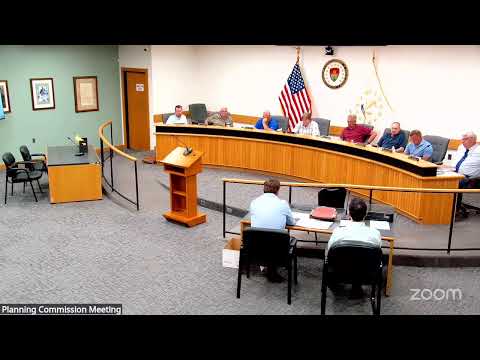
Coventry planning commission approves preliminary plan for 66-unit Highlands at Hopkins Hill addition, with conditions
Loading...
Summary
The Coventry Planning Commission granted preliminary plan approval June 25 for the Highlands at Hopkins Hill subdivision, a 66-unit detached single-family condominium addition by DT Homes, while requiring the applicant to work with staff and the town engineer to resolve certificate-of-conformance language and other technical conditions.
The Coventry Planning Commission on June 25 approved a preliminary plan for Highlands at Hopkins Hill, a proposed 66-unit detached single-family condominium addition to the Highlands on Dante Boulevard. The motion incorporated the staff report and the conditions listed in the report, and included a requirement that the applicant work with planning staff and the town engineer to resolve certificate-of-conformance and related construction-level language or return to the commission for final plan approval.
The approval matters because the project would add 66 condominium units on roughly 13.6 acres and prompted extended debate over stormwater plans, unit mix, and how the town will verify construction of private infrastructure. Commissioners also discussed whether older master-plan restrictions—specifically an 80%/55+ limitation referenced in historic approvals—apply to the new proposal.
Attorney Joel Broch, representing the owner-applicant, said the applicant submitted a stormwater letter for the record and offered to provide a copy for the commission. He asked the board to accept that letter as an exhibit; staff accepted it as Applicant Exhibit 1. Broch also told the board that staff had no outstanding concerns with the stormwater materials that were supplied.
Engineering consultant Greg Guglielmo of DuPree Engineering urged the commission not to lock the project into overly prescriptive unit-mix rules. ‘‘We’re kind of looking for the same thing, where it'd be an option,’’ Guglielmo said, describing market demand for flexible floor plans and den/office spaces that today are sometimes counted as additional bedrooms under building-code definitions.
Planning staff and the town engineer pressed for stronger assurances that constructed infrastructure will match the approved design. Staff described several recommended conditions (identified in the staff report as items 5b, 8 and 9) that would require certificates of conformance from the engineer of record before the town issues certificates of occupancy. The town engineer reiterated that those conditions reflect the standard language used in recent preliminary-plan decisions and said the comments were intended to provide an ‘‘even bar’’ for inspection and acceptance of infrastructure.
The applicant asked for the commission to allow negotiation of the certificate language between now and final plan so that the parties could reach a mutually agreeable, practical process for phased construction, testing and verification. The town engineer agreed to modest clarification on one technical item (comment number 5 in the TRC report) by specifying that ‘‘proof of valid testing and written verification by contractor shall be provided to the town engineer at substantial completion of construction phases, and such proof shall be provided before certificates of occupancy are issued.’’
Commissioners also discussed two planning conditions that had drawn comment from the applicant: a staff-proposed limit on the ratio of 2-bedroom to 3-bedroom units and a referenced 55-and-over age restriction. The applicant said the proposed bedroom-ratio condition ‘‘came out of left field’’ when the staff report was issued, that the developer has not committed to a final bedroom mix, and that market conditions support flexibility. Broch and the applicant’s engineer said the 55+ language the planner cited traces to a 2003 master plan approval that has been modified by later court orders and consent agreements; the town solicitor agreed to verify how those older documents affect current approvals.
After extended discussion, a board member moved to approve the preliminary plan as described in the staff report and to require the applicant to work with planning staff, including the town engineer, to resolve the TRC comments and the certificate-of-conformance language; if the parties cannot agree, the applicant must return to the commission for final plan approval. Another board member seconded the motion. The commission voted in favor; the chair announced ‘‘motion carries.’’
Next steps: the applicant may proceed to prepare final plans. If staff and the applicant reach agreement on the engineer-related conditions, the final plan could be handled administratively; if not, the commission will review the final plan in public session.
Closing note: the commission accepted the applicant’s stormwater letter into the record as Applicant Exhibit 1 and directed staff to verify the status of the older master-plan restrictions before final plan review.