Get Full Government Meeting Transcripts, Videos, & Alerts Forever!
Get email alerts on the Jail Financing topic
No spam. Unsubscribe anytime.
Council backs ACRJ financing plan over public objections in 3-2 vote
Summary
Charlottesville City Council voted 3-2 to approve a support agreement enabling Albemarle–Charlottesville Regional Jail (ACRJ) to proceed with permanent bond financing and a grant-anticipation note after bids came in above the projectbudget. Public commenters and advocacy groups urged delay until a final scope and price were available.
Charlottesville City Council voted 3-2 to authorize the citysupport agreement for the Albemarle–Charlottesville Regional Jail (ACRJ) to proceed with permanent bond financing and a grant-anticipation note, enabling the jail authority to move forward with renovation and limited new construction despite bids that exceeded the previously stated budget.
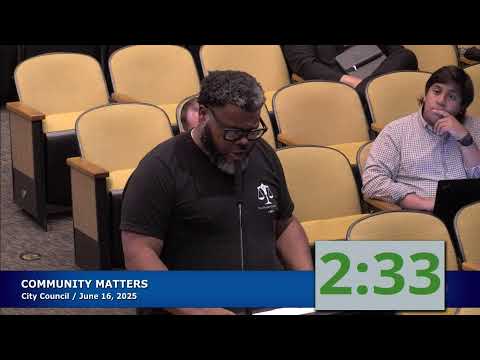
The vote followed several hours of public comment opposing the proposed financing. Speakers representing the Peoples Coalition and other advocacy groups asked council to delay any commitment until ACRJ produced a final scope and firm cost estimates. Harold Povier of the Peoples Coalition told council the current plan amounted to "writing a blank check" because the authority had not shown a full scope or final price. Ruby Cherian, an attorney with the Legal Aid Justice Center, said federal budget changes could increase local service needs and urged prioritizing community services over jail expansion.
ACRJ and its financial advisers said the project is eligible for a 25% state reimbursement for eligible capital costs and that interim and permanent financing must be aligned with a summer sale schedule. Courtney Rogers of Davenport & Company, financial adviser to ACRJ, summarized the two-part plan: a bank loan as a grant-anticipation note (GAN) to bridge the period until state reimbursement is paid, and permanent bonds through the Virginia Resources Authority (VRA) to fund the long-term portion. Rogers said bids received May 30 ranged from about $53 million to $76 million; the project budget used in planning had been $49 million. The authority projects roughly $12.1 million in GAN borrowing and about $36.9 million in permanent bonds, with the City of Charlottesvilles pro rata share of debt service shown in ACRJ projections.
ACRJ superintendent staff described the scope being retained after a redesign to fit budget limits: demolition and new construction of the oldest 1975 portion, creation of single-occupancy trauma-informed general population cells (65 beds), smaller mental-health units (two units of seven beds each), new visitation space, expanded classroom space and updated ADA- and code-compliant systems. Superintendent Coomer said some renovations originally planned for other sections of the facility will be postponed; demolition and rebuilding of the 1975 wing are prioritized. Project staff said about 95% of the revised scope was finalized the week of the meeting; the remaining items chiefly concern demolition sequencing and specific HVAC/plumbing approaches.
Opponents said the deferred renovations, the inclusion of "special purpose segregation" (described in some documents as special-management or mental-health cells), and the absence of a firm final scope and net price warranted a pause. Several speakers warned that mental-health-designated rooms could function as solitary confinement if implemented without adequate clinical services. Supporters and council members who voted in favor said the project addresses urgent safety, legal-compliance and humane-housing deficiencies in the existing facility and that timing constraints around bond and GAN markets would delay the project if council waited for additional meetings.
Council members were told the GAN would be structured so it could be repaid as soon as state reimbursement arrived; the permanent bonds would be issued through VRA to obtain a blended double-A rating. Rogerss materials showed a planning debt-service profile with interest-only payments during construction and full principal-and-interest payments once bonds are issued. The jail authority expects to use interest earnings on bond proceeds during construction to reduce the citys budgetary impact in FY2026.
The councils approval is couched as a not-to-exceed authorization tied to the ACRJ boards final scope and budget approval; the ACRJ board is scheduled to finalize project parameters at its July meeting. If the board approved a higher final contract amount that required more borrowing than the support agreement authorized, project staff would need to return to the participating local governments for further approvals.
The vote was 3 in favor, 2 opposed.