Get Full Government Meeting Transcripts, Videos, & Alerts Forever!
Get email alerts on the Public Safety topic
No spam. Unsubscribe anytime.
Police chief outlines tactics, data and outreach after West Haven, South First Street shootings
Summary
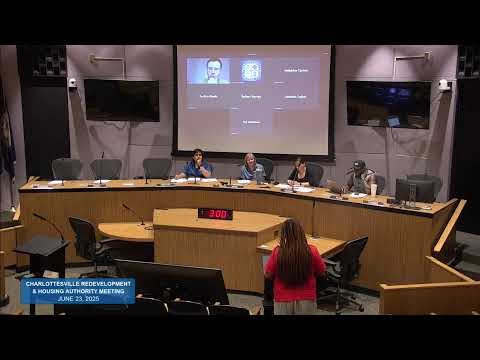
Charlottesville Police Chief Conyers briefed the Charlottesville Redevelopment and Housing Authority (CRHA) board on a recent decline in citywide gun-related crimes and on targeted tactics and community outreach following high-profile shootings in West Haven and on South First Street.
Charlottesville Police Chief Conyers told the Charlottesville Redevelopment and Housing Authority board on July 8 that gun-related crimes across the city are down about 40% on a three-year average but that recent incidents, including one that involved about 30 rounds fired on a lot with small children, underscore continuing local safety concerns. "Gun violence incidents across the city wide are down on a 3 year average about 40% right now," Conyers said.
The chief presented patrol and deployment data to explain how the department places resources in neighborhoods with spikes in calls. He said South First Street sees most spikes Friday–Saturday between 5 p.m. and 1 a.m., while West Haven spikes Thursday–Saturday between 7 p.m. and 2 a.m. Conyers described a policing approach that emphasizes officers leaving vehicles, walking the neighborhood and building relationships rather than simply sitting in cars.
Why it matters: Board members pressed for local detail and for tactics that reduce trauma to residents, particularly immigrant and refugee communities. The discussion ran through both operational explanations — how search warrants and high-risk entries are planned — and community-facing steps such as translation and resident-services follow-up.
Conyers explained the department's approach to executing high-risk search warrants and the precautions it requires, including surrounding a house, calling occupants out, having negotiators and medics on standby and staging behind protective vehicles. He said those steps are meant to reduce the chance of immediate violent confrontation when firearms are suspected. "We will roll up, and we will surround the house. And then we will knock and call you out and call every individual out of that house," Conyers said, describing the more deliberate method used by Charlottesville police.
Board members asked about granular data for West Haven and South First Street and whether the citywide decline is reflected equally in those neighborhoods. Conyers said the 40% figure is citywide and offered to provide neighborhood-level breakdowns after digging into the data. He emphasized that declines reflect many factors, including community investment and partnerships, not a single strategy. "You can't just say it's 1 thing... it's a whole of community approach and a whole of government approach," Conyers said.
Several commissioners raised concerns about trauma and fear in immigrant communities when seeing heavily armed or tactical police units. Conyers said the department has been working to build trust, recently graduated a Hispanic Community Police Academy and does not enforce federal immigration law. He also described steps the department has taken to clarify public notices about search warrants, including specifying which agencies are involved and the incident type to reduce misinformation and fear.
CRHA Executive Director mister Sales said CRHA provided resident services and property management support after the West Haven incident and is working on a notification model that includes translated notices in nine spoken languages. "Everything that goes out to the public gets translated," Sales told the board.
Board direction and next steps: Commissioners requested neighborhood-level crime breakdowns for West Haven and South First Street; Conyers agreed to provide that data. The board also discussed improving advance communications to residents (including translations) and coordinating resident-services outreach after critical incidents.
Ending: Chief Conyers thanked the board and said he would continue to attend meetings and community events. The board took no formal vote related to policing during the meeting.