Get Full Government Meeting Transcripts, Videos, & Alerts Forever!
Get email alerts on the Transmission Line topic
No spam. Unsubscribe anytime.
Elbert County commissioners direct staff to draft competing approval and denial resolutions for Xcel’s Power Pathway after contentious hearing
Summary
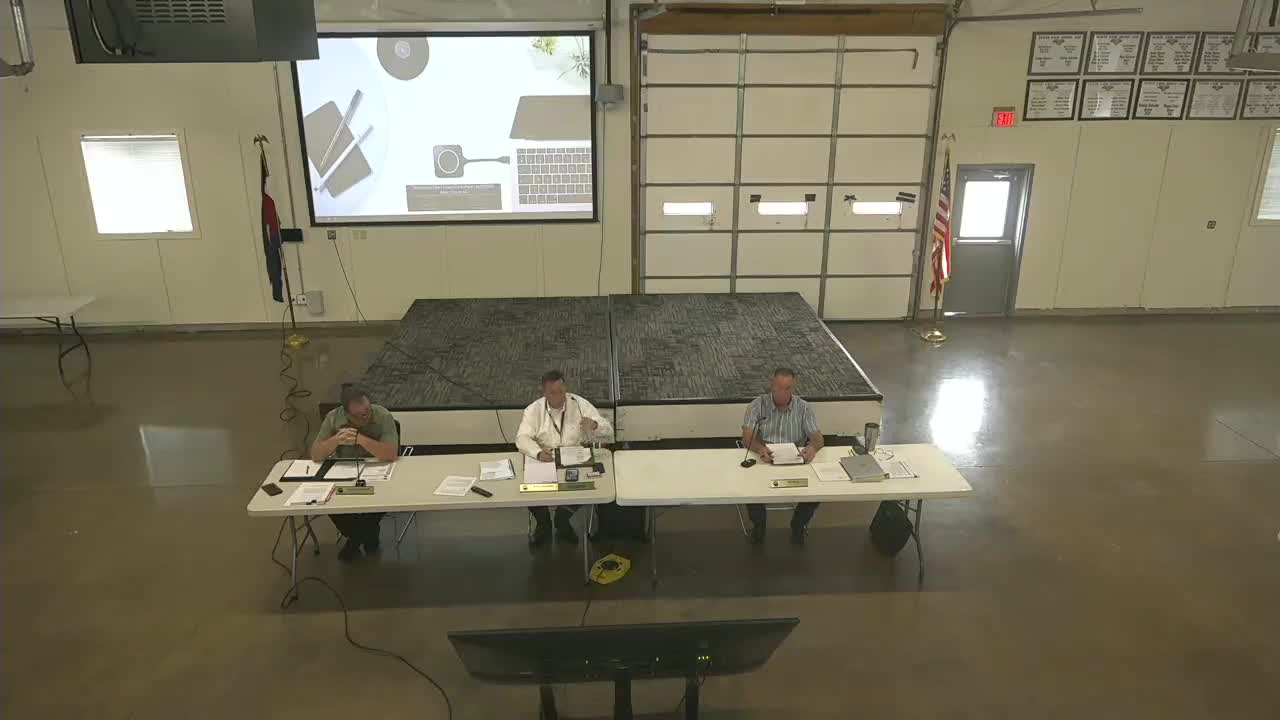
At a public hearing in Kiowa, Elbert County commissioners heard technical briefings from Xcel Energy and county staff, then voted to have the county attorney prepare competing draft resolutions — one that would approve the permit and one that would deny it — to be finalized at a special meeting July 2, 2025, at 1 p.m.
At a public hearing in Kiowa, Elbert County commissioners heard technical briefings from Xcel Energy and county staff, then voted to have the county attorney prepare competing draft resolutions — one that would approve the permit and one that would deny it — to be finalized at a special meeting July 2, 2025, at 1 p.m.
The hearing centered on Xcel Energy’s proposed Colorado Power Pathway transmission line, the company’s wildfire-mitigation measures, and land-acquisition tactics including condemnation. Patrick Kuretisch, who identified himself as working for Xcel Energy and supporting transmission operations on wildfire matters for Colorado, told the commissioners that Xcel has filed wildfire mitigation plans (one in 2020 and an update for 2025–2027) and that the company uses multiple tools to reduce risk. “We do take that extremely seriously,” Kuretisch said, and explained that Xcel uses a mix of weather models and an internal meteorological team (four meteorologists) and “we provide 24/7 monitoring of our lines” with redundant protection systems and situational awareness tools such as Pano AI cameras.
County staff described how local conditions could be addressed through conditions of approval. Staff reiterated that while some project-level information is managed at the state Public Utilities Commission (PUC) level, information the county wants considered must be part of the local land-use record. Staff summarized suggested conditions drawn from county practice and referral agency comments: completed agreements and fire-district forms prior to construction start in those districts, construction-site safety and emergency action plans, preconstruction wildlife and nest-clearance surveys (with seasonal timing), cultural- and biological-resource monitoring during construction, stormwater and SPCC (spill prevention) plans, road-use agreements and documentation of construction impacts, and coordination with fire districts including preconstruction trainings and quarterly notices during construction.
Xcel and staff also explained the company’s land-acquisition timeline and condemnation process. Xcel said it had offered option agreements allowing access for surveying (a 500-foot option corridor that could be narrowed to a typical 150-foot easement) and that, where negotiations stall, the company will send notice of intent to acquire and final offers before filing condemnation (eminent-domain) cases. Xcel reported it has filed 13 condemnation cases in Elbert County; the company said there are 48 landowners in the project corridor and that it had secured agreements with 25 of them. Xcel said it pays for appraisals in condemnation proceedings and generally offers near–full fair market value for easements (approaching 95–100% of market value, stated in testimony).
Commissioners and the public pressed Xcel on several topics: how many and which weather and camera assets will be available to local first responders; the degree of on-the-ground inspection and maintenance commitments; easement width and pole heights; visibility and tree clearing along scenic corridors; proximity of poles and easements to homes (Xcel said the closest modeled centerline point to a dwelling in the area discussed was 163 feet); how appraisal evidence supports compensation amounts; whether county development fees or mitigation payments would cover increased risk to volunteer fire districts; the lack of signed fire-district forms in some districts; and county concerns about decommissioning and a financial assurance mechanism for removal of infrastructure if it became obsolete.
On property-value impacts, the hearing included two expert statements that reached different, evidence-based points: Xcel presented appraisal work (cited studies and a 2022 appraisal report) indicating limited or mixed off-easement impact in comparable studies, while local stakeholders and some commissioners disputed those findings and urged the county to treat potential tax- and development-revenue impacts carefully. Appraiser David Bethel, who described his experience with right-of-way appraisal on acreage properties, testified that his paired-sales analysis in several states shows primary value impacts are typically limited to the easement area itself and that off-easement impacts are not consistently measurable beyond a given distance; he also said he had not seen counties reduce assessed values across the board because of transmission encumbrances.
Two formal actions were recorded at the end of the hearing. First, the board voted to direct the county attorney to prepare a resolution “containing findings and the final decision” in favor of the application, to be presented and considered at a special meeting on July 2, 2025, at 1 p.m. That motion carried on a voice vote. Second, a separate motion directing the county attorney to prepare a denial resolution (citing outstanding items including unsigned fire-district forms, a requested road-use/development agreement, and documentation related to a Natural Resources Conservation Service easement) also passed and was likewise scheduled to be reviewed at the same July 2 special meeting. The board then continued the land-use hearings and closed the public hearing; the final decision was reserved for the July 2 meeting.
What the record shows: Xcel described monitoring and mitigation measures (eight weather models in use, four meteorologists, redundant protection systems, situational awareness cameras, and regular transmission inspections) and explained the company’s rationale for concurrent permitting and land acquisition in order to meet PUC schedule and cost constraints. County staff emphasized that conditions of approval can be used to convert recommended avoidance and mitigation practices into enforceable permit requirements and outlined more than two dozen suggested stipulations (examples above) drawn from referral-agency letters and standard construction best practices.
What remains unresolved: signed fire-district forms for some districts (county staff and Xcel said they were continuing to negotiate), the specific content of road-use and development agreements, an agreed decommissioning/financial assurance approach (Xcel said a decommissioning plan appears as Attachment S in the application and that the PUC process would be involved in any facility removal), and a clarified interpretation of the county’s co-location rule in the zoning code (Article 17/J/26/D) concerning proximity to subdivisions. Commissioners specifically asked staff to clarify the local code definition of “co-located” when the county’s regulations are next updated.
The board scheduled a special meeting for July 2, 2025, at 1 p.m. for the county attorney to present final findings and a decision. In the meantime, Xcel and county staff will continue outreach and negotiations with landowners and local agencies, and the record will be updated with any additional signed agreements or referral responses before the special meeting.
Sources: County public hearing transcript; testimony from Patrick Kuretisch (Xcel Energy), Heather Brickey (Xcel Energy), Parker Rosak (Xcel engineer), David Bethel (appraiser), county staff, and public commenters.