Get Full Government Meeting Transcripts, Videos, & Alerts Forever!
Get email alerts on the School Facilities And Transportation Assessment topic
No spam. Unsubscribe anytime.
Indianapolis launches Local Education Alliance to assess school facilities and transportation under new state law
Summary
The newly formed Indianapolis Local Education Alliance opened its inaugural meeting to review its mandate under House Enrolled Act 1515, outline a data-driven timeline to assess school facilities and transportation across the IPS boundary, and solicit public feedback on equity, charter access, and transportation barriers.
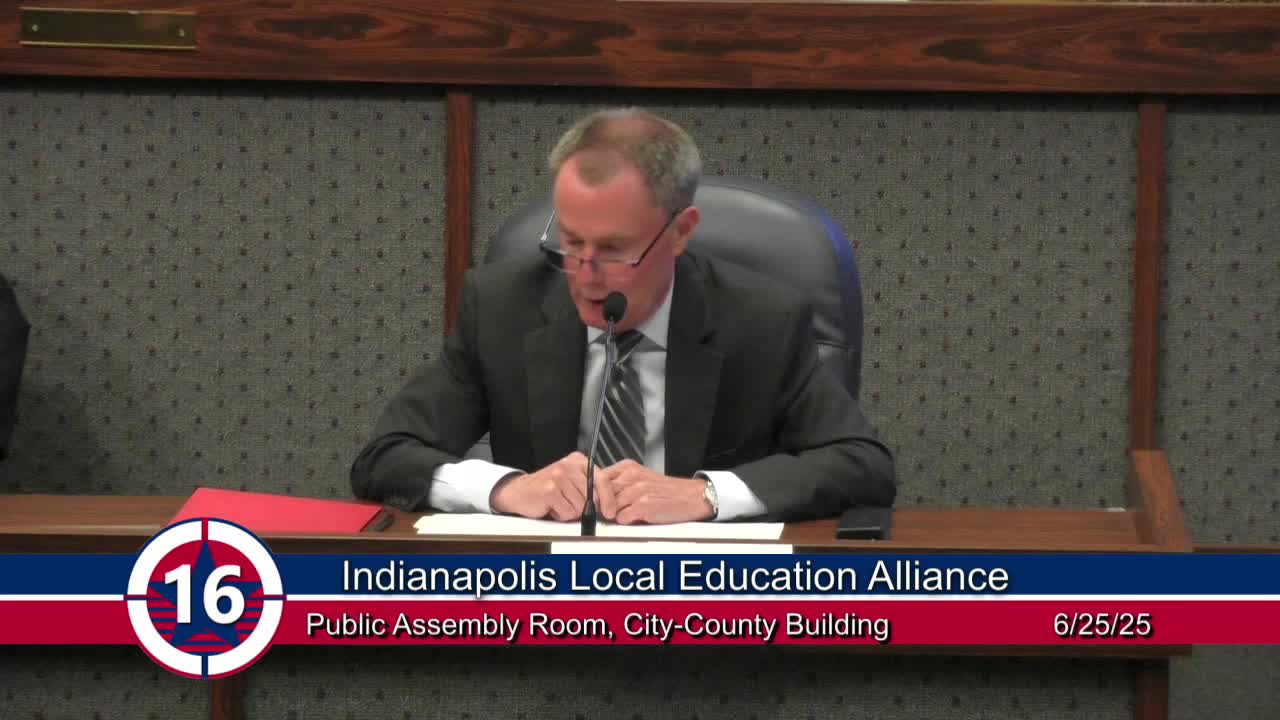
The Indianapolis Local Education Alliance opened its inaugural meeting to begin work required by House Enrolled Act 1515, the mayor said, including a citywide assessment of public school facilities and an implementation plan for facilities and transportation to be delivered by Dec. 31, 2025.
The alliance’s purpose and immediate timeline were the focal points at the meeting, which combined a presentation from Indianapolis Public Schools and the mayor’s Office of Education Innovation with a public-comment period that highlighted concerns about funding, charter accountability and transportation access.
The mayor told the group the alliance was created by law “to conduct an assessment of all public school facilities within the IPS boundaries” and that the panel “shall submit our final recommendations and implementation plan by December 31” (the transcript identifies the law as House Enrolled Act 1515). That implementation plan, he said, should consider co‑location, shared services, consolidation and “high quality program expansion.”
Deputy Superintendent Andrew Strope and Shana Cavazos, director of the mayor’s office of education innovation, outlined the current landscape and historical context. Strope traced the system’s modern history to the 1970 creation of Unigov and said the city’s school system has been reshaped across decades. “The story of modern education in Indianapolis truly begins in 1970 with the creation of Unigov,” Strope said during the presentation.
City and district presenters provided a series of baseline figures the alliance will use for analysis: roughly 42,000 public school students live within the Indianapolis Public Schools (IPS) boundary; IPS and its innovation partners operate about 67 facilities; independent public charter schools own or lease roughly 29 additional facilities; and the public schools in the boundary operate under multiple governance structures (direct‑run IPS schools, IPS innovation schools, innovation charter schools and independent charter LEAs). The presenters said the combined charter and innovation charter sector serves about 22,000 students while IPS direct‑run and in‑LEA innovation schools serve about 20,000.
Cavazos emphasized the legal status of charter schools in Indiana, noting that “charter schools are considered public schools according to Indiana law,” and explained that governance diversity has led to fragmented use of buildings and buses.
The alliance discussed the funding context: state tuition support (the education fund) is distributed by student enrollment and makes up a large share of state resources, while local property taxes flow to operations funds that pay for transportation, building maintenance and safety. Presenters said property‑tax limits and other changes can squeeze operations funding even as costs rise.
On process, the alliance agreed to compile a comprehensive data set and to engage external technical assistance for data aggregation and modeling. City staff said the Office of Education Innovation (OEI) and IPS are already collecting facility specifications, enrollment and building utilization data as well as existing transportation routes and contracts. The city said it will issue a request for qualifications (RFQ) for outside technical support and may use existing city or district contracts where appropriate. An initial data request to charter operators was described as having been issued with a requested return date of July 18, 2025 (the presenters indicated flexibility to accommodate summer schedules).
Alliance members asked for additional data, including: a map of facility locations across the IPS boundary, a consolidated budgetary view that includes all public schools in the boundary, a breakdown of funding flows for innovation school partnerships, special‑education and transportation specifics, and demographic or birth‑rate trend information.
The meeting’s public comment speakers repeatedly emphasized transportation and equitable funding as central practical barriers for families. Martha Cortez, chief partnerships officer at KIPP Indy Public Schools, urged “stronger partnership, especially around equitable funding and resource sharing,” saying “all public school students in our city deserve consistent investment and support, regardless of school type.” Several parents described students who rely on multiple buses or lengthy commutes and asked the alliance to prioritize transportation solutions that make choice meaningful.
Public commenters also debated charter accountability and facility stewardship. Speakers including Leslie Schulte — who described a career in facility planning and construction — urged that publicly paid facilities remain subject to public procurement rules and bidding to preserve taxpayer accountability. Other commenters asked for a moratorium on new charter openings within the IPS boundary until the alliance completes its work.
No formal votes or motions were taken at the meeting. The alliance said it plans continued community engagement and data collection through the summer, deep data dives in the fall, and refining recommendations toward a December 2025 final plan. The next meeting was announced for 6 p.m. on July 23, 2025, and the chair adjourned the session.
The meeting combined the statutory charge set in the 2025 legislation with early requests for technical support and community input, establishing a time‑bound process for mapping facilities and transportation and testing options for co‑location, shared services and other operational efficiencies.