Get Full Government Meeting Transcripts, Videos, & Alerts Forever!
Get email alerts on the Budget topic
No spam. Unsubscribe anytime.
Santa Cruz Valley Unified Governing Board adopts proposed FY26 budget amid enrollment decline and funding uncertainty
Summary
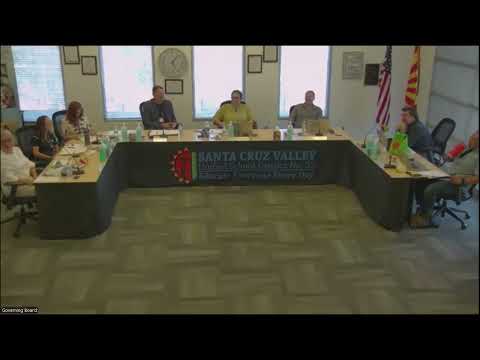
The Santa Cruz Valley Unified School District Governing Board approved its proposed fiscal year 2025–26 budget at its June meeting after a staff presentation that kept spending largely at current-year levels while the state budget remains unsettled.
The Santa Cruz Valley Unified School District Governing Board approved its proposed fiscal year 2025–26 budget at its June meeting after a staff presentation that kept spending largely at current-year levels while the state budget remains unsettled. The board voted to approve the proposed budget by voice vote; the motion passed and the budget will be submitted as the district’s required preliminary budget.
The vote followed a presentation by Superintendent Dave Verdugo and finance staff (Miss Brown) explaining the district must file budget forms on a statutory timetable even though the state had not completed its appropriations. The district used current-year funding levels and conservative enrollment projections to prepare FY26 plans, Verdugo said.
Board members and staff framed the proposal as cautious. Miss Brown told the board the proposed budget is based on an enrollment projection of 3,390 students, a decline of 151 students from the prior year; the district’s June 16 attendance count was 3,380. Because state one-time funding fields were removed from the state forms, the district recorded a reduction of roughly $248,000 that had previously been treated as one-time support for free-and-reduced-price-lunch students. Staff also noted uncertainty around continued funding from the statewide proposition commonly discussed as "Prop 123"; the presentation advised this funding stream is unresolved and may be restructured by the state.
The budget preserves a 5% pay increase for eligible employees approved by the board last year and absorbs the employer share of a roughly 4% rise in medical insurance premiums for employee-only coverage (the presentation estimated that employer absorption at about $7,100 per employee). The board heard that most of the district’s operating fund is salaries and benefits (over 80% of the budget), and that the proposed budget places significant emphasis on maintaining staffing and benefits while rightsizing positions where enrollment requires it.
Staff described several planned staffing and program changes embedded in the proposed budget: conversion of a 0.5 assistant-to-principal role at one high school to a full-time behavior coach at another site; suspension of elementary band FTE in multiple elementary schools and replacement with computer instruction; consolidation of elementary PE teachers with a K–8 athletic coordinator; a new instructional coach position at one high school and additional stipends for new sports; and suspension of regular preschool operations at one site. The budget also allocates a new full-time learning and development coordinator in teaching, learning and assessment and additional paraprofessionals for student services.
Capital and contingency planning were part of the presentation. Staff proposed capital allocations for curriculum rotation, technology (including copier licenses and set-asides for replacements), athletics, facilities, transportation and software/licenses, plus a $2,000,000 contingency set-aside. The classroom site fund was shown increasing in the district’s slides (figures referenced in the presentation) and staff proposed splitting that funding into base pay ($2,400,000), performance pay ($769,000) and district initiatives ($768,000). Remaining bond funds were shown as $524,000.
The board asked clarifying questions about cafeteria programs and one-time funding reductions. Verdugo and Brown emphasized the loss of the one-time state adjustment does not change local meal provision: "All of our students, regardless of their income level, will continue to receive the program," Brown said, adding the district’s bus-route meal program is serving about 1,200 meals per day. The board also discussed contingency planning, contract start dates for new hires and added onboarding days for staff (long-term substitutes: +5 days; new teachers: +4 days; alternative education paraprofessionals: +5 days; PE paraprofessionals: +2 days) aimed at improving preparation and retention.
Board members thanked staff for a conservative and thorough approach. After the presentation the board approved the proposed FY26 budget as presented. Verdugo noted state timelines allow the district to file preliminary forms now and return with a first budget revision before Sept. 15 to incorporate final state numbers.
Why it matters: approving a conservative preliminary budget lets the district meet statutory deadlines and ensures payroll and contracts can proceed even as the state delays final appropriations. The budget conserves operating capacity for salaries and benefits while directing capital funds to curriculum and technology, and it explicitly accounts for lower one-time state funding that will reduce the general fund unless replaced by future state action.
Ending note: staff said the document will be revised when state allocations are finalized; the law permits a first-budget revision before Sept. 15 to update the forms with final figures.