Get Full Government Meeting Transcripts, Videos, & Alerts Forever!
Get email alerts on the Blue Oval Megasite Transparency topic
No spam. Unsubscribe anytime.
Marshall residents urge legislative probe into Blue Oval megasite, cite NDAs and environmental, transparency concerns
Summary
Residents and local activists told a Michigan House subcommittee in Lansing that the Marshall "Blue Oval" megasite process relied on nondisclosure agreements, limited public input and overstated benefits; speakers asked lawmakers to investigate and questioned acreage, job claims and water impacts.
Lansing — Residents, local activists and other speakers told the House oversight subcommittee on corporate subsidies and state investments that the planned Marshall “Blue Oval” megasite was developed with insufficient public notice, overreliance on nondisclosure agreements and claims they say overstate jobs and public benefits.
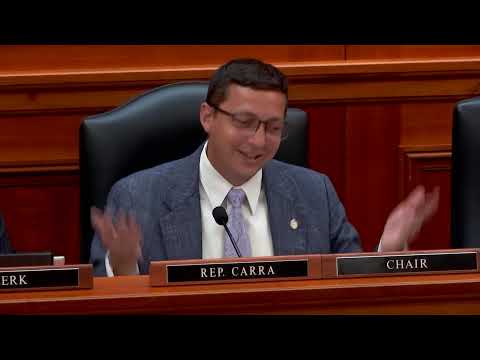
The testimony, delivered during a subcommittee hearing convened by Chair Carr, focused on the Marshall megasite and the Blue Oval project, with multiple speakers urging state lawmakers to investigate land deals, zoning changes and the role of local economic bodies such as the Michigan Economic Development Corporation (MEDC) and Marshall Area Economic Development Association (META).
Why it matters: Speakers said the project uses taxpayer money and public incentives for a private industrial development while limiting residents’ access to information. They called for legislative review of contracts, public outreach and environmental and safety risks tied to large battery manufacturing facilities.
At the start of the hearing, Chair Carr said the committee had invited supporters of the project but that few showed and the subcommittee instead heard sustained opposition. “We gave the opportunity,” Carr said, noting his office sent letters to 76 people asking for in-person support; he said only a handful had responded and his office received 46 letters in opposition and a single two-page letter of support from Marshall Mayor Scott Wolfersberger. “It’s unfortunate…hundreds of millions of dollars in taxpayer funds are being used, from the people of Michigan to put money towards a project in a community that doesn't even want it themselves,” Carr said.
Regis Klingler, a Marshall resident and member of the Committee for Marshall Not the Mega Site, disputed testimony given earlier by MEDC representatives about zoning and public outreach. “This parcel and the surrounding land were not zone heavy industrial by Marshall Township until November of 2022,” Klingler said, and he told the panel that many landowners and local officials signed nondisclosure agreements (NDAs) that limited public disclosure during site planning.
Klingler and other speakers challenged several points cited by MEDC in prior testimony: the number of acres set aside for conservation and recreation, the extent of public meetings between 2019 and 2023, and the makeup of letters described as public support. Klingler told the subcommittee that the conservation easement along the river is about 230 acres and the Bear Creek Center about 36 acres, and that a claimed “500 acres” of green space does not match those figures.
Other speakers described broader process and safety concerns. Rebecca Sebring, a Fredonia Township resident, described local effects she said her family has experienced and raised questions about NDAs signed by local officials. “They did sign nondisclosure agreements with the City of Battle Creek,” she said.
Autumn Smith, who identified herself as a citizen journalist, told the committee she had investigated city trips to China and alleged agreements that were not publicly disclosed; she said she faced retaliation for her reporting. “I was jailed. Not for a crime, but for what [I was] uncovering,” Smith said, asking lawmakers to examine real estate deals, educational partnerships and other local agreements tied to the megasite.
Barry Adams urged the subcommittee to pursue a wide-ranging legislative investigation into what he described as conflicts of interest and suppression of public records, invoking legal concepts and saying the project had been advanced through tactics he termed coercive. William Martin, a nearby resident, framed his opposition in broader environmental terms, urging preservation of farmland and warning of possible risks from large battery projects.
Speakers also questioned economic projections and subsidies. Regis Klingler and others cited a compilation attributed to Bridge Michigan claiming billions in subsidies and a large gap between promised and created jobs, and they expressed skepticism about job counts and the scale of public incentives offered to the project. One witness told the committee that a petition signed by more than 800 Marshall registered voters sought a public vote on rezoning; the petition was later rejected, the speaker said, and litigation has followed.
Committee members briefly engaged; Representative Wigela, the minority vice chair, said she opposed using public tax dollars for private corporations and corrected one witness’s reference to a gubernatorial trip (saying Governor Gretchen Whitmer traveled to Taiwan, not China) while joining others in urging scrutiny of subsidies and local input.
No formal action on the Blue Oval project was taken by the subcommittee at the hearing. The committee did approve the minutes of a prior meeting by unanimous consent after Representative Wigela moved to approve them; later, Representative Bierlein moved to excuse absent members, which the committee also approved by unanimous consent. Chair Carr closed the hearing and adjourned the committee.
Speakers emphasized a common request: that the legislature investigate the use of NDAs, zoning and site-plan procedures, the composition of letters of support, the accuracy of acreage and job claims, and the environmental and water-supply implications of large-scale battery facilities. No state-level investigation was announced at the hearing.
The committee’s record will include the letters Chair Carr described and the testimony submitted at the session; several speakers asked lawmakers to pursue a comprehensive review of the Marshall megasite approvals, funding and oversight.