Get Full Government Meeting Transcripts, Videos, & Alerts Forever!
Get email alerts on the Mayor's Council Budget topic
No spam. Unsubscribe anytime.
Mayor's Council of Guam seeks $20.96 million for FY2026 as lawmakers weigh smaller executive request
Summary
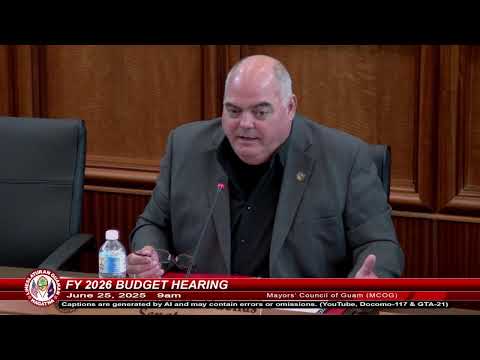
The Mayor's Council of Guam asked the Guam Legislature's Committee on Finance and Government Operations on June 25 to approve a $20,956,877 general‑fund appropriation for fiscal year 2026, saying that amount is needed to maintain village services, hire staff for new gyms and community centers, and buy vehicles, heavy equipment and data management software.
The Mayor's Council of Guam asked the Guam Legislature's Committee on Finance and Government Operations on June 25 to approve a $20,956,877 general‑fund appropriation for fiscal year 2026, saying that amount is needed to maintain village services, hire staff for new gyms and community centers, and buy vehicles, heavy equipment and data management software.
"This is not a wish list. It is a focused and necessary investment in the basic services, emergency response, and community support that our mayors are expected to provide every day," Mayor's Council Executive Director Joy Jean Arceo told the committee. Arceo said the council has a team of roughly 240 employees working across Guam's 19 villages.
The council's request is substantially larger than the executive budget submitted by the governor: the hearing record shows the governor requested $9,624,109 for the Mayor's Council of Guam, creating an $11.33 million gap between the two figures. Committee Chair Senator Christopher Duenas noted the variance and reminded the panel that part of the apparent gap stems from prior-year authorized levels and a $4.5 million supplemental appropriation enacted in fiscal 2025 (Public Law 37‑135).
Why the money: Arceo and multiple village mayors said day‑to‑day duties have expanded beyond traditional mayoral functions to include trash and abandoned‑vehicle removal, emergency shelter operations, school support, distribution of food commodities, traffic and crowd control during emergencies, and ad hoc public‑works tasks when other agencies do not respond. The council's FY2026 request itemized increases for: procurement and office training; internet and copier leases; a centralized village data management and mayor's‑council software ($600,000); district vehicles ($1.2 million); and heavy equipment and rentals ($300,000). Contractual services and supplies lines also rose in the request.
"Without adequate staffing in every village, we simply cannot deliver the level of service our communities expect and deserve," Arceo said. Mayors gave examples during the hearing of recent disaster response, vaccine distribution and food distribution operations they coordinated or hosted. Mayor Robert Hoffman, who read the president's written testimony on behalf of Mayor Jesse L.G. Alig (off island), said "the cost of continued underfunding is too high in dollars and in human terms and in missed opportunities." Hoffman and other mayors asked for flexibility in using appropriations at the village level and for reclassification of some mayor's‑council job titles to reflect transferable job skills.
The mayors also described operational constraints: several testified that they lack heavy equipment and reliable district vehicles and that rental costs for short‑term heavy equipment are high. They said some equipment available through the U.S. General Services Administration and other sources is effectively inaccessible because of procurement and payment rules. Mayors asked for funding that would allow phased purchases or leasing with operators so certified local staff can use and maintain the equipment.
Federal funds and grants were a recurrent theme. Committee members and mayors discussed expired or reduced federal grants, including ARP‑era projects that were not completed because of timing and procurement limits. Arceo and mayors said some earlier federal projects lapsed or could not be converted into local purchases when grant timelines closed. The council also said it is facilitating an EPA‑funded abandoned‑vehicle removal program (about $1.5 million) and that procurement for that work is underway.
Committee members pressed for detail. Accountant Royelle Carter explained that a drop in the benefits line for FY2026 compared with FY2025 reflects a one‑time annual‑leave payout tied to leadership transitions in the prior year. The council said it plans to support 237 positions in FY2026, about 16 more than FY2025, and reported roughly nine vacancies among community maintenance workers and one administrative vacancy.
Operational problems raised during questioning included vendor payment delays and outstanding prior obligations. Arceo told the committee that the council has processed invoices quickly on its end but that several long‑standing vendor debts remain unpaid at the Department of Administration level; she estimated about seven major vendors are affected. The council also said it expects to obligate roughly $3 million of identified needs in the current fiscal year through procurement, not lapses.
Senators at the hearing signaled willingness to work with the council but said the budget process must reconcile the council's request with the executive ceiling. Chair Duenas said the legislature will review mandates shared between mayors and other agencies such as the Department of Public Works and the Department of Parks and Recreation to identify possible reallocations or policy changes. Duenas asked the council to provide requested supporting documentation, including an invoice aging for outstanding vendor payments, to the committee for follow up.
The committee will accept written testimony on Bill 44‑38 COR and the Mayor's Council request for seven calendar days after the hearing. The testimony and committee discussion make clear the central policy issue lawmakers will confront as they draft the FY2026 budget: whether and how to align a marked increase in village responsibilities with additional recurring local funding, capital purchases and clearer interagency roles.