Get Full Government Meeting Transcripts, Videos, & Alerts Forever!
Get email alerts on the Bylaws Gallery Session topic
No spam. Unsubscribe anytime.
Bylaws committee votes to require 36‑hour registration for speakers, keeps limited in‑person gallery slips and merges ethics and bylaws
Summary
At its June 24 meeting, the Community Board 11 Bylaws Committee approved a package of bylaw changes requiring gallery‑session speakers to register 36 hours before full board meetings, reserving 10 in‑person sign‑up slips, imposing a six‑minute limit per speaker and combining the ethics and bylaws committees.
At its June 24 meeting, the Community Board 11 Bylaws Committee approved a set of bylaw changes that require gallery‑session speakers at full board meetings to register at least 36 hours before a meeting, reserve 10 in‑person registration slips at each meeting, impose a six‑minute total time limit per speaker, and combine the board’s ethics and bylaws committees.
The measures, discussed at length during the committee session, were intended to clarify long‑running disagreement over how and when members of the public may sign up to speak. Veronica Castillo, committee member, formally moved the registration motion at the meeting: “Hi. I make a motion. I have to work in 36 hours,” Castillo said. The committee voted unanimously to send the language to the full board as amended.
Why it matters: the changes respond to more than a year of debate on whether remote and in‑person speakers should be required to sign up in advance. Supporters said the requirement helps staff plan and directs commenters with complex matters to committee meetings where issues can be vetted in more detail. Opponents said the rule might limit late‑breaking, urgent complaints from community members who learn of a problem shortly before a meeting.
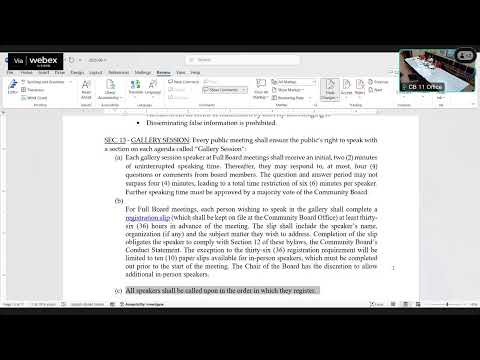
Most debate focused on two practical compromises. First, the committee adopted a 36‑hour registration requirement for gallery speakers at full board meetings. Second, as an exception, the committee agreed that 10 paper registration slips will be available at the meeting for in‑person speakers who could not or did not register in advance; the board chair retains discretion to allow additional in‑person speakers if needed. The committee’s final motion reads, in part: “For full board meetings, each person wishing to speak in the gallery shall complete a registration slip ... at least 36 hours in advance of the meeting. ... The exception to the 36 hour registration requirement will be limited to 10 paper slips available for in‑person speakers, which must be filled out prior to the start of the meeting. The chair of the board has the discretion to allow additional in‑person speakers.”
Committee members also approved a cap on the length of gallery remarks. Under the adopted language, each gallery speaker receives an initial two minutes of uninterrupted speaking time; after that the speaker may answer up to four questions or comments from board members, and the question‑and‑answer portion may not exceed four minutes, producing a six‑minute maximum unless the full board votes to allow more time. The committee additionally added wording that speakers will be called in the order in which they register.
Members weighing both sides stressed the committee’s role in steering detailed complaints to working committees. “When you bring it to a committee meeting, the committee can discuss it in‑depth. You have the expertise in the room,” said a committee member during the debate. Several community members who spoke in the gallery session said they had relied on staff follow‑up in previous cases when an urgent issue could not await the next committee meeting. David Levitt, who identified himself as a community board member, told the committee he would pursue a complaint if he could not secure a full board vote on keeping gallery slips available; he asked that the board record and vote on the question.
Separately, the committee voted to merge the bylaws and ethics functions into a single standing committee and to remove the term “disciplinary” from its description. Joanne Rubino, cochair, and other members argued the committee’s role is review and resolution, not punishment, and said truly disciplinary matters would be referred to the Bronx Borough President’s office or the board’s executive body. The committee’s amended description says the combined committee will “initiate review of bylaw amendments ... and complaints lodged by board members, members of the public, agency personnel and non‑union employees of the community board” and that alleged violations of the city’s EEO policy will be handled by the Bronx Borough President’s EEO officer per the city policy. The motion to combine the committees passed unanimously.
What the committee decided (votes at a glance): all bylaws changes discussed in the meeting passed in committee and will be forwarded for consideration at the full board meeting. The committee recorded the motions and noted unanimous passage for the measures during the meeting.
Next steps: committee members said they will prepare printed copies of the proposed amendments for the full board meeting and circulate the exact revised language ahead of that vote. Several members urged that the full board vote next week to resolve months of contested debate.
The committee session included multiple public commenters and extended discussion among members about procedure, enforcement, and how to ensure community members with urgent issues can still raise concerns. The committee said staff will keep the 10 in‑person slips on hand and that the chair can use discretion to allow additional speakers in extraordinary circumstances.