Get Full Government Meeting Transcripts, Videos, & Alerts Forever!
Get email alerts on the Dual Enrollment Concurrent Enrollment topic
No spam. Unsubscribe anytime.
Board OKs Mesquite–ASU instructional time addendum to let Mesquite students take ASU Poly courses
Summary
The board approved an Instructional Time Model addendum enabling Mesquite High students to enroll in Arizona State University courses on ASU Poly campus under an arrangement with ASU Prep; parents will pay $110 per ASU credit hour and the district outlined calendar, attendance and transportation logistics.
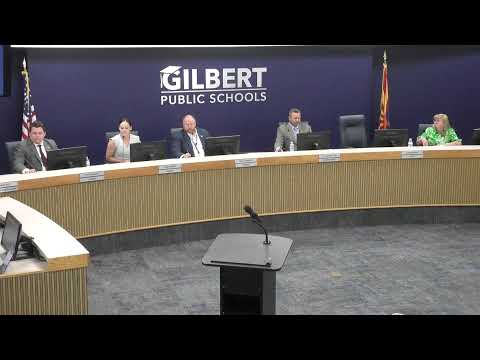
The Gilbert Unified District Governing Board on June 24 approved an Instructional Time Model (ITM) addendum to establish a Mesquite–Arizona State University experience that lets selected Mesquite High students take university courses at ASU Poly through an ASU Prep mechanism.
The district said the addendum covers instructional location, tuition/fee collection, calendar alignment and attendance tracking. Under the plan, students begin their day at ASU Poly where a student success advisor will take attendance; they will continue to take transferable university coursework and also remain affiliated with Mesquite High for high-school graduation requirements and campus activities.
Parents will be responsible for a $110 payment per ASU credit hour; district staff said payments will flow through the school to ASU/ASU Prep. District staff and the board discussed financial safeguards: ASU/ASU Prep has a 10-day drop window after which tuition is not recoverable. District staff said they would first explore supports for students with financial hardship and ensure coursework choices are transferable and have high-school equivalents if a student needs to return to the Mesquite campus.
Why it matters: The addendum creates a concurrent-enrollment pathway (college-awarded credits) rather than a traditional dual-enrollment arrangement run by a district teacher. Supporters said it expands access to collegiate-level courses, while some board members questioned whether the district should subsidize part of tuition and raised equity and long-term funding concerns.
Program details and logistics presented to the board included: - Enrollment: the program was described as selective; an application and interview process began in April. Staff said roughly 20 students had signed up for the pilot year. - Curriculum and credit: Year 1 focuses on core, transferrable coursework (English, science, math, history); Year 2 may add more pathway-specific classes (engineering, computer science, etc.). ASU credit would be awarded by Arizona State University via ASU Prep/ASU Poly arrangements. - Tuition and refunds: Parents pay $110/credit hour; Bonnie Betts explained ASU operates a 10-day drop window and tuition paid after that point is generally not recoverable. - Transportation: staff said existing routes (including EVIT/Poly-area options) allow students to access campus without adding district transportation costs. - Oversight: Mesquite High leadership, counselors and a student success advisor will manage logistics, attendance and student progress.
Board discussion addressed growth and equity. Some board members said students and families already arrange similar college attendance independently; others emphasized access and the benefit of college coursework taught with peers at Mesquite. Several members expressed willingness to facilitate the program but concern about the district funding tuition in future years; one board member said the district should help students seek outside scholarships rather than assume recurring tuition costs.
Board action: Board member Jill Humphreys moved to approve the Instructional Time Model addendum; Sheena Murray seconded. The board voted in favor and approved the addendum.
Ending: The approved addendum authorizes district leadership to submit the ITM description to the Arizona Department of Education and to complete the intergovernmental agreements with ASU Prep and ASU Poly. District staff said the program will run on a small scale initially to collect data and adjust the model for future expansion.