Get Full Government Meeting Transcripts, Videos, & Alerts Forever!
Get email alerts on the School Budget topic
No spam. Unsubscribe anytime.
Gilbert Unified Board adopts conservative FY2026 budget, plans $15.2 million for facility renewal
Summary
The Gilbert Unified District Governing Board on June 24 adopted a cautious fiscal year 2026 budget that assumes a 1,300-student drop, preserves the district's 15% override commitments, uses Classroom Site Fund for pay increases and allocates about $15.2 million for facility renewal—largely roofs.
The Gilbert Unified District Governing Board on June 24 adopted the district's fiscal year 2026 proposed budget, a conservative plan that assumes a 1,300 average daily membership (ADM) decline and an estimated K–12 enrollment of about 28,702 for the 2025–26 school year.
District budget staff described the adopted plan as a "bare bones" budget that incorporates the district's November override commitments and projects a weighted student loss of about 1,679. The district also factored in uncertainty from the state budget process, including unresolved matters related to Prop 123 and whether the legislature will apply the inflation/2% increase to the base (commonly associated with Prop 301).
Why it matters: The enrollment and revenue assumptions shape staffing, pay increases and one-time capital work. The board was presented a plan that preserves a pay increase funded in part by Classroom Site Fund revenue, anticipates a net reduction of roughly 44 FTE through attrition (no reduction-in-force), and draws on carryover and unrestricted capital to meet facilities needs.
Key fiscal details provided to the board included: - Enrollment assumptions: a proposed 1,300 ADM decrease (split between 9–12 and K–8), producing an estimated 28,702 students for FY2026 and a weighted student loss of about 1,679. - Classroom Site Fund: a per-student increase (about $50) was noted but prior-year counts reduce the net Classroom Site Fund capacity; staff said Classroom Site Fund would contribute roughly $4.5 million toward pay increases and other eligible costs. - Pay and staffing: the plan includes a pay increase recommendation (presented as approximately $5.6M total) and funding for 3 FTE additions for English language learners, gifted teachers and conversions of deans to assistant principal roles; staff said the district is not pursuing layoffs and expects natural attrition to realize a 44-FTE reduction. - Program and grant changes: staff reported a projected $1 million reduction in IDEA (special education) grant funding; state and federal grants were shown declining in the presentation. - Carryover and capital: the district projects carryforward of about $31.7 million in total, of which roughly $9.6 million has been parked for maintenance and operations. The adopted capital plan includes about $15.2 million for facility renewal (largely roof work), with roughly $11 million devoted to three projects: Desert Ridge High, Greenfield Junior High and Gilbert High. Staff said they are pursuing School Facilities Board building renewal grants to reduce district unrestricted capital spending on roofs.
Risks and offsets: The budget presentation highlighted several downside risks—possible additional student loss, uncertainty over state funding (including Prop 123 and the statutory 2% or inflation floor), inflation and minimum-wage increases—and offsetting actions such as department discretionary reductions (estimated about $1.3M), lower Arizona State Retirement employer rates (about $0.5M savings) and other internal savings that together were presented as roughly $5.8M in total savings. Staff reported an estimated FY2026 budgetary deficit of approximately $4.8M that would be covered by the combination of Classroom Site Fund contributions, program savings and carryforward.
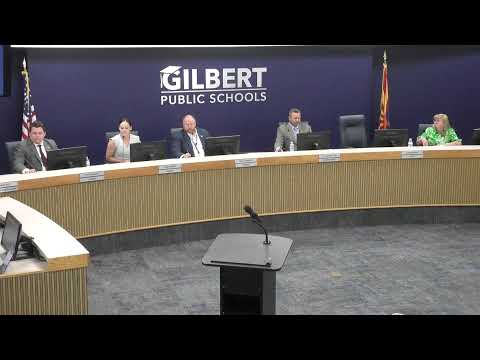
Board action: Board member Jill Humphreys moved to approve the FY2026 proposed budget for adoption; Jesse Brainard seconded. The board voted to approve the budget (ayes called by the chair; all members present signaled approval). The motion passed.
Context and next steps: Staff stressed the budget remains sensitive to the final state budget and student counts. They plan routine reporting and a first budget revision once October teacher data and other state numbers are finalized. The district will continue to seek grant support (including building renewal grants) to lower one-time capital expenditures from unrestricted capital.
Ending: The board's adoption allows the district to move into the next steps of finalizing allocations and implementing the FY2026 plan while monitoring state budget action and actual enrollment counts.